Edmunds
1 / 2How to Qualify for the Used EV Tax Credit
The tax credit for used EVs will be calculated based on either 30% of the vehicle's value or $4,000, whichever is less. As mentioned earlier, there are no assembly requirements or battery component percentages for used EVs and PHEVs. The rules for used EVs went into effect on January 1, 2023, and are as follows:
- Price limit for used vehicles: There is a hard eligibility ceiling at a sale price of $25,000 for all used EVs regardless of type.
- Income limits for used vehicles: As with new vehicles, the income limits are determined by modified adjusted gross income (MAGI). By filing status, the limits are as follows.
- Joint tax returns or surviving spouse: $150,000
- Head of household: $112,500
- Individual or any other filing status: $75,000
Other eligibility requirements for used EVs:
- The vehicle must be at least two model years older than the calendar year in which it was purchased.
- The used EV tax credit applies only once in the vehicle's lifetime. Subsequent owners are not eligible.
- Once a buyer has taken the federal used EV credit, they are not eligible for another credit for three years.
- The vehicle must be for personal use and "not for resale."
- The vehicle must be purchased through a dealer.
- Only an individual may claim the used EV tax credit. Businesses are excluded.
Electric Vehicle Tax Credit for Leasing
Leased electric cars or plug-in hybrids from dealerships are considered "commercial vehicles" under IRS regulations. This means that the full $7,500 tax credit goes to the company that leased it to you, which is usually the automaker's captive finance arm. In other words, the automaker itself effectively gets the benefit of the tax credit. Moreover, leased EVs and PHEVs are not subject to the major restrictions detailed above—there are no limitations regarding final assembly, battery sourcing, or vehicle pricing, while the caps on buyer income are irrelevant because there is no purchase in the case of a lease.
There's also no obligation on the automaker's part to pass along any savings to you, but in practice, many automakers seem to be offering at least some kind of discount on EV leases as a direct result of this loophole. It probably won't last forever, so if you're interested in leasing vehicles not on the list here, check with your local dealership to see if there are loophole-driven lease discounts.
How to Qualify for the Full $7,500 Federal Electric Vehicle Tax Credit
Several requirements will determine whether an electric car qualifies for the full $7,500 federal electric vehicle tax credit. The maximum buyer credit for new vehicles is $7,500, provided that several requirements are met. Click on any of the links below to jump to the information you're looking for, or keep scrolling to get all the details.
Final Assembly, Parts, and Mineral Sourcing Requirements
The final assembly of the new vehicle must occur in North America (i.e., the U.S., Canada, or Mexico). This is the gateway requirement for the federal EV tax credit—if the answer is no, the EV won't qualify (unless you're leasing; please see the leasing section for more details). This rule went into effect on August 16, 2022, and affects vehicles purchased through 2032.
If the vehicle meets the assembly requirement, you can think of the $7,500 federal EV tax credit as being split into two halves—critical battery minerals and battery components—each worth $3,750 and subject to requirements of its own. The EPA has already calculated the percentages below to determine which cars are eligible and are reflected in this list, so you won't have to figure it out yourself.
- Critical battery minerals: To qualify for this $3,750 credit, at least 60% of the critical minerals in the vehicle's battery must have been either recycled in the U.S. or extracted or processed there (or in any country with a free trade agreement with the U.S.). After that, the required percentage increases to 70% in 2026 and 80% in 2027.
- Battery components: To qualify for the remaining $3,750 credit, at least 60% of the EV's battery components must be manufactured or assembled in the U.S. (or in any country with a free-trade agreement with the U.S.). After that, the percentage increases to 70% in 2026, 80% in 2027, 90% in 2028 and 100% in 2029.
New Vehicle Pricing Limits for EV Tax Credits
The following price caps by vehicle type became effective as of January 1, 2023, and refer specifically to the manufacturer's suggested retail price, or MSRP. It does not include the manufacturer's destination charge, optional items added by the dealer, or taxes and fees. For example, if you're looking at an SUV with a $79,990 MSRP, and the destination fee takes it over $80,000, the vehicle is still eligible. If, for example, the vehicle is priced above the MSRP limit (let's say $82,000), but there's a manufacturer incentive that brings it back down to $80K, the vehicle would also not be eligible.
For SUVs, vans and pickup trucks, the eligible MSRP maximum is $80,000. For any other qualifying vehicle, the eligible MSRP maximum is $55,000.
New Car Buyer Income Limits for EV Tax Credits
The income limits are based on modified adjusted gross income, or MAGI, which is roughly the adjusted gross income with certain allowable deductions added back in for the current or prior tax year. Depending on your tax filing status, the limits for a new vehicle are:
- Joint tax returns or surviving spouse: $300,000
- Head of household: $225,000
- Individual or any other filing status: $150,000
What's Changed for 2025?
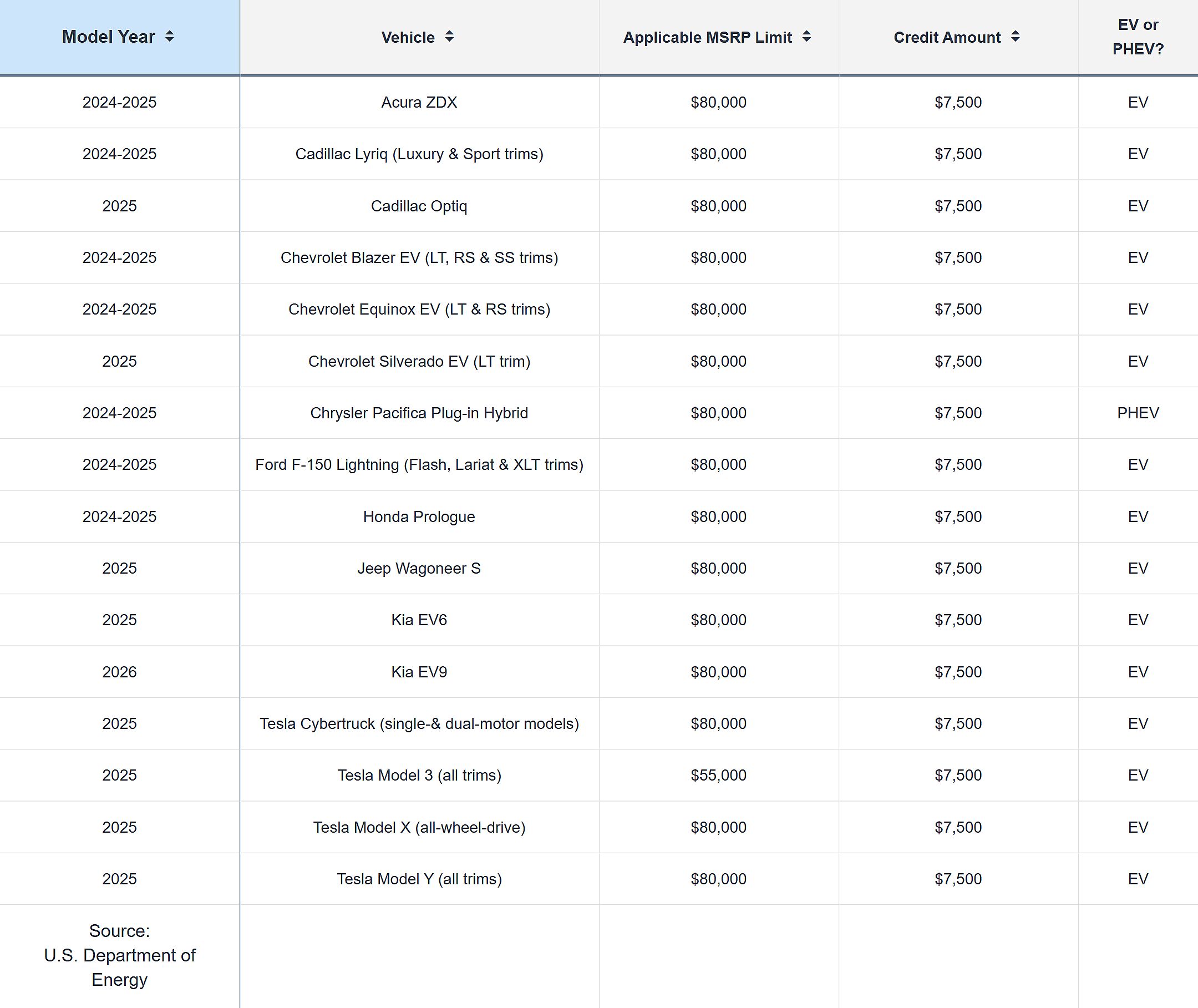
As of January 1, 2025, a vehicle is ineligible for a tax credit if any of the battery's components and critical battery materials were sourced from a "foreign entity of concern," which includes China, Iran, North Korea, and Russia. That's a big deal given China's outsized role in the minerals supply chain to date. The critical battery minerals requirement went up to 60% (from 50% last year). These added requirements have reduced the list of eligible vehicles until automakers can restructure their supply chains. We'll monitor this list and update this article as things change.
How Do I Claim the EV Tax Credit?
If you purchased an eligible vehicle in 2024 and onward, you have two options to claim the tax credit:
- You can claim the credit on your tax return for the year in which it was purchased, using Form 8936. If your tax liability is less than $7,500, the IRS said it will not seek repayment, but just keep in mind you won't get to keep the difference either, as it is a nonrefundable credit.
- You can transfer the EV tax credit to an eligible dealership so that they can apply the credit amount to your final purchase cost. The dealership must be registered with IRS Energy Credits Online. They should submit and give you a copy of the "time of sale report" to confirm that the report was accepted. This document will be needed when filing your tax return. If you lease the vehicle, the credit goes to the lessor and may be used to reduce the price of the lease if the leasing party chooses to do so. If you choose to go this route, please note that you still need to fill out IRS Form 8936, which reports your eligibility for the credit and your decision to transfer the credit to the dealer.
It is important to verify that you meet the income requirements listed above; otherwise, you may need to repay the IRS if your modified adjusted gross income is higher than the authorized limits.
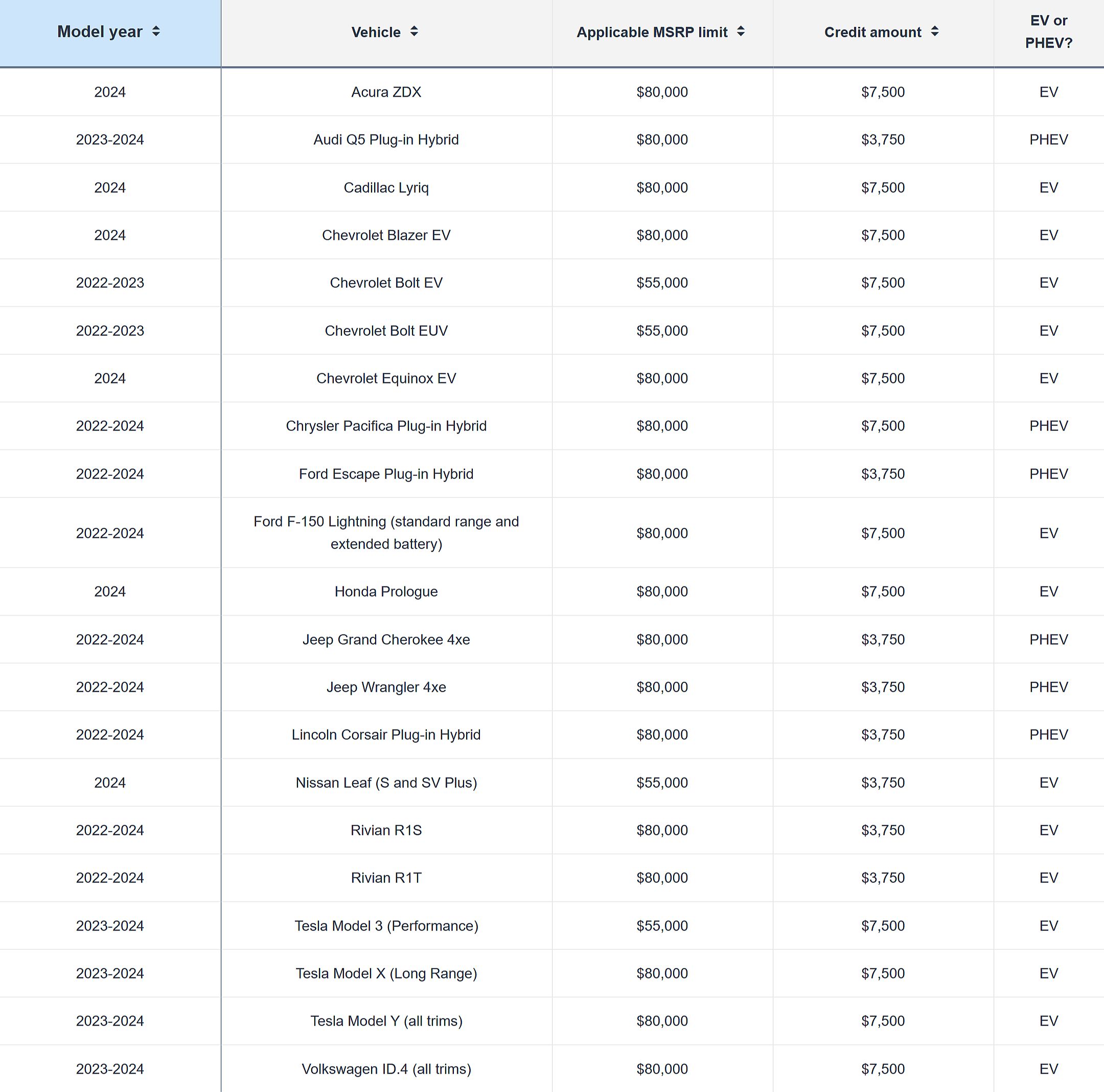
List of 2024 Eligible Vehicles
Edmunds kept this list from last year for those who purchased an EV in 2024 and are looking to file their taxes soon. These are the vehicles that were eligible to qualify for up to a $7,500 tax credit.