Canva
1 / 2A parking double standard
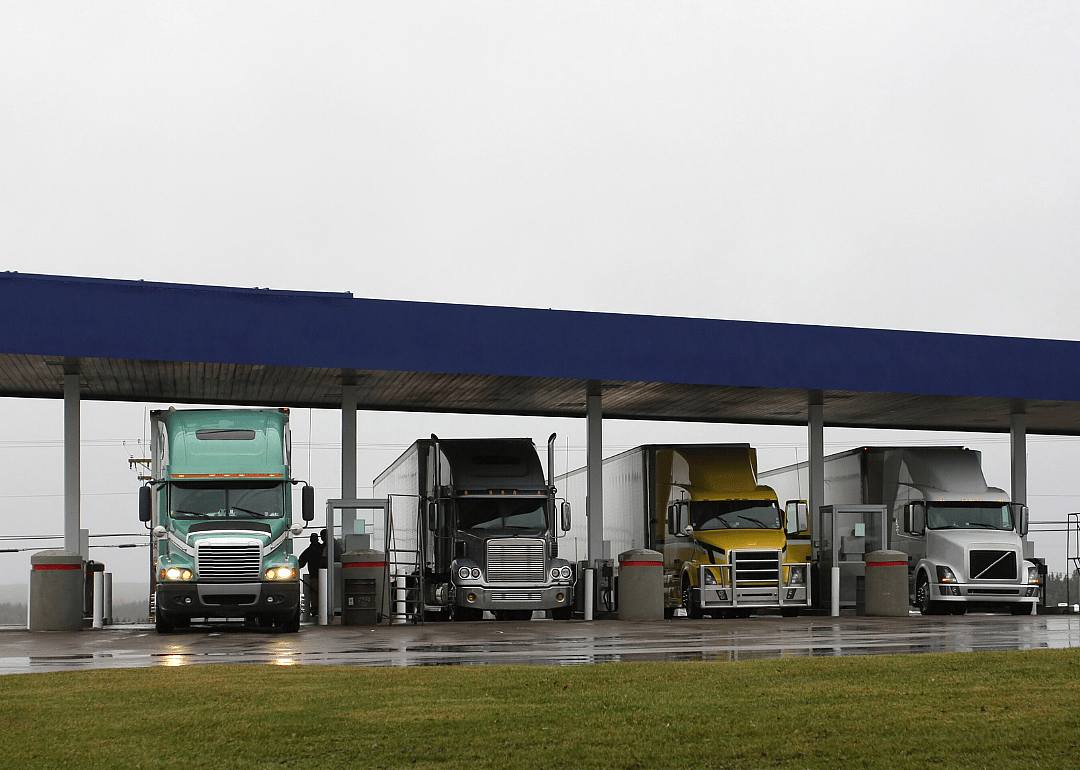
Some of the highest traffic areas for long-haul trucks are those that are the least accommodating for practical solutions. Rural states are typically better at meeting the demands of big-rig truck parking, but in more urban areas, the calculus flips, according to data from the Bureau of Transportation Statistics analyzed by Stacker. Massachusetts has about 35.5 parking spaces for every 100,000 truck miles traveled, while New York has about 57.1 spaces. Compare this with New Hampshire, where 230 parking spaces exist for every 100,000 truck miles.
In places like New York City, where more than 70% of goods are transported by trucks, semis can only rest at very few commercial parking lots which are typically bursting to capacity. In Clark County, Nevada, there have been reports of residents placing dirt piles on vacant lots to prevent trucks from parking—an example of residents opposing infrastructure adjustments in their immediate area despite the amenities trucks provide them on a daily basis.
In his book, "Paved Paradise: How Parking Explains the World," Henry Grabar, a Slate journalist, argues that far too much space and resources are devoted to residential parking in the United States, a large contributing factor in the national semitruck parking shortage. "The core distinction between the truck parking and car parking is that car parking is required by law in most jurisdictions for most land uses," Grabar told freight market reporting agency FreightWaves. "Truck parking has become something that nobody wants in their neighborhood ever."
As it stands, there are over 11 truck drivers for every parking space, and a leading concern is safety. In a 2020 survey, the Federal Highway Administration found that 98% of drivers struggle to find safe parking for their trucks. In addition, they spend an average of 56 minutes a day to ensure a safe spot, according to a study from the American Trucking Associations. When they can't find suitable parking, more than half admit to taking a risk and parking in unauthorized or undesignated spots at least three times a week. These risks can sometimes have fatal consequences: In July 2023, three passengers were killed and 14 injured when a Greyhound bus crashed into three tractor-trailers parked along an exit ramp along Interstate 70 near St. Louis.
While there aren't yet concrete solutions for commercial parking, things have gotten more complicated for the truckers who are looking. Drivers are only allowed to drive a maximum of 11 hours within a 14-hour window before they're required to take a 10-hour break, according to the FMCSA. These hours of service regulations have been around since 1937, but a 2017 mandate to use electronic logging devices has made it more difficult for drivers to work around these hours and yielded no significant safety benefits. According to a study of 2017 through 2018 data, it may have even caused the opposite effect, increasing the frequency of unsafe driving for truckers in a hurry.
For truck drivers, every minute of moving counts. Their wages rely on the miles logged each day, so limited time coupled with scarce parking has created a headache for America's 2 million long-haul truckers.