The General
1 / 1Middle of the country boasts high concentrations of car dealerships
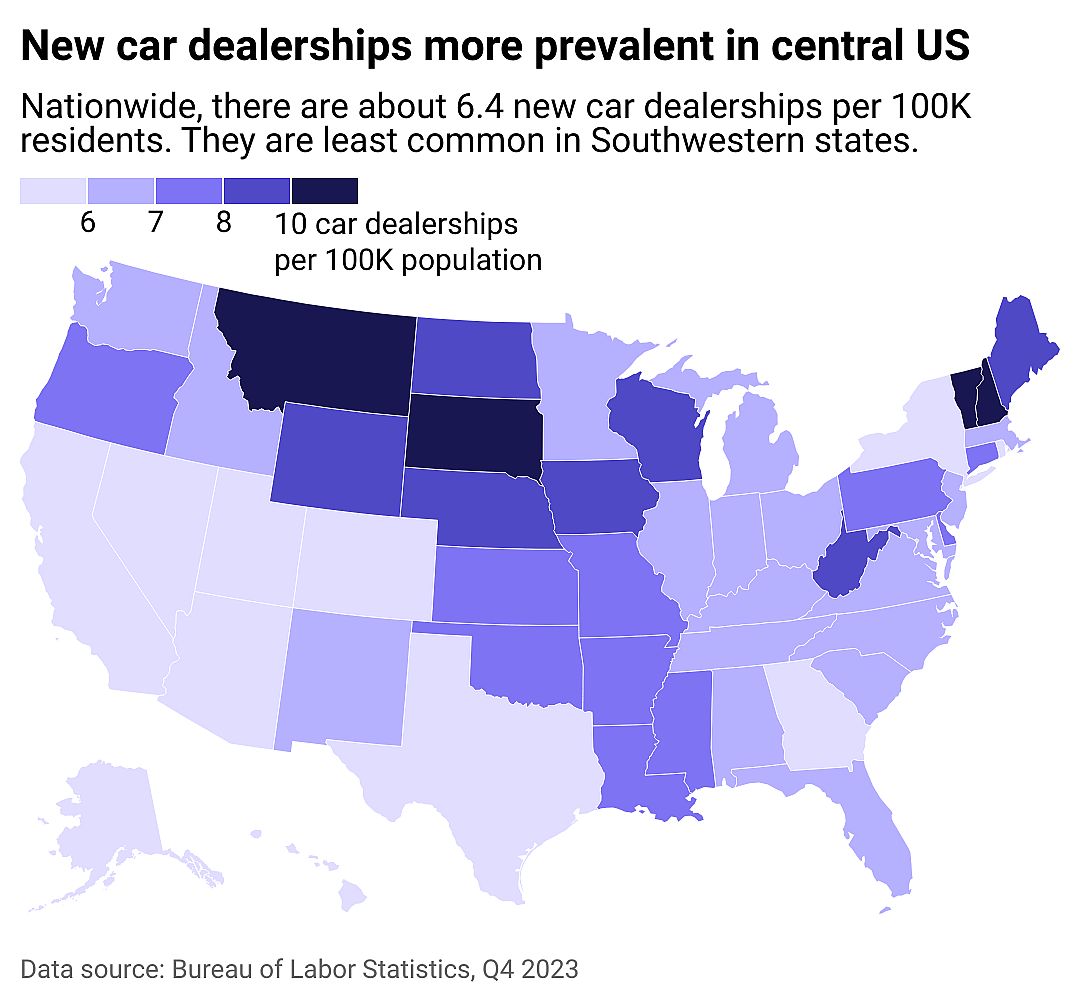
The states with the highest concentrations of new car dealerships aren't the ones many might expect. Vermont leads the way, nearly doubling the national statistic at 12.5 dealers per 100,000 residents. Rounding out the top six are Montana (10.9), South Dakota (10.7), New Hampshire (10.2), and Iowa and North Dakota (tied at 9.6).
While the top-ranked states were somewhat spread out, states in the middle of the country generally had higher concentrations of new car dealerships than those further east or west. States in this central region rely more heavily on driving their personal vehicles because they have less access to and usage of public transit.
Several states with more dealerships than average have laws prohibiting car manufacturers from selling vehicles directly to consumers. That means all cars must be sold through franchised dealerships, driving a need for more of them. This was once the primary way people purchased new cars, causing little friction.
However, when Tesla entered the market with its direct-to-consumer sales model, it sparked shifts in the market and policy. States either adopted laws to formally allow these sales or to prevent and limit them in the name of protecting consumers and existing dealerships. Trends toward more online vehicle purchases have also urged these debates.
Montana, South Dakota, Iowa, and other states with highly concentrated dealerships outright ban car manufacturer direct-to-consumer sales. Vermont restricts direct-to-consumer sales but does allow nonfranchised, zero-emission vehicle manufacturers (like Tesla) to make these sales. Many other states have similar limitations.
However, it's not a cut-and-dry issue: For example, Texas fully prohibits direct sales by manufacturers but also has one of the lowest concentrations of dealerships at 5.4 per 100,000 residents. This is surprising on both fronts, considering Texas is known for scorning regulations and depending heavily on cars.
A unique factor is at play in Texas. Recently, car dealerships in the state have been scandalized by rampant fraud concerning paper license tags. In 2021 and 2022, its DMV suspended dozens of licensed car dealers suspected of illegally selling paper tags. It then required all dealers to get fingerprinted and will soon require them to issue metal plates when vehicles are sold, adding new hurdles for car sellers.
Trailing Texas and a few other states, Nevada had the fewest dealerships, at 3.6 per 100,000 residents. Compared to the rest of the country, states in the Southwest had a very low prevalence of car dealerships.
Higher access to dealerships aids residents in sprawling regions with limited transit options as well as where electric vehicles and EV infrastructure have yet to gain much traction. In coastal areas, where e-commerce is flourishing and the EV and hybrid market is already taking off, approaches to car sales are already evolving. As these market shifts progress, American car buyers may become even less restricted by geography when making their next purchase.
Story editing by Carla Pineda. Additional editing by Kelly Glass. Copy editing by Tim Bruns.