Jared Beilby // Stacker
1 / 5Triple plays have become rarer
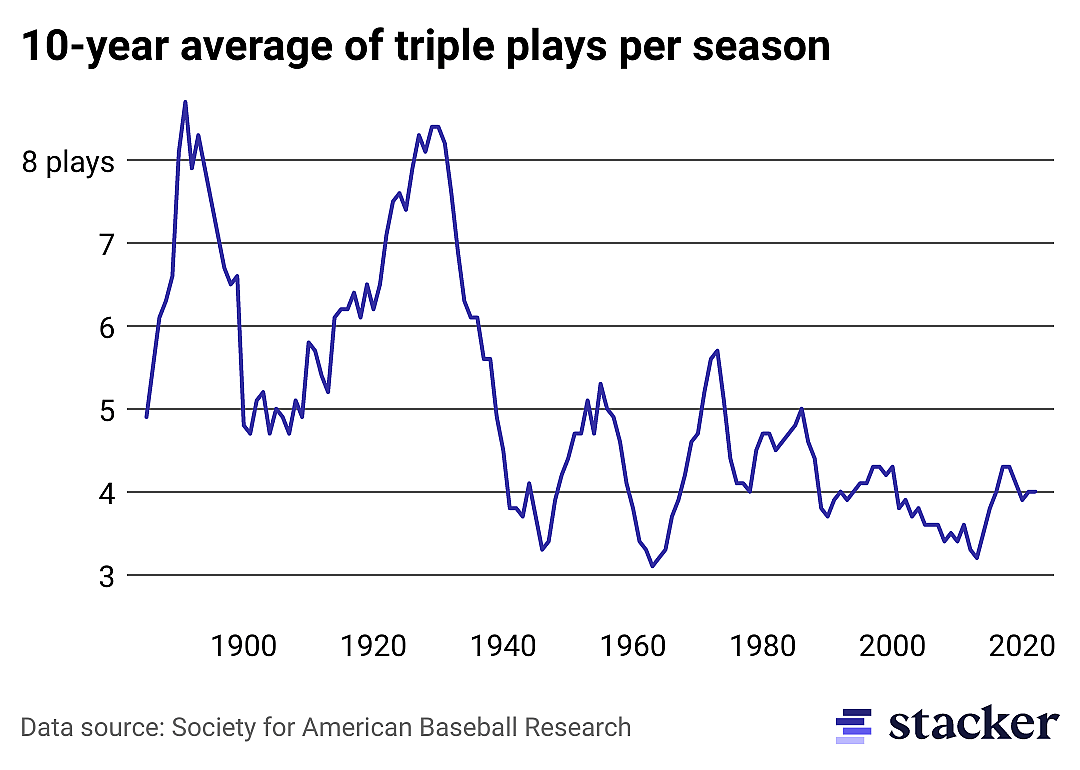
During the dead ball era of the early 1900s, the average number of triple plays per season reached a number as low as 4.7 over 10 years. That rate spiked to above 8 in the late 1920s. Since a high of 8.4 triple plays per season over 10 years in 1929 and 1930, the rate shrank and has frequently remained below even dead ball era averages. The 10-year average currently sits at around 4.0 per season.
The rate of triple plays appears roughly correlated to offensive production. Throughout the years, as the rate of balls-in-play changes, so too does the rate of triple plays. The dead ball era—well known for its meager offensive numbers—saw fewer triple plays and balls-in-play. Then in the 1920s, balls-in-play and triple play frequencies shot up, as offense ruled the day. Ever since that initial post-dead ball era burst, the rates have generally decreased for both stats.
While the triple play is an execution on defense, its correlation to offensive production makes sense. A triple play requires at least two players to reach base. This means that if players are more unlikely to reach base, the chances of a triple play decrease. Because batters are putting fewer balls in play than they were 90 years ago, there are fewer chances for triple plays.