Uniqode
1 / 2A rapid expansion
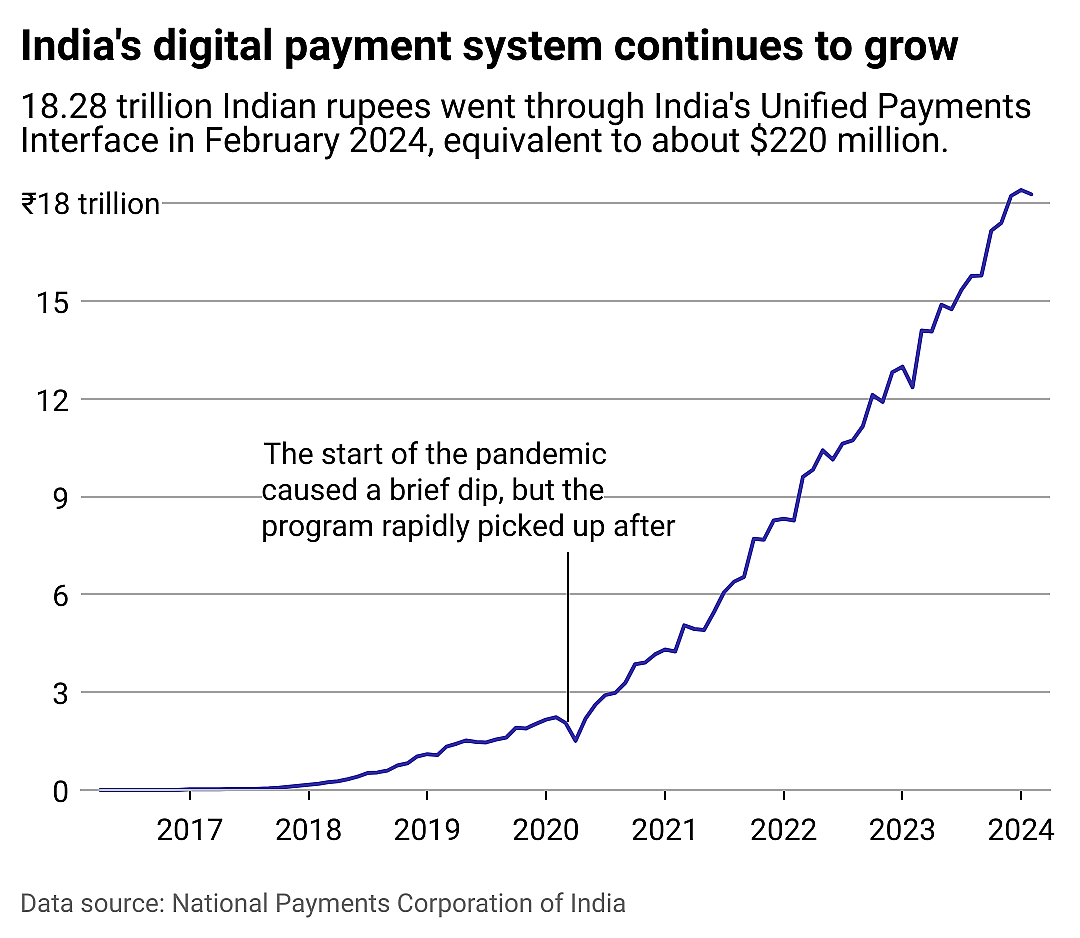
UPI has had a significant impact on India's economic growth, helping the Indian economy save about $67 billion since April 2016, according to a 2023 World Economic Forum report. The technology helps small businesses by reducing transaction costs and bolstering operational efficiency and cash flow. UPI also opens small businesses to a broader customer base due to its accessibility to those who prefer not to carry around cash.
About half of the payments made via UPI can be categorized as small payments, such as a cup of milk tea worth 10 cents or a $2 bag of vegetables. With no minimum transaction amount, customers and merchants can use the technology for various microtransactions and macrotransactions.
Speaking to the Times in 2023, Dilip Asbe, the managing director and CEO of the NPCI, said as of that year approximately 300 million individuals and 50 million merchants used UPI for sending and receiving money.
During the COVID-19 pandemic, the Indian government used UPI to send financial aid to nearly 200 individuals.
India has also worked to export the technology to other countries. In 2023, Bhutan and Nepal started facilitating transactions through UPI. During the February G20 summit that year, Indian Prime Minister Narendra Modi expressed India's willingness to assist other countries with setting up their own similar payment systems.
Nonresident Indians living in Australia, Canada, Hong Kong, Oman, Qatar, Saudi Arabia, the United States, the United Arab Emirates, and the United Kingdom started using the technology in 2023 on their international phone numbers. In February 2024, merchants in France began accepting UPI—including at the Eiffel Tower.