Funding Rounds
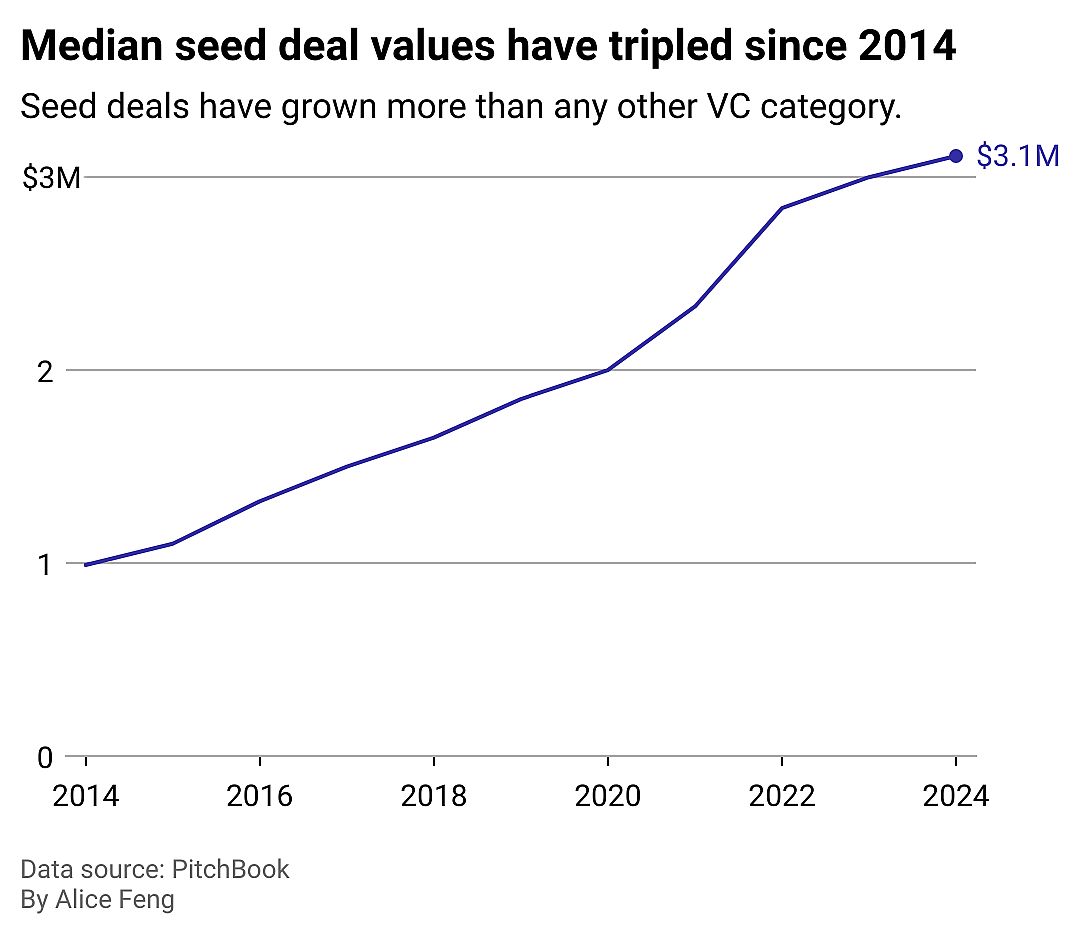
1 / 1Seed deal growth primarily driven by select industries
Seed deals tend to be concentrated in up-and-coming industries; it's no surprise that artificial intelligence startups have caught the attention of investors. Nearly half of all deal value in 2024 went to AI companies, including the top five largest deals in Q4. Databricks, the AI cloud and data analytics platform, had the single largest funding round, raising $10 billion in venture capital in 2024.
It was followed by OpenAI, which raised $6.6 billion, and Elon Musk's xAI, which had two rounds that each raised $6 billion. Anthropic, the AI startup that has prioritized the safety of using AI chatbots, was another big winner in the funding market. Though it initially delayed the launch of its chatbot Claude out of concerns about the potential harms of such a powerful AI model (which allowed rival OpenAI to beat it to the market), Anthropic has since attracted an investment of $4 billion from Amazon in November 2024, on top of the $1.25 billion it received the year prior.
Other AI startups that had significant rounds of funding in 2024 included Waymo, G42, CoreWeave, and Wayve. In total, nearly 30% of all deals in 2024 were for AI startups, triple the amount from a decade ago.
At the seed stage, investors were especially enthusiastic about companies applying artificial intelligence to health care, in areas such as diagnostics, pharmaceutical research, and administrative automation. AI-assisted diagnostics was one of the more popular areas with startups: Floy, which developed AI-driven software that helps radiologists detect abnormalities, raised nearly $6 million. Investors were also interested in startups using AI to better understand immune response. New York-based Jona, which raised $5 million, promises to help consumers better understand the relationship between the microbiome and health using AI.
Other top sectors for seed investors included space tech, construction, and fintech companies focused on the carbon economy. Such startups have raised millions of dollars to tackle a variety of challenges, such as asteroid mining, satellite design, construction permitting automation, and renewable energy financing.
While innovation startups in health, technology, and energy saw increased funding, consumer-facing startups have fallen out of favor with seed investors, with backing for cannabis, food and beverage, and e-commerce businesses in decline. The number of seed deals in consumer products have declined since reaching a high of 129 deals in early 2021, hitting a decade low of just 31 deals in Q3 2024. Median seed valuations for startups in this sector likewise fell to $11 million in Q3 2024 after reaching a high of $18 million just two quarters prior.
Overall, the size of seed rounds has been growing as more venture capital firms move toward investing in earlier stages. In addition to increasing deal sizes, valuations have also been rising. According to Carta, an equity management software company, the median valuation of seed-stage startups hit a record high of $14.8 million in Q3 2024. Median seed valuations ranged between $11.4 million and $12.5 million between Q3 2022 and Q1 2024 before jumping up by nearly 20% in the second half of 2024.
Dilution, or the share of ownership given up during funding, has not changed as much over the past few years, declining only slightly to 20% in Q3 2024. Dilution has been mostly flat since 2020, between 20 and 21%; 20% dilution is typically the established industry standard for a new seed investment.
While seed-stage companies have benefited from investor enthusiasm, fewer of them have been able to advance to later stages of funding. According to Crunchbase, only 20% of startups that had a seed round in 2022 have moved on to a Series A or later round of funding, compared to 61% of seed startups in 2018.
As startups struggle to prove their ability to grow, many will remain stuck in the seed rounds or shut down entirely, leading to significant losses for the venture capital firms that funded them. Whether investors' bets on these young companies pay off remains to be seen.
Story editing by Alizah Salario. Additional editing by Elisa Huang. Copy editing by Tim Bruns.