Wysa
1 / 2Engagement reaches lowest point in more than a decade
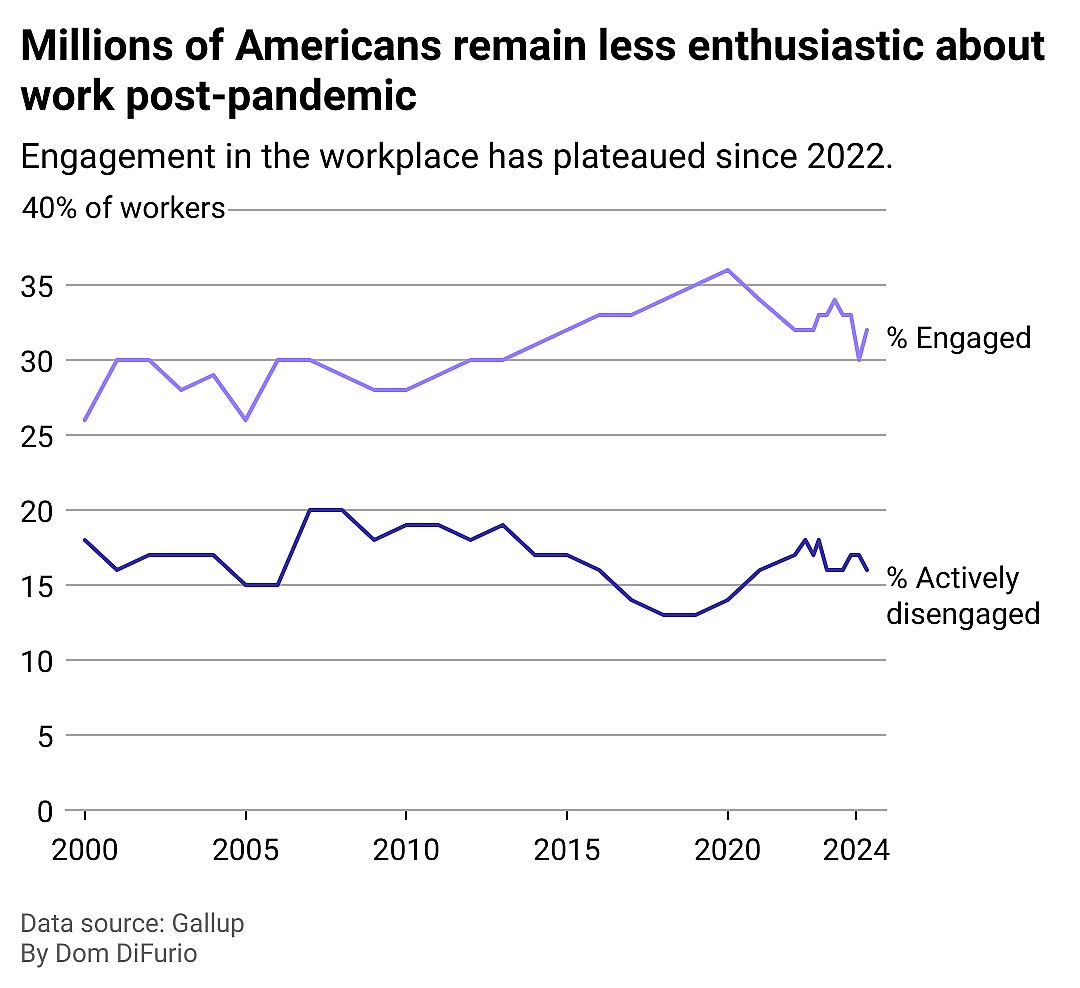
It's not wrong to trace the decline in employee engagement to a once-in-a-lifetime pandemic that upended every aspect of daily life—including work across industries. Employee engagement in the workplace rose throughout the 2010s, ultimately peaking in 2020. It fell between 2020 and 2022 and has hovered around nine-year lows.
To stem the spread of the virus, many employers quickly pivoted to offering fully remote and eventually hybrid work options.
Today, half of workers capable of working fully remote work in hybrid work environments, according to Gallup. Only 27% work exclusively remotely.
Most workers find hybrid work arrangements beneficial. However, miscommunication, feeling disconnected from their organizations, and difficulty being productive are all drawbacks some workers in hybrid work arrangements feel today, according to an April 2024 survey from workplace collaboration software provider Lucid Software.
"Employers are struggling," Jocelyn Dove, a talent acquisition manager and project management professional, told Stacker.
"You need that in-person type of experience. Working from home is not built for everybody," Dove told Stacker. "It's important for leaders to find touchpoints to meet their team, remind them of the culture, mission, and why they're there. [It's important for] enforcing certain rules and [making] sure people are complying."
But the rise of hybrid work isn't the only thing to blame for elevated disengagement in recent years. Other studies have shown a mismatch between employer and worker expectations is another contributing factor.
Gallup data showed that Gen Z workers and younger millennials born after 1989 lacked a sense of alignment with their organization's culture. Employees entering the workforce who haven't experienced in-person work may find it challenging to connect with coworkers and senior management.
Human resources consultant Victoria Yang spoke to Stacker about how poor employee engagement can stem from systemic issues. Workers can become disengaged if companies don't have "environments that people want to work in," said Yang, whose work with companies like Google, Looker, and Bonusly has, at times, focused on employee engagement.
For younger workers who missed out on pivotal in-person moments like high school or college graduation, starting a first job without a traditional in-person onboarding program may mitigate their ability to bond or develop professional social skills development before entering the workplace. Employers might find these workers pushing back on participating in workplace activities designed to boost engagement, Dove explained.
Simply put: "People still need people," Dove said.
Dove and Yang emphasized the importance of providing employees with a sense of purpose and understanding their place within the company values system to boost engagement. That's especially true for younger employees who "want to feel like they are working toward something that's positive," Dove said.
According to Yang, employee engagement boils down to three factors: learning opportunities, the potential for growth, and buy-in toward the company's mission.