The Hechinger Report
1 / 2A simple tweak to instructions yielded very surprising results
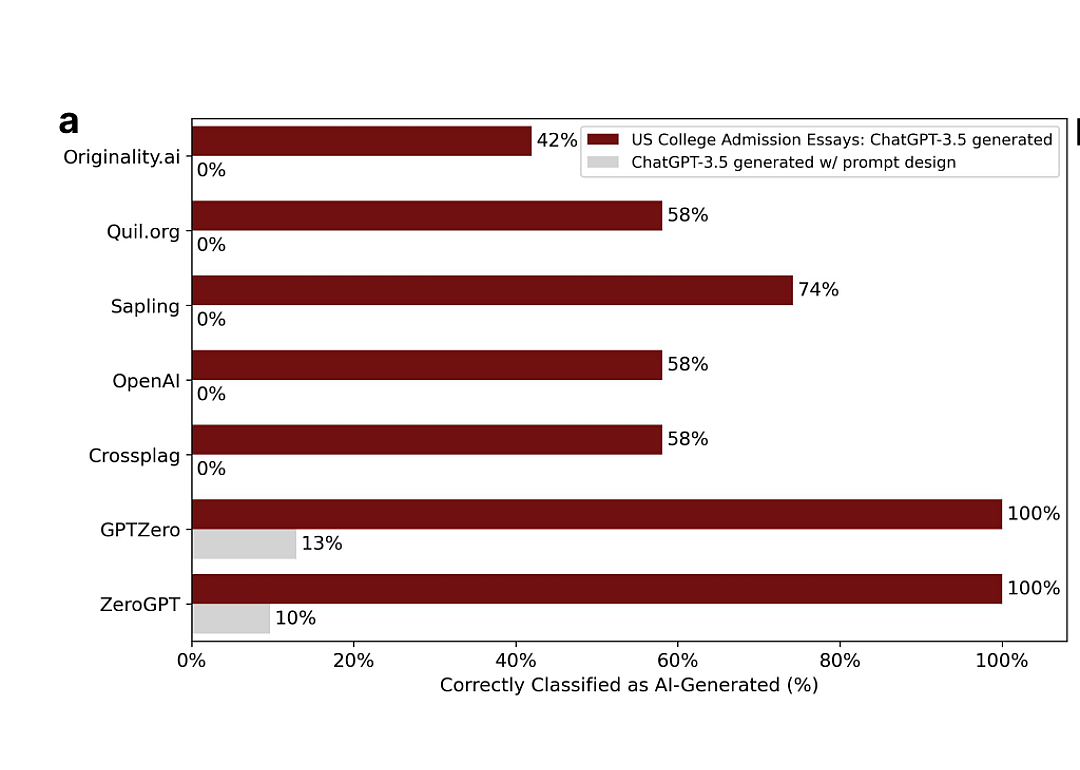
For ChatGPT 3.5 generated college admission essays, the performance of seven widely used ChatGPT detectors declines markedly when a second round self-edit prompt ("Elevate the provided text by employing literary language") is applied. Source: Liang, W., et al. "GPT detectors are biased against non-native English writers" (2023)
The scientists began by generating 31 counterfeit college admissions essays using ChatGPT 3.5, the free version that any student can use. GPT detectors were pretty good at flagging them. Two of the seven detectors they tested caught all 31 counterfeits.
But all seven GPT detectors could be easily tricked with a simple tweak. The scientists asked ChatGPT to rewrite the same fake essays with this prompt: "Elevate the provided text by employing literary language."
Detection rates plummeted to near zero (3 percent, on average).
I wondered what constitutes literary language in the ChatGPT universe. Instead of college essays, I asked ChatGPT to write a paragraph about the perils of plagiarism. In ChatGPT's first version, it wrote: "Plagiarism presents a grave threat not only to academic integrity but also to the development of critical thinking and originality among students." In the second, "elevated" version, plagiarism is "a lurking specter" that "casts a formidable shadow over the realm of academia, threatening not only the sanctity of scholastic honesty but also the very essence of intellectual maturation." If I were a teacher, the preposterous magniloquence would have been a red flag. But when I ran both drafts through several AI detectors, the boring first one was flagged by all of them. The flamboyant second draft was flagged by none. Compare the two drafts side by side for yourself.
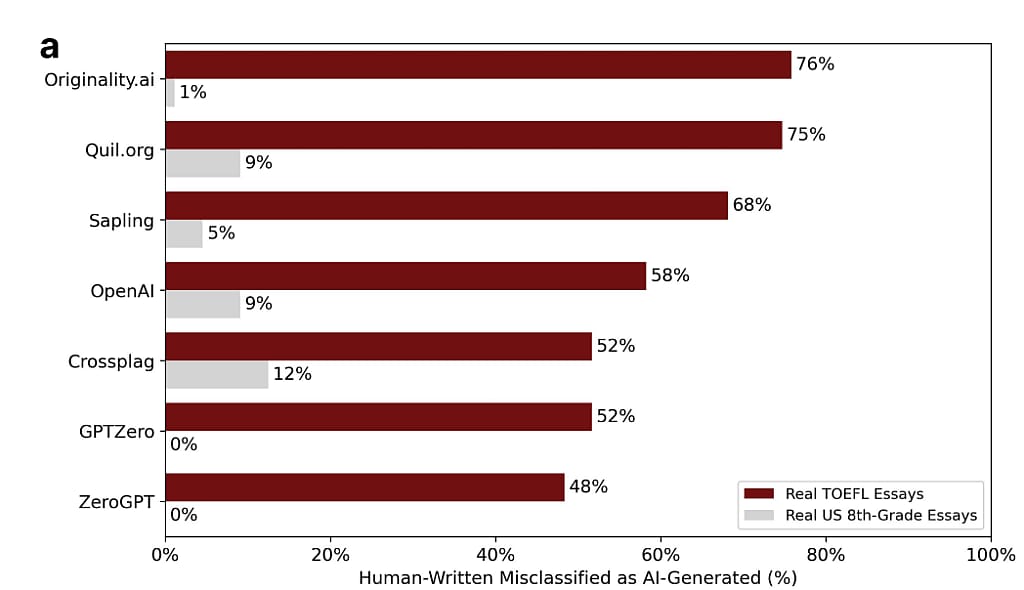
Meanwhile, these same GPT detectors incorrectly flagged essays written by real humans as AI generated more than half the time when the students were not native English speakers. The researchers collected a batch of 91 practice English TOEFL essays that Chinese students had voluntarily uploaded to a test-prep forum before ChatGPT was invented. (TOEFL is the acronym for the Test of English as a Foreign Language, which is taken by international students who are applying to U.S. universities.) After running the 91 essays through all seven ChatGPT detectors, 89 essays were identified by one or more detectors as possibly AI-generated. All seven detectors unanimously marked one out of five essays as AI authored. By contrast, the researchers found that GPT detectors accurately categorized a separate batch of 88 eighth-grade essays, submitted by real American students.
My former colleague Tara García Mathewson brought this research to my attention in her first story for The Markup, which highlighted how international college students are facing unjust accusations of cheating and need to prove their innocence. The Stanford scientists are warning not only about unfair bias but also about the futility of using the current generation of AI detectors.