Learner
1 / 3College is still a good bet, but only for some
When companies or investors consider a project, they care about the internal rate of return, or IRR, a form of ROI. Investing in a project with a 5% internal rate of return is financially equivalent to putting your money in a savings account that pays 5% interest a year.
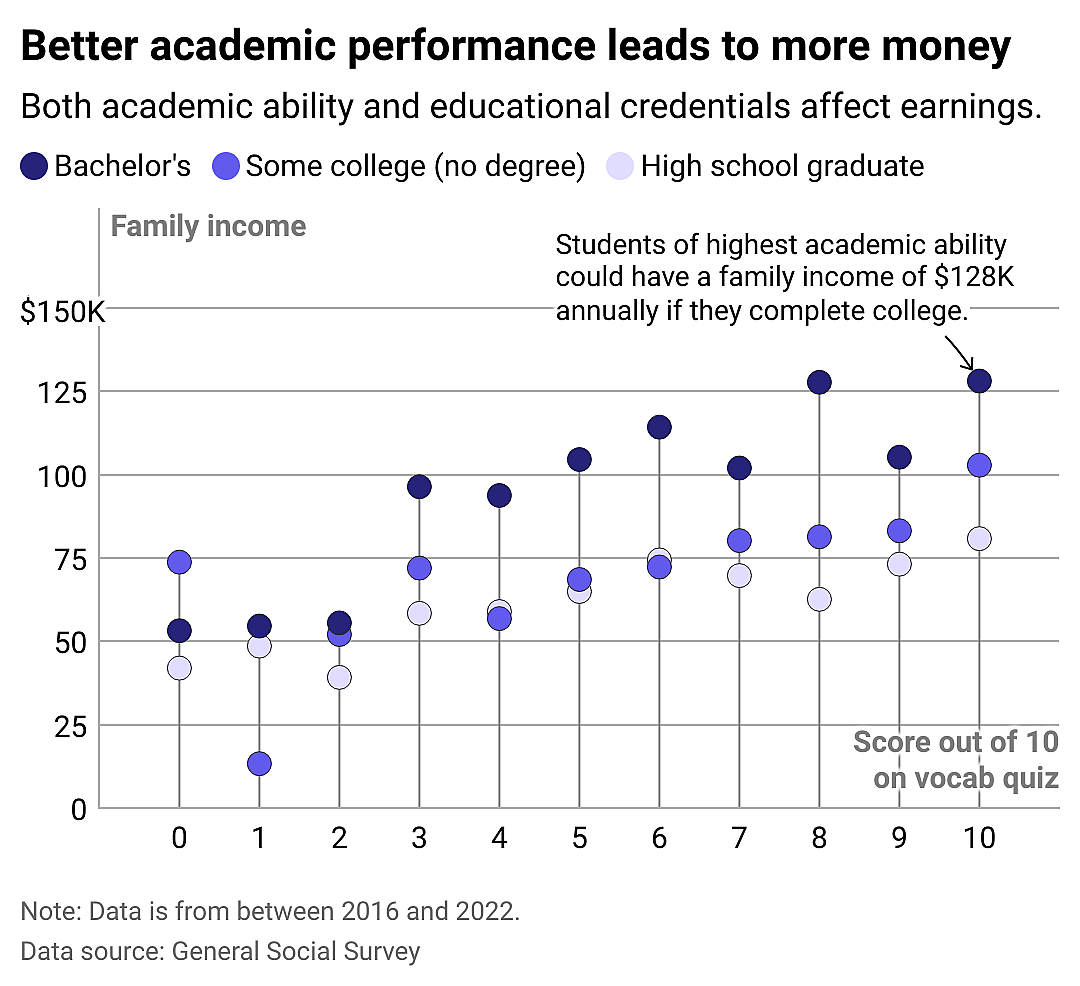
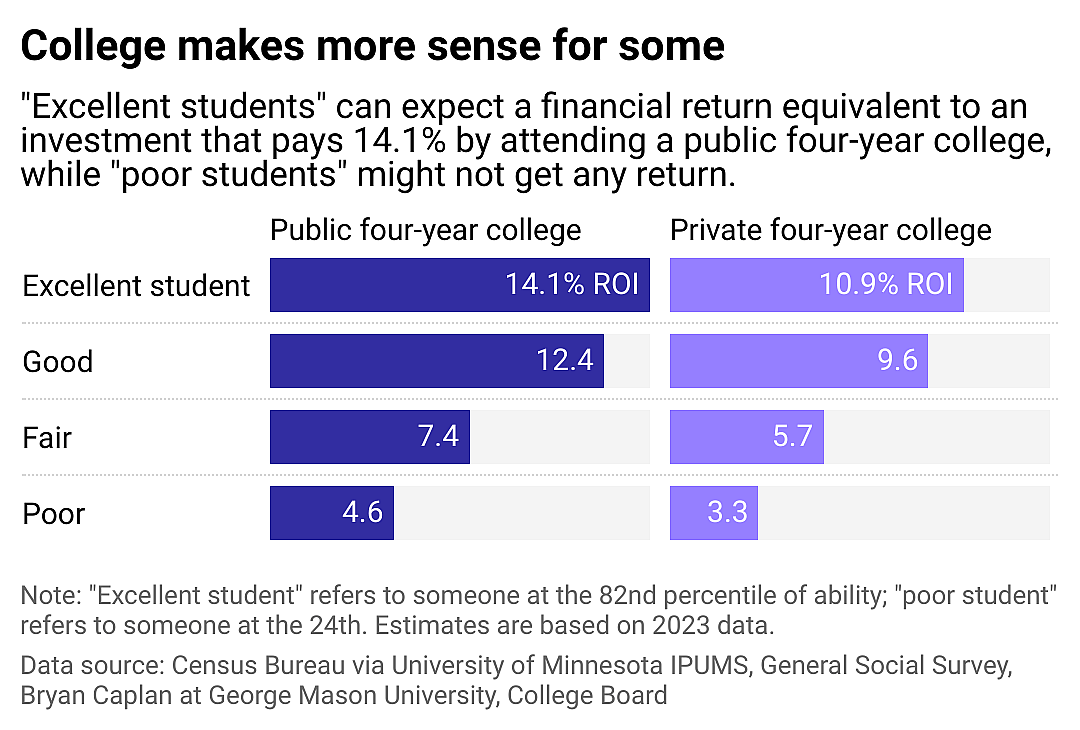
Stacker has built a statistical model that estimates how much people of different academic abilities and education levels can expect to earn and estimates the internal rates of return on pursuing a four-year degree. It considers the sum of all personal-level income, such as wages, bonuses, tips, rental income, and more. Borrowing from Bryan Caplan's aforementioned book, this analysis breaks students into four levels of academic ability, ranging from "excellent students," who have grades and test scores at roughly the 82nd percentile on tests, to "poor students," who are at roughly the 24th percentile of academic performance.
This model makes several simplifying assumptions. It assumes everyone who goes to a four-year college does so between 18 and 21, and anyone who drops out does so after two years. It also assumes full-time college students do not work and that everyone files taxes as single persons with no dependents and takes the standard tax deductions. It ignores the impact of state and local taxes, as well as living expenses, since people who do not go to college need housing too. Students who can live at home during college save a lot of money.
Overall, this analysis finds that college is a good bet, at least for those with a good academic record. Excellent students can expect an ROI of about 14.1% at public four-year colleges, while poor students can expect only a 4.6% return. For comparison, the S&P 500 Index, which tracks the performance of shares in the biggest listed companies in America, has provided a total return of around 10% a year over the past three decades.
The biggest reason some students can expect much better returns than others is graduation rates. Drawing from Caplan's research, this model assumes excellent students have a 66.5% chance of graduating with a bachelor's degree, while poor students have only a 6.1% chance.
These numbers also do not account for inflation, which would lower the expected returns on investment by two to three percentage points.