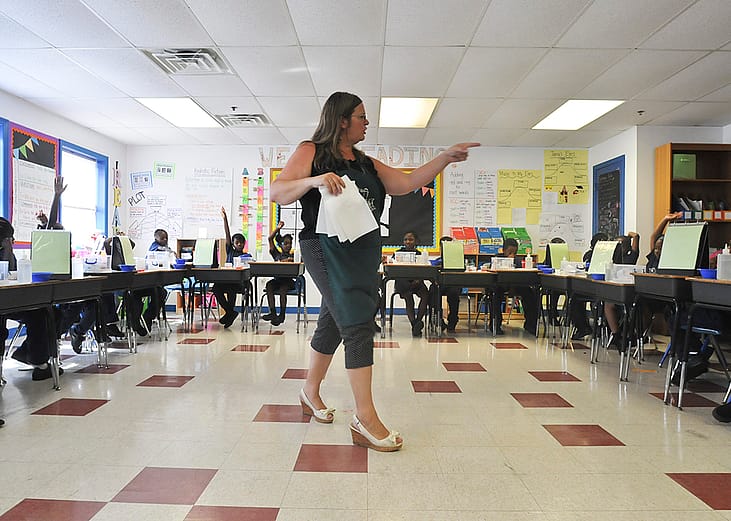
It was hours before the vice presidential debate inside Kevin Melrose's eighth grade social studies class. But there would be no talk of JD Vance or Tim Walz.
Social studies teachers at the school avoid instruction about national politics in order to remain nonpartisan, said Melrose, per direction from the district. Washington Township, where Westlane is located, is a politically and socioeconomically diverse district, Melrose notes, even though Marion County as a whole is a blue dot inside red Indiana.
And while the state did not pass a divisive concepts law that would have limited teachers' abilities to discuss race and other topics, the scrutiny and charged rhetoric of the last few years have led teachers to tread carefully. It's a common stance: Fifty-eight percent of K-12 teachers surveyed by the EdWeek Research Center this summer said they do not plan to talk about the election in their classrooms. Of those respondents, 22% said they were worried about parent complaints, while another 19% didn't think discussions could be respectful.
Melrose, the chair of the school's social studies department, has focused on teaching democracy through student council elections. All eighth graders break into groups of four—a president, vice president, and two campaign managers—and hold classroom elections with campaign posters, videos, and in-class debates.
The winning candidates from each classroom face off for the role of eighth grade class president, who effectively leads the student council.
Despite the moratorium, students are paying attention to state and national politics. Some students even watched the presidential debates to get a sense of what to do as candidates. And Melrose doesn't stop them from discussing issues that directly affect them.
Many of the students' presidential platforms include typical school election fare such as promises of better cafeteria food and changes to the dress code. This year, many also promise to convince Westlane to loosen cellphone restrictions. Indiana this year passed a law requiring schools to ban cell phones during instructional time, but Westlane has gone further and required students to put phones in their lockers at the beginning of the day, worrying students who want easier access to their phones in the event of an emergency, like a school shooting.
"The world has changed," said one candidate, Travis Smith. "There's more shootings and stuff like that than at any time before."
Other students challenged the candidates on how, exactly, they would enact their policies. If the cellphone ban is a state law, they ask, what can an eighth grade class president really do about it?
But, Melrose pointed out later, the student council has had big wins. Members successfully opened up field trips to more students, and a few days after the debates, the eighth graders were due to head to D.C.
East Bronx Academy for the Future, Bronx, N.Y.
In Christine Montera's 11th grade U.S. History class, the past is used to explain the present.
Montera, social studies department chair at the grades 8-12 school, recently explored with her students elements of the distant past that are still being felt today: the ways regional identities developed in colonial America and the formation of the electoral college in 1787.
"My goal in teaching the election in history class is to help students understand that we truly did not fall out of a coconut tree into a current election cycle," Montera said, referencing a viral quote from Vice President Kamala Harris, "and that all of it is based on the context and history of our country."
This background helped her students answer two urgent questions on Tuesday: Is the electoral college democratic? And does it help or hurt democracy today?
She pulled up an electoral college map of the 2020 presidential election and asked her class, "What do you notice about this map?"
Students chimed in that it looked like the Trump supporters were clustered in the middle of the map, and that there were different numbers around the map. Montera asked what those numbers meant, and students tried to guess before Montera explained that the number of electoral votes a state receives is based on their population size.
Jannatul Urmi, 16, noticed that most of the southern states were red.
"Good, what do you think that says about their regional identity?" Montera asked.
"Maybe they're more traditional. They're more religious, so that's why they're voting for Donald Trump," Urmi offered.
The more the students learned about the electoral college through a video and then a worksheet reinforcing what they'd learned, the more questions they had.
"Can the electoral college be corrupted?" asked Arisnoely Vivaldo, 16.
"Why does it still exist if so many people are against it?" Urmi wondered.
"What happens if the elector doesn't follow the majority?" asked Alexander Cataquet, 16.
"They'd go to jail, right?" Urmi responded to him.
Then the class returned to one of Montera's guiding questions: Is the electoral college helpful or hurtful to democracy? Many students settled on hurtful, critiquing that individual votes don't have equal weights in each state and pointing out the possibility of corruption if an elector goes rogue.
When asked what stuck with them from Tuesday's lesson, students said they were offered different perspectives, which in turn changed the way they think about the election and the role different people play in it.
"I never realized how much the background of a region affects the way society is now," said Vivaldo. "Like certain social norms and ideas have passed down throughout the generations."
Thinking about these regional identities made some students reflect on how they have come to their own political beliefs.
"I feel like I wasn't too big on political stuff, but I feel like knowing more of the background helped me understand and have my own opinion," said Emma Alvarado, 16, "and not just listen to what everybody else thinks around me."
This story was published in collaboration with Headway, a new initiative at The New York Times. Chalkbeat and Headway have been posing questions about the presidential election to educators and high school students since February. We have heard from nearly 1,000 students and 200 teachers across the nation.