HeyTutor
1 / 1Education spending
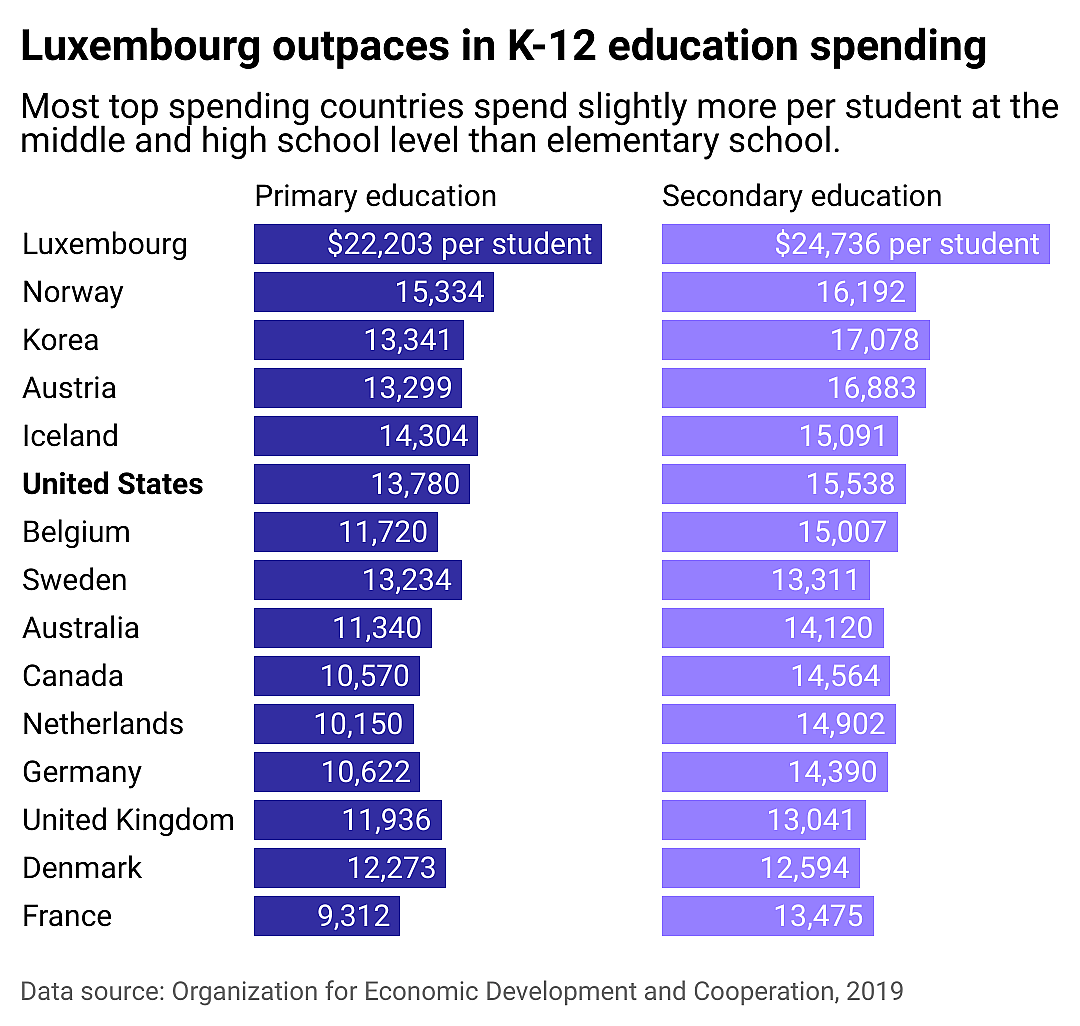
The amount spent annually per student in the U.S. is comparable to Germany's yearly investment in secondary studies. However, the national budget for K-12 public education represents only 3.2% of the GDP in the U.S., a spending output that places it closer to Canada and Portugal. Seven member countries of the OECD spend 4% or more of their GDP on elementary and secondary funding. Israel spent the highest percentage at 4.8%.
The United Kingdom—where university tuition is one of the priciest in the world—spends about 30% less on elementary and secondary public education than the U.S. On the other hand, Norway, where a college education is free to students, invests about 20% more than the U.S. in K-12 subsidies.
In Norway's case, 36% of the population seeks a post-secondary education. Meanwhile, in the U.S., 1.7 million people ages 16 to 24 enrolled in higher education institutions in 2021 for the first time, which is 61.8% of high school graduates. Nonetheless, Norway has a higher yearly percentage of college graduates.
The amount of money spent on a pupil's basic education doesn't mirror the quality of the instruction received. Their performance on international tests can more accurately reflect the efficiency of a national school system. The OECD runs the Program for International Student Assessment (PISA), which evaluates how 15-year-old students perform in math, reading, and science every three years.
In 2018, the latest data available, "Estonia, Canada, Finland, and Ireland were the highest-performing OECD countries in reading." The organization concludes that since the year 2000, the importance of reading has not diminished, though the variety of written material has expanded to electronic formats.
About 16.5% of urban Chinese students tested and 14% of those in Singapore, "scored at Level 6 in mathematics, the highest level of proficiency" in PISA. Only 2.4% of OECD students were able to reach that score.
Trends in academic performance in a 20-year period are widely diverse among OECD nations, and even among students in each specific country. The main concern is a "widening of performance disparities," with low-performing students consistently scoring low grades in periodical assessments, affecting the national average.
The OECD recommends governments gear their education funding and policies towards opportunely spotting students who need extra help "to ensure that learning gaps observed today don't widen into larger social and economic inequalities in the future."
Data reporting by Emma Rubin. Story editing by Robert Wickwire. Copy editing by Tim Bruns. Photo selection by Elizabeth Ciano.