CheapInsurance.com
1 / 2Motorcycle fatalities by state
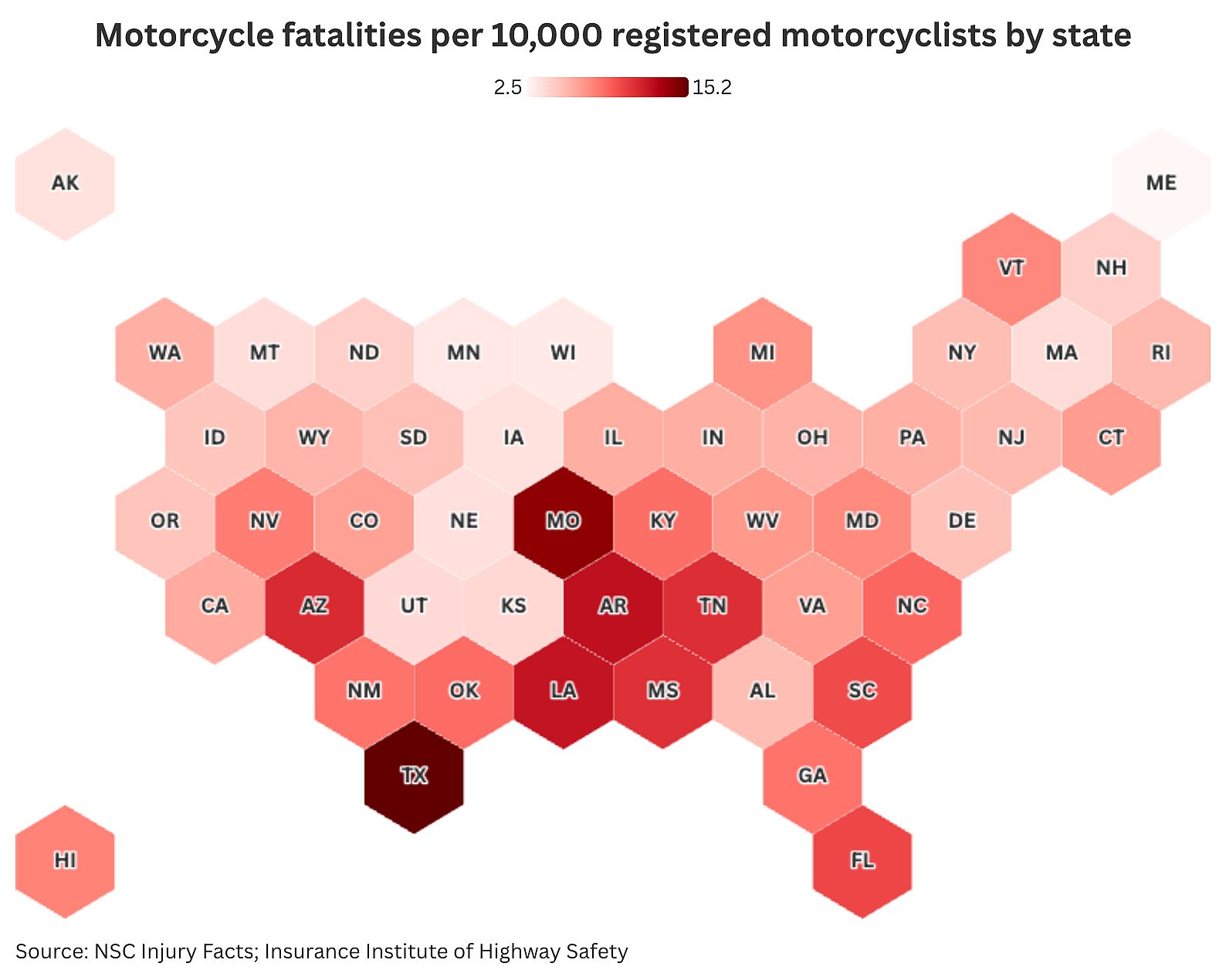
The rate of motorcycle fatalities varies widely from state to state. There can be many reasons for these discrepancies; however, helmet use is one of the biggest contributing factors, according to the National Safety Council.
The graph displays the rates of motorcycle fatalities by state. This data is normalized for motorcycle ownership in each state.
In 2023 there were 6.6 motorcycle fatalities per 10,000 registered motorcyclists in Colorado, ranking as the #23 highest rate among all states.
Top 5 most dangerous states based on motorcycle fatalities per 10,000 registered motorcyclists
- Texas - 15.2
- Missouri - 13.9
- Arkansas - 12.3
- Louisiana - 12.1
- Arizona - 11.2
Top 5 safest states based on motorcycle fatalities per 10,000 registered motorcyclists
- Maine - 2.5
- Wisconsin - 3.2
- Minnesota - 3.3
- Alaska - 3.6
- Iowa - 3.6
Motorcycle helmet laws: Historical to present
Universal helmet laws were once in place across the United States. The Centers for Disease Control and Prevention reported that the Highway Safety Act of 1966 required states to implement universal helmet laws in order to receive federal transportation funds. As a result, these laws were in effect in 47 states and the District of Columbia by 1975.
However, federal penalties for not implementing these laws were removed in 1975, and half of these states reduced or removed the requirement. Since then, some states have re-initiated helmet laws for motorcyclists. Today, only 19 states and the District of Columbia require all riders to wear helmets. Others have age restrictions.
How helmet laws affect motorcycle fatalities
According to Eric Teoh, the IIHS director of statistical services, "Wearing a helmet is one of the biggest things riders can do to protect themselves from death and traumatic brain injury." Data reported from the National Safety Council supports this. Wearing a helmet on a motorcycle is 37% effective at reducing fatalities for the driver and 41% for passengers.
These findings suggest that states with less restrictive helmet laws will have higher rates of motorcycle fatality. However, this does not paint a definitive picture, as other factors are at play.
State roadway infrastructure and its impact on motorcycle fatality
The Federal Highway Administration recognizes that poor road infrastructure can be dangerous for motorcyclists. The FHA uses suggestions and information from the Motorcyclists Advisory Council to make decisions on improving roadway safety. The key issues they focus on include:
- Motorcyclist safety
- Barrier design, road design, construction, and maintenance practices
- Intelligent transportation technologies
Using the advice given by the advisory council, the FHA has taken measures to improve the quality of roadways for motorcyclists. Most of this focus has been on non-interstate major roads, as it has been found that 53% of motorcyclist deaths in 2023 occurred on them, based on data collected from the total number of motorcycle fatalities in the U.S.
Behavioral attitudes affected helmet usage
It's worth noting that the culture of each state can have an impact on the number of fatalities, particularly the attitude towards helmets.
For example, in a 2024 study in the Injury Epidemiology journal, researchers found that adolescents who lived in more rural farm areas were less likely to wear a helmet while riding an ATV or motorcycle. This study surveyed 1,331 residents, half of whom resided on a farm, 21% in the country but not on a farm, and 28% in a town.
In a 2025 study in the International Journal of Critical Illness and Injury Science, researchers investigated the primary reasons why non-helmeted motorcyclists involved in a crash did not wear protection in India. Alcohol abuse, lower education levels, and travel on municipal roadways all had a statistically significant correlation to non-helmeted motorcycle use. This study was conducted by using data from emergency room visits from March 2021 to December 2021 in Eastern India. In that study, 346 patients were surveyed.
- This data could suggest that motorcyclists in states with lower levels of education, higher rates of alcohol abuse, more municipal-maintained roads, and more rural zoning may have higher rates of non-helmeted motorcycle use.