The Daily Yonder
1 / 1Democrats Build a Bench in Rural Areas
The strategy in Missouri is changing this year, Piper said. Money—to the tune of $100,000—has come in from the Democratic National Committee.
"It's going to take a while before we see the fruits of our labor," Piper said. "We know it's a long game, but we know it's worth playing."
Other Democratic rural organizers hold a similar sentiment to Piper's, regardless of whether they have also received national party funding this year.
In upstate New York, Paolo Cremidis runs the Outrun Coalition, a grassroots group of 523 local Democratic elected officials from across rural America. Cremidis, the coalition's executive director, said each official also brings a diverse identity not often represented in politics, including women, immigrants, young people, Latinos, Indigenous people, people of color, and members of the LGBTQ+ community.
"We need to delve into this diversity, because if we don't, we are not going to have a candidate base or bench going into the future," Cremidis said. Much like building a team of players, Cremidis and other rural organizers are looking to field a group of candidates they can train and then tap to run in future races.
Building a bench of Democratic candidates in rural areas is part of what Piper called a "long game" for Democrats. Gepford said Contest Every Race has similar goals with its recruitment efforts, which focus on races at the local and state level.
Republicans Look Beyond Rural
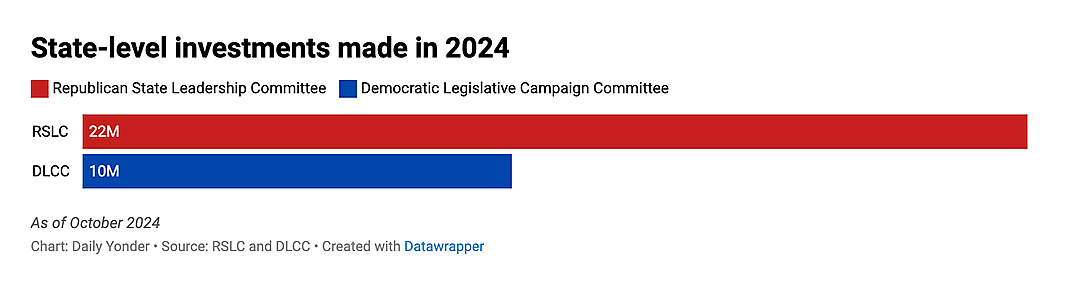
As Republicans outspend Democrats on down-ballot races by more than two to one, they are looking beyond rural America to pick up voters.
This is part of the national strategy, said Nicholas Jacobs, a professor of political science at Colby College and author of The Rural Voter: The Politics of Place and the Disuniting of America.
Jacobs said former President Donald Trump needs to win in more districts than he did in 2020 in order to win the presidency. For the Republican candidate, Jacobs said there are more votes to be won in the suburbs.
"Even if you start to lose a little bit in rural areas, if you can pick up in suburban areas, then you do just that," Jacobs said.
Greener said turnout can actually be a challenge for Republicans in rural areas.
"There are a whole lot of people that don't turn out and vote in rural America," Greener said. For elected offices down the ballot, community turnout decides the fate of local candidates.
Additionally, Jacobs said local candidates are not immune to the hyper-polarization and partisanship happening on the national scale this election cycle
"It is becoming harder and harder for candidates running down-ballot to escape the nationalized images of the party," Jacobs said.
Some Democrats, though, have maintained a degree of separation. Gepford said this is the "reverse coattails" effect.
"Our [Democratic] candidates down-ballot will outperform the presidential [race], because they're more likable in the area than the presidential candidate is," Gepford said. Contest Every Race is focused on identifying reverse coattails in rural counties, particularly in swing states, this year.
That is, if rural Americans vote. Even as vice presidential candidates JD Vance and Tim Walz bring up their connections to small-town America while on the campaign trail—the word "rural" was used multiple times during the vice presidential debate, after no mention at all during the presidential debate—rural strategists and organizers from both parties said it remains to be seen how community members will cast their support this year, if at all.
In some rural areas, Jacobs said local candidates could push people to cast ballots more than anything else.
"Sometimes local candidates' ground games, especially for state legislative office, do actually have an important bearing on who turns out, so it'll be interesting to see," Jacobs said.