Chokniti-Studio // Shutterstock
1 / 3A history of community care for seniors, starting in San Francisco
The modern PACE approach came into existence in 1973, when a doctor and social worker in the Chinatown district of San Francisco banded together to open On Lok, a community-based care and services center for seniors. Among other things, it provided hot meals and health care services to older people who lived at home rather than in a clinical setting. Through the rest of the decade, the daytime adult care center gained attention from lawmakers who helped secure grant funding for On Lok, which expanded into a second location.
In the 1980s, On Lok's board members went all in. They took out a loan against their own homes to secure enough money to demonstrate to the state their novel financial model for providing Medicare-funded out-of-home care to aging adults was effective. By 1997, Congress had passed legislation making PACE centers a permanent Medicare program and an optional program that state Medicaid programs could include.
Today, a vast majority of older adults would prefer to age at home. In an AARP survey of 3,000 adults over 50, 3 in 4 respondents said they'd rather age at home than in a facility. For some, that is a crucial factor in their longevity and quality of life.
Michael and Irene saw this firsthand when their grandmother became a PACE participant at WelbeHealth, which operates several centers in California and is headquartered in Menlo Park.
"It seemed like her mental state had changed. She was talking. She was laughing. It was night and day," Michael said in a testimonial, commenting on how his grandmother Wai, a Chinese immigrant who spoke limited English, had changed after transferring from a nursing home back into her home community in 2021. Wai passed away in 2023 at age 88.
Though their family expected the benefit of returning their grandmother to the social and cultural community she was most comfortable with, they hadn't anticipated how much the wraparound services—case managers, social workers, nutritionists—could make such a positive difference until after she began the program. Despite having high care needs, PACE participants can live in their communities for an additional four years typically, according to a study published in 2010.
Additionally, a study from the Department of Health and Human Services noted that the PACE program "stands out from our analysis as a consistently 'high performer,'" earning its reputation as the gold standard in community-based care for aging adults. This living arrangement helps patients avoid the high nursing care costs while still living independently and within their communities.
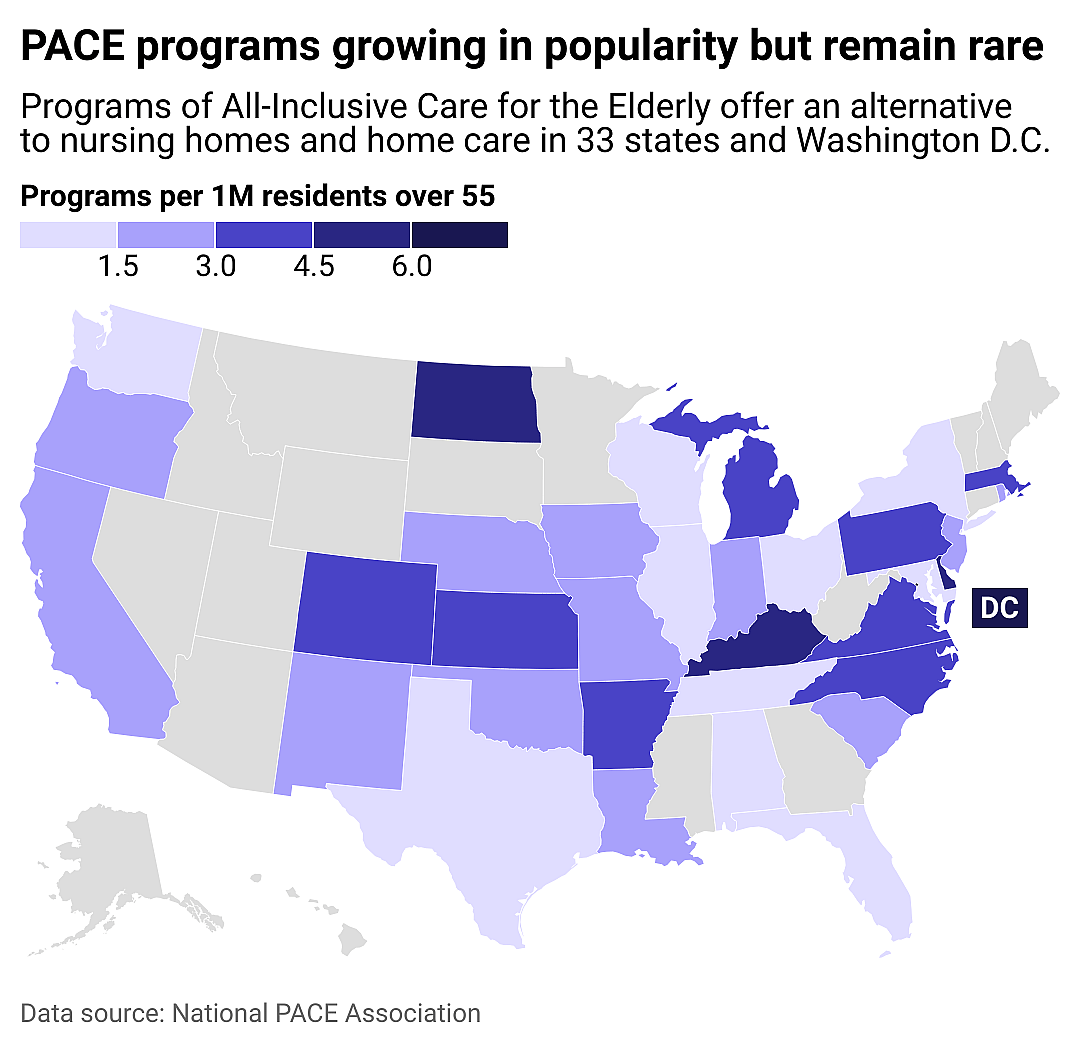
These care centers for aging adults appear in more communities nationwide each year. Since 2019, the number of PACE centers has grown almost 30% and enrollment has grown 50%, according to an ATI Advisory study.