Rula
1 / 1Learning How to Prioritize Tasks With ADHD
Prioritizing your to-do list when you live with ADHD can be challenging, but these strategies can help.
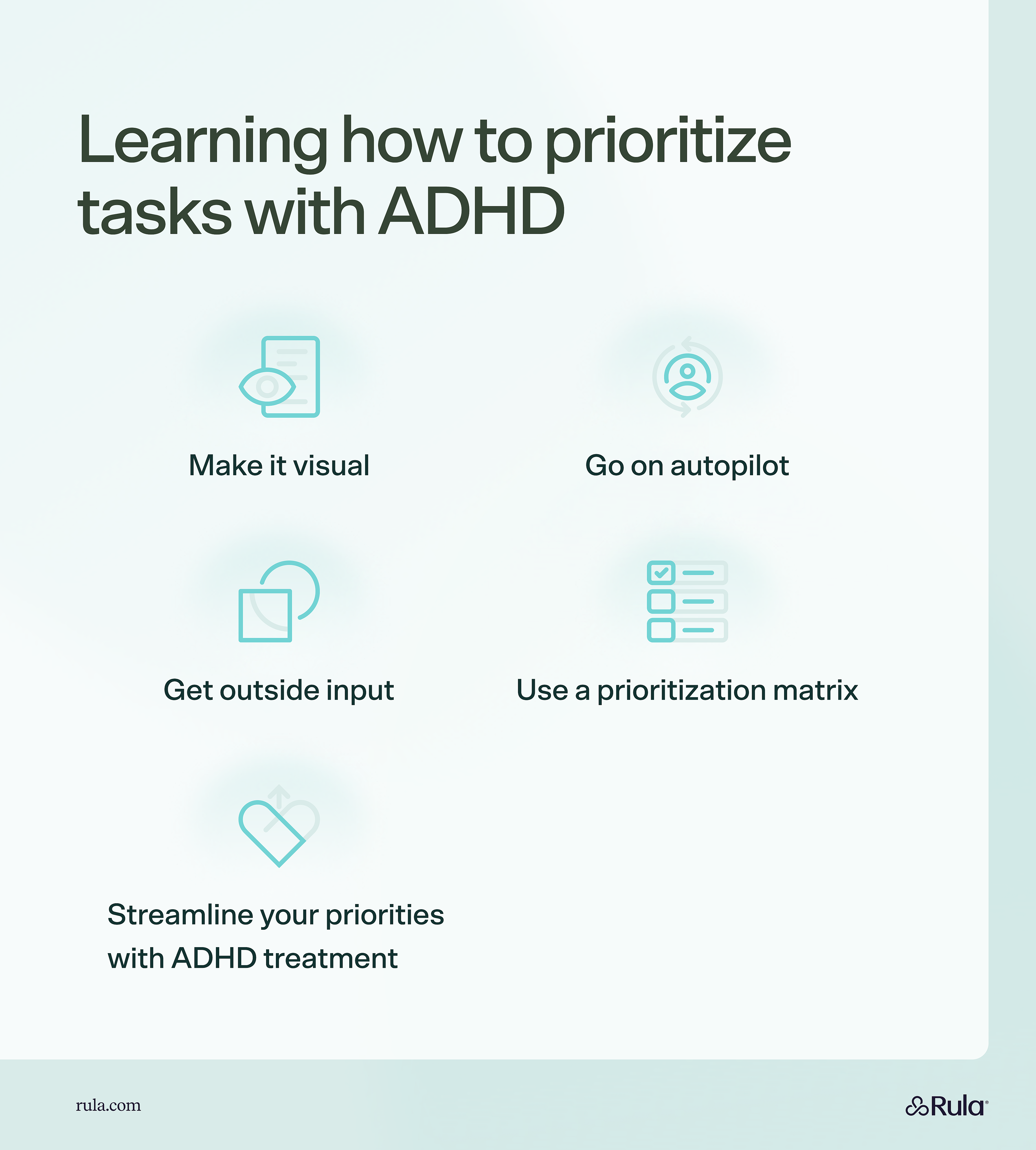
1. Make it visual
Many people with ADHD find it helpful to make task lists visual to help them analyze which items are most important. You can use whatever visualization strategy works for you, including ideas like:
- Creating a large poster of tasks
- Color-coding tasks depending on importance or deadline
- Using visual timers to measure the time each task takes
It can be easier to prioritize tasks when you have them laid out visually in front of you rather than trying to figure it out mentally. Visual reminders can also help with forgetfulness because you may find it easier to stay on track when there's a visual cue to do so.
One systematic review found that visual activity schedules were effective in helping children with ADHD improve their social and independent skills and stay on task.
2. Go on autopilot
Part of the reason you may have difficulty completing high-priority tasks first could be because the steps needed to complete them are uncertain. You don't know exactly how much time it will take or what steps you'll need to go through to finish the task.
On the other hand, some lower-priority tasks on your list might feel more automatic and, therefore, easier. For example, you have done laundry a thousand times, so you know exactly what that task entails.
One way to approach task prioritization when you have ADHD is to automate every task as much as possible. Try to break each task down into smaller steps that feel more second nature and manageable to you. Make yourself step-by-step instructions for each task to make it easier for you to complete without even thinking about it.
For example, if you need to file your taxes, start by giving yourself 30 minutes to find a local tax person and make an appointment with them. Then, give yourself 20 minutes each day to compile documents from a checklist before the appointment.
When every task feels automatic, you may be less likely to procrastinate on more complex, high-priority tasks. In the study mentioned above, employees who had explicit routines and consistent implementation were more likely to perform well, even with ADHD.
3. Get outside input
Sometimes, problems with judgment and problem solving can make it difficult to differentiate which tasks are higher priority. It's not that you're procrastinating on higher-priority tasks— it's that you didn't realize that other tasks were more urgent than what you're doing now.
It can sometimes help to get an outside perspective to help you with prioritization instead of trying to guess. Remember that ADHD affects your brain, and this isn't anything to be ashamed about. It's OK to ask for support. Plus, help with prioritization could be considered a reasonable accommodation at school or work, which you have a legal right to under the Americans with Disabilities Act.
For example, you could ask your manager or professor to provide you with tasks in order of urgency rather than sporadically assigning you projects over time. And if it's within your means, getting a virtual assistant to prioritize your tasks for you can be an excellent investment. You can also ask loved ones to support you. For example, when they ask you to do something, you could ask them to rate how urgent it is.
4. Use a prioritization matrix
Prioritization or decision matrices are tools that can help anyone, with or without ADHD, with prioritizing tasks. It gives you a clear-cut way to label tasks as high, medium, or low priority. This lifts the need to figure everything out on your own and gives you a simple way to organize your to-do list.
One popular decision matrix is the Eisenhower Matrix, popularized by Stephen Covey, author of "The 7 Habits of Highly Effective People." To use the Eisenhower Matrix, you only need to differentiate between urgency and importance.
Urgent tasks are tasks that demand your attention immediately. They may not be important to you personally, but the consequences will be significant if you don't attend to them. These can be things like:
- Responding to emails from managers
- Meeting a last-minute deadline
- Going to the doctor when you or your child is feeling very ill
Important tasks are more subjective. They're things that are important to you and are aligned with your values and goals. For example:
- Spending time with friends
- Engaging in hobbies
- Going back to school
- Practicing meditation
The Eisenhower Matrix guidelines go like this:
- Quadrant 1: If it's urgent and important, do it yourself as soon as possible. This should be your first priority.
- Quadrant 2: If it's urgent but not important, try to delegate the task if possible. If not, get it done as soon as possible.
- Quadrant 3: If it's important but not urgent, schedule a time for you to do it in the near future.
- If it's neither important nor urgent, take it off your list. Try to spend minimal, if any, time on these tasks. Examples include busy work or scrolling social media.
Keep in mind that spending too much of your time with Quadrant 2 tasks (urgent tasks that aren't important to you) can result in ADHD overwhelm. So it's important to fill your life with tasks that are important to you—without neglecting urgent tasks.
5. Streamline your priorities with ADHD treatment
Although these strategies can help, the best way to deal with difficulties with prioritizing is to get treatment for ADHD. Difficulty with prioritization is a direct result of ADHD symptoms. It may not be something you can simply "willpower" your way out of. You aren't lazy, and difficulty prioritizing isn't a personality defect.
Research shows that cognitive behavioral therapy strategies, including skills training groups, can help with prioritization and organization.
If you live with ADHD, you may need clear instructions on how to prioritize tasks—something that you may have never been taught because of the assumption that it's "basic" knowledge. Skills training can provide you with specific strategies that you can implement to organize and prioritize your tasks.
On top of skills training, effective ADHD treatment in general—which typically involves a combination of medication and therapy—can help you continue using these strategies and reduce the challenges that ADHD may cause in your life.
Some research suggests that people with ADHD can have difficulties with organization even after learning skills because they don't apply them consistently. So a therapist can help you stay on track and keep practicing new skills you've gained without becoming frustrated or overwhelmed.