Incredible Health
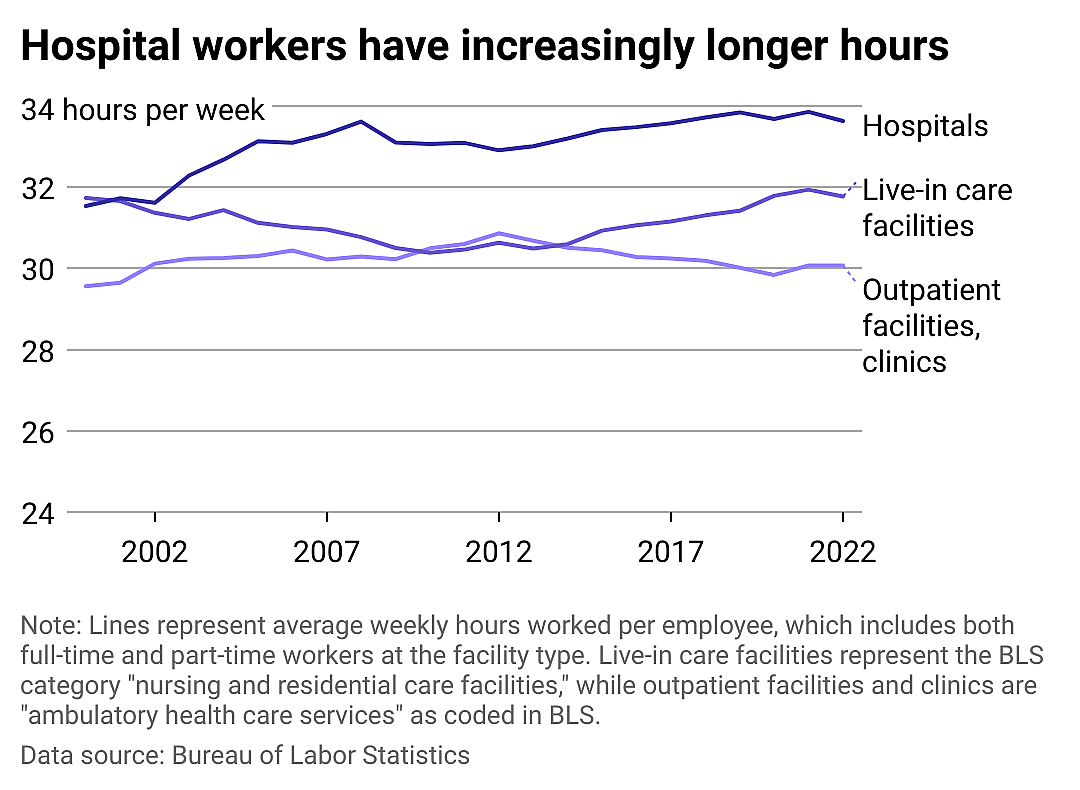
1 / 1Average hospital workers work longer hours, and their lead has grown
Nursing home facilities are operating with the leanest workforce in health care right now, but BLS data shows that a smaller number of workers are still working roughly the same average number of weekly hours as a much larger workforce did in 2000.
The average ambulatory health care service professional's hours have increased by half an hour a week to cover staff shortages in other parts of health care: Hospital workers are working two hours more a week.
Unlike other industries like airline pilots, where exhaustion and workload are under close watch, research shows that efforts to reduce workload in medicine are "haphazard" and mainly focused on trainees, according to the March 2023 paper published in the Journal of General Internal Medicine.
For emergency medical services professionals, 40-plus-hour workweeks are by necessity—for the workers, not for the patients. Research published in PubMed in 2020 shows that 71% of surveyed EMS professionals had to work overtime, or multiple jobs, to make ends meet.
Three-quarters of hospital nurses work 12-hour shifts, not including commute time, according to the American Nurses Association, since their schedules are based on around-the-clock patient care in hospitals and long-term care facilities.
Over the course of two years, around half of the nursing staff in Katie Carroll's nursing unit at a hospital in New Brunswick, New Jersey, left, she told The New York Times. The effects of staff shortages can reverberate into patient care: "You're running around so busy with a frazzled mind that more mistakes can happen, because there's so much on your plate" Caroll said.
The consequences of overworked staff can be devastatingly fatal. Research published in 2021 by BMJ Open found that the probability of the 30-day mortality rate for a patient increased by 16% when an additional patient was added to the caseload of an average hospital nurse.
For physicians in 2021, the average workweek was 50 to 59 hours, though 36% worked 60 to 80 hours or more. Some of that is because of the corporate consolidation of U.S. health care. That activity, plus increased demands by insurers and hospital administrators, has led to "doctors drowning in a sea of paperwork and patient visits," Dr. Robert Pearl, a former CEO of Permanente Medical Group, wrote for Forbes.
Even with so much on the shoulders of health care staff, many take on even more. The Accreditation Council for Graduate Medical Education has periodically proposed tighter restrictions than its 2003 limitations that capped medical residents' work hours at 80 hours per week.
The Biden administration's proposal to establish staffing minimums at nursing homes could also meaningfully clarify the 1987 act that simply required nursing homes to have "sufficient" staffing. That change could ensure nurses aren't overworked, but the bill's fate is in the air, facing significant criticism.
Hope might also come in the form of increased transparency during the hiring process. A March 2023 op-ed in Medical Economics argues that hourly pay transparency is becoming an expectation on job listings as clinicians want more information upfront.
Also, 77,000 health care jobs were created in November 2023, mostly in ambulatory health care services, hospitals, and nursing care facilities. If filled, the additional help could reduce the burden on other health care workers. But the need will continue to be significant.
Story editing by Jeff Inglis. Copy editing by Kristen Wegrzyn.