NBER
1 / 1Greater number of young people are reporting despair
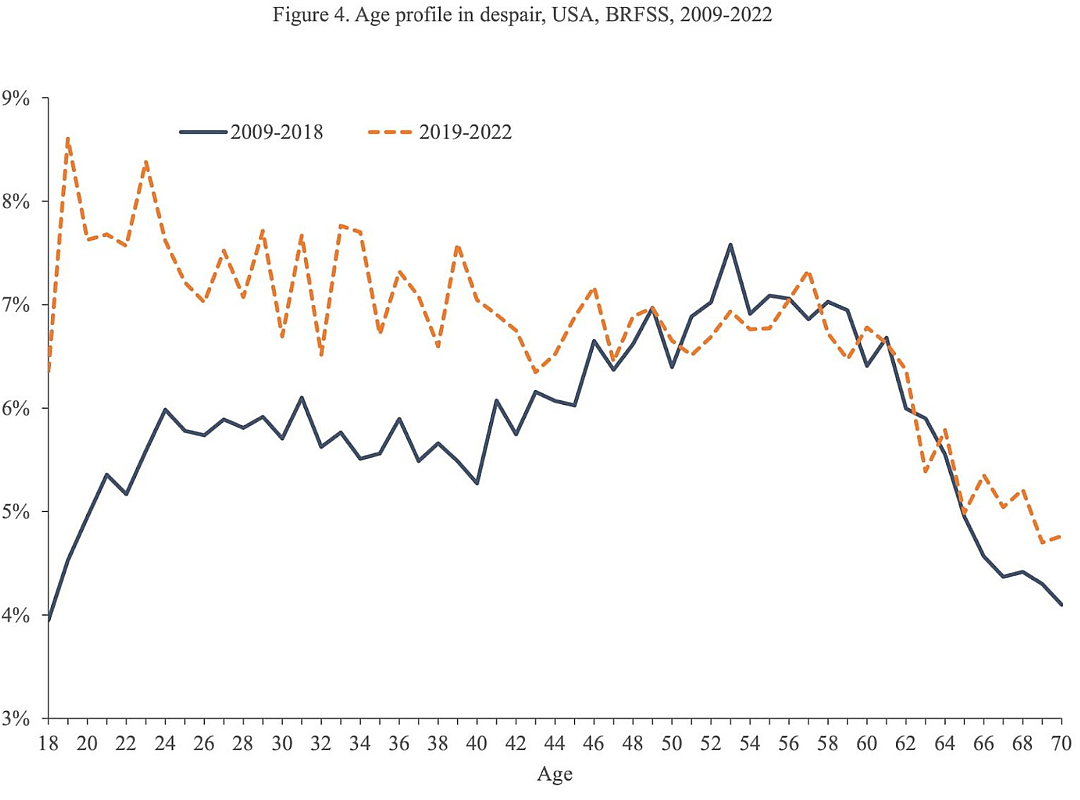
Blanchflower said that reports of freefalling indicators of mental health for teenagers and young adults, including increased hospitalizations for self-harm and greater suicidality, led him to check on the latest data from benchmark surveys such as the Centers for Disease Control's Behavioral Risk Factor Surveillance System, which conducts health-related interviews with 400,000 adults every year. The results from the past half-decade were eye-opening, he recalled, and were equally present in figures from the United Kingdom as well as the United States.
"I got in there early and said, 'I'd better take a look at this because I've got endless research saying there's a happiness U-shape,'" he said. "And I started to look and said, 'Holy moly, it's gone!'" People in their late teens and early 20s are now the most likely to report experiencing despair, with people in their late 60s and early 70s substantially less apt to say the same.
An additional overview of findings from the Global Mind Project, which polls a vast swath of international respondents, also demonstrated a steep rise in fear, anxiety, and suicidal thoughts among adults in dozens of countries (again including the U.K. and the U.S.).
COVID-19 has often been cited as a major force playing on the anxieties of young people. But the survey responses strongly indicate that the pandemic actually accelerated pre-existing trends, Blanchflower and his co-authors noted. The sense of displacement brought on by online instruction in the early 2020s may have only intensified the same alienation triggered by online interaction in the 2010s.
Devorah Heitner is a parent and author who has personally canvassed children around the country to learn how they and their peers navigate a world mediated by screens and social networks. While intermittently skeptical of the most vocal critics of smartphones and social media, including Twenge, she said many young people express a desire to limit their interactions with technology.
"Kids are very aware of their relationships with their phones," said Heitner, whose book on the virtual lives of kids, Growing Up in Public, became a bestseller last year. "They wish they could take a break from it, or that they could get their friends to use them less."
The 'cost of not doing something'
Educators, parents, and politicians are increasingly open to considering restrictions on how children can engage with the internet and social media.
In Florida, Republican Gov. Ron DeSantis recently signed a law banning social media accounts for children younger than 14 and requiring 14- and 15-year-olds to obtain parental permission. Last month, the U.S. House of Representatives passed a bill that would force the sale of the Chinese-owned platform TikTok, citing concerns both about users' data security and the app's effects on its youngest users. (The proposal has since been tied to a comprehensive package of foreign aid that is expected to win approval in the Senate.)
Heitner said that social media companies should curb their most "manipulative" features, including location sharing, which allows users to see where their friends are at a given time. Yet she also believes that full-on bans risk curtailing some of the constructive ways that adolescents use technology. While many are bullied or harassed online, for example, others find outlets for their stress and connections with new friends.
"Many of the girls I've talked to are using social media in really positive ways: to stay connected to friends, to do activism, to do creative work," Heitner said. "It really does vary."
Mitch Prinstein, a neuroscience professor at the University of North Carolina and the chief science officer of the American Psychological Association, struck a similar note. The existing research revealed a correlation between the introduction of mass smartphone use and the decline of youth mental health, but not a firm causal connection, he argued. While some studies offered more suggestive evidence — including one experiment that paid students to deactivate Facebook, which left them happier and less polarized than before — potential contributors to the well-being crisis could also include a worsening political climate, along with the frequently circulated fears of environmental disaster and school shootings.
"We can certainly demonstrate that some features of social media are bad for kids," Prinstein said. "They don't fit kids' brain development, they're depriving kids of alternative experiences — absolutely. I just bristle at the idea of saying this is the singular cause of the youth mental health crisis."
In both of the new papers, Blanchflower and his co-authors identified additional factors that may have contributed to rising rates of depression and dismay. In particular, the aftereffects of the Great Recession may have altered the family lives of huge numbers of children by putting their parents out of work. A significant majority of the young women feeling despair between 2020 and 2022 also reported having suffered one or more adverse child experiences, such as cohabitating with a mentally ill person, living through their parents' divorce, or being physically or sexually abused.
But the mounting data pointed to a clear role played by the shift of socialization to the internet, he remarked. While adding that it could take 50 years or more to establish the relationship conclusively, Blanchflower said that all the existing evidence argued in favor of enacting hard limits to the exposure of young people to social media and smartphones. Acting decisively could save lives, he said. "We could fart around about causality, but the potential cost of not doing something is so much greater than the cost of doing something and being wrong. It doesn't look to me like there are actually detrimental consequences of acting."