The Lancet
1 / 1#7: If you drink alcohol, stay below 7 standard drinks per week
- Benefit: +31%
- Scientific Rigor: 3/3
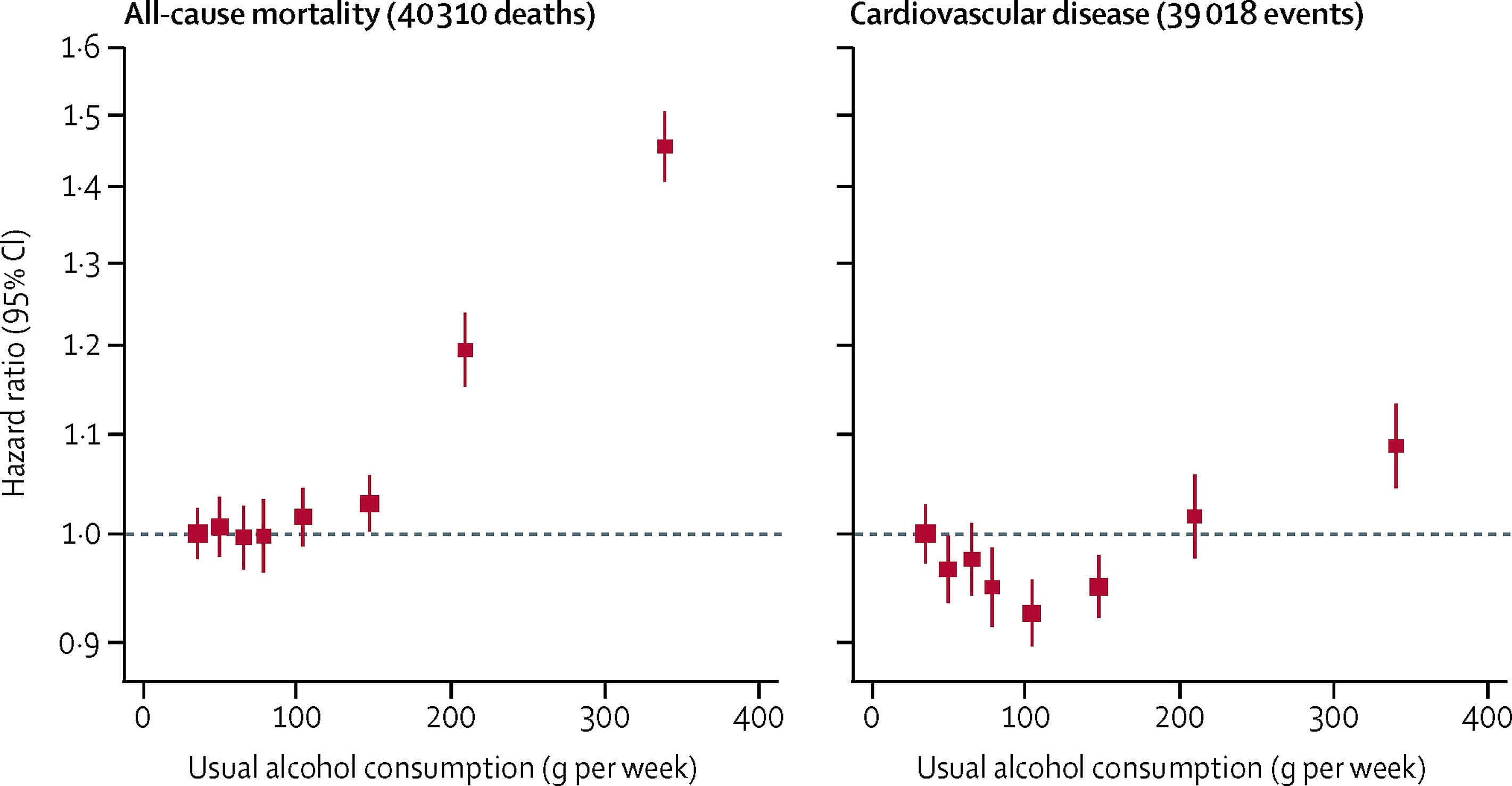
A small amount of alcohol appears to give you slight protection from a few causes of death, notably myocardial infarction, but it's still detrimental to overall longevity. For amounts below 100 grams (~7 drinks) per week, this study of 599,912 people found negligible effects on mortality. But, as you can see in the chart, those negative effects increased steeply above 7 drinks per week. Cutting down from 3 drinks per day to 1 drink could reduce your risk of death by 31%.
Keep in mind that if you don't currently drink, it's not recommended you start, since alcohol is known to be addictive and moderating your consumption might be difficult.
#8: Consider intermittent fasting
- Benefit: +26%
- Scientific Rigor: 1/3
Caloric restriction is one of the most effective and persistent methods of extending life across every species of life ever studied. Humans, however, have not been equally proven to live longer simply by reducing calories. There are some studies showing probable positive effects, such as the people who eat less in the Japanese islands of Okinawa, and across studies of fasting, which is a little different from calorie restriction. The best study Guava Health found wasn't as thorough as hoped because it studied only 2,714 people and they were all recovering from a surgical procedure. But, it did show a very substantial reduction in mortality for those who routinely fasted for 5+ years compared with those who didn't fast.
#9: Don't consume too much sugar
- Benefit: +23%
- Scientific Rigor: 2/3
This study found that consuming only 10% of your daily calories as sugars compared with 20% or more offered a 23% reduction in mortality. The authors also found that it was more helpful to reduce sugar in beverages than it was in solid foods. Similar to avoiding excess sugar, avoiding high glycemic index foods can also be helpful to your longevity. Basically, eat more of the stuff like nuts and vegetables that don't give you an instant dump of energy.
#10: Minimize processed meat
- Benefit: +19%
- Scientific Rigor: 3/3
Of all the meats you can eat, fish is one of the best for longevity, while red meat and processed meat are among the worst. That's a generalization, of course — some fish are much healthier to eat than others (wild salmon is great), and the quality of red meats can vary significantly. The study Guava Health chose shows the biggest offender to be processed meat by far, but also indicates red meat is slightly harmful on average. So the official recommendation here is to avoid processed meat when you can, and either avoid red meat or be sure it's high quality.
#11: Avoid bad air quality
- Benefit: +17%
- Scientific Rigor: 3/3
Bad air can come from many sources, including polluted cities, factories, forest fires, and high-heat cooking. Basically, it's not healthy to burn stuff and then breathe it in. A massive study on U.S. cities found that each 10 µg/m3 decrease in PM2.5, a common measure of air pollution, reduces your mortality by 17%. This amount of reduction or more could be achieved by moving from a polluted city or factory to the suburbs. You can easily find your neighborhood's current PM2.5 measurement online. If you're in one of the world's most polluted cities, your potential benefit could be much higher than 17%. And if you don't plan on moving, you can also use an air purifier in your home and office, and use a car with HEPA filters to help minimize your exposure.
#12: Consider drinking coffee — even decaf
- Benefit: +15%
- Scientific Rigor: 3/3
Before modern science began adjusting for confounding factors, researchers used to think that coffee increased death rates. In reality, coffee drinkers were just more likely to also smoke cigarettes. After adjusting for this, recent studies show a non-trivial reduction in mortality for moderate coffee drinking of 2-4 cups per day. Furthermore, the improvement appears to remain even if you're a slow metabolizer of caffeine, which is something you can test for with popular genetic test kits. Note that it's coffee studied here, not caffeine. Decaffeinated coffee has shown similar results.
Remember, caffeine is a drug and is often addictive. It can be beneficial, but can also cause serious effects on your body, particularly at high amounts, so consult your doctor if you're unsure.
#13: Eat 5 servings of fruits and vegetables per day
- Benefit: +13%
- Scientific Rigor: 2/3
More servings of fruits and veggies were associated with lower mortality, plateauing around ~5 servings. Notably, this does not include starchy veggies like corn, peas, and potatoes, nor does it include fruit juices. Increasing from 2 to 5 servings per day is what showed the 13% benefit being highlighted.
#14: Sleep 7-9 hours per night
- Benefit: +11%
- Scientific Rigor: 3/3
Many studies, including this meta-study, show increased mortality if you sleep too little. One difficulty is they had to combine different definitions of "short sleep" ranging from 4 to 7 hours, but the overall result was that staying above ~7 hours reduced mortality. A curious result of their study was that long sleep was even worse than short sleep. Somewhere in the range of 7-9 hours looked optimal for most studies, and although the studies were based on survey answers and couldn't measure it, it's common to recommend 7 hours of time actually asleep and not just laying in bed.
#15: Consider metformin
- Benefit: +7%
- Scientific Rigor: 3/3
Normally a drug targeting a specific disease would not be included in a longevity cheat sheet built for everyone, but metformin is a notable exception. In studies meant to understand its effectiveness at improving diabetes, the researchers were surprised to find that metformin reduced death from all causes for diabetics, even beyond non-diabetics, by 7%. This suggests that non-diabetics could benefit by even more than 7% by taking it. However, metformin is a prescription drug in the U.S., so Guava Health only recommends considering it through talking with your doctor, or other legitimate pathways if you live outside the U.S.
Bonus: Drinking more water doesn't seem to help
- Benefit: +0%
- Scientific Rigor: 1/3
Strangely, no correlation was found between the amount of liquids consumed in a day and mortality. We all know that you'll die within days if you stop drinking water, but perhaps the negative effects only appear with extreme dehydration, whereas all the study participants had full access to water.