Northwell Health
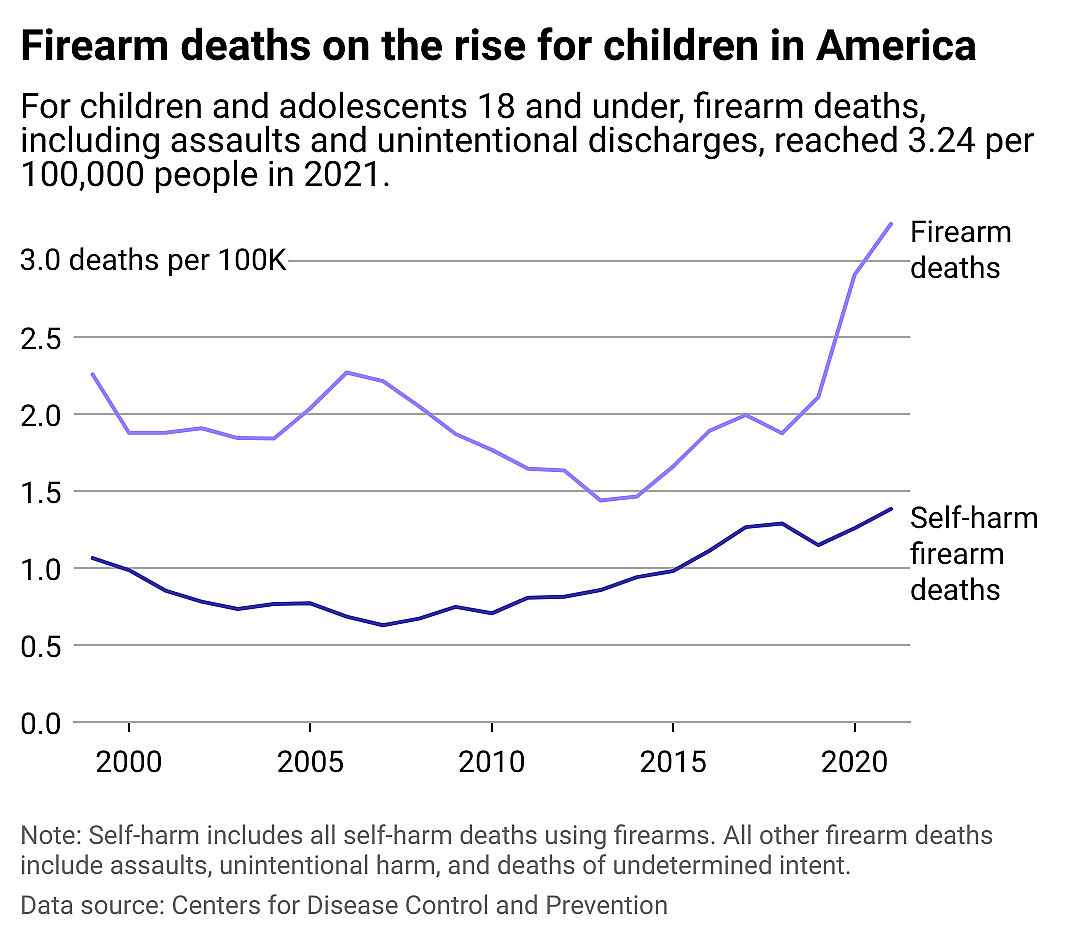
1 / 1Firearms are the leading cause of death among children
A 2023 study in the journal Pediatrics found that gun-related injuries are the leading cause of death for young people in the U.S., with firearm homicides having a disproportionate impact on Black children. The study, led by researchers at Northwell Health's Center for Gun Violence Prevention, also found that childhood firearm deaths continued to increase after a spike in 2020 with growing disparities in Southern and Midwestern states. Across the U.S., preparing for the worst has become a way of life for many American children.
In a recorded 2023 talk with Dr. Megan Ranney, dean of the Yale School of Public Health and a leading gun violence researcher and emergency physician, she said she realized her daughter was always wearing sneakers to events. When Ranney asked her why, she said, "You never know when you're going to have to run." Ranney's son also showed her how in preschool they had learned "turtle time," where one crouches down to take cover and remains quiet.
Studies show that active shooter drills, which now happen in almost all schools, may increase anxiety, stress, and depression symptoms in children and adolescents.
Regardless of whether their child has been exposed to gun violence, parents' stress levels are also high. A Pew Research Center survey found that about 1 in 3 parents with children in grades K-12 were "very or extremely worried" about a shooting taking place at their children's school.
The Health Affairs study found mothers and fathers had more than four and five times, respectively, the rate of psychiatric disorders than families who hadn't experienced gun violence. Siblings of young people who died from gun violence had twice the rate of psychiatric disorders. A lead researcher of the study at Harvard Medical School, Dr. Zirui Song, hypothesized the cause of this finding, telling NBC News: "Siblings may be staying in their rooms on the phone and on the internet, avoiding social interaction, coping in a way that may not be healthy and is less visible to the health care system."
Mothers were also found to be slightly less likely to see a doctor for routine care following the incident, perhaps neglecting preventative or nonurgent care.
The risk for PTSD symptoms increases as a person relates more strongly to the event or the person injured, called psychological proximity. Thus, not only do familial links to gun violence carry psychological burdens, but physical proximity does too, according to an analysis of 44 school shootings. A study published in JAMA Pediatrics found that children and teens living within four to five blocks of a shooting were more likely than others to use an emergency room for mental health concerns.
The media narrative that mental health issues cause gun violence is oversimplified and overstated, according to research. Rather, according to a large-scale study, the risk of a person living with mental illness becoming a victim of violence is exponentially larger than such an individual committing assault.
Factors that are more closely linked to perpetrating gun violence are having experienced trauma and violence as a child, being a young person and male, living in neighborhoods with higher rates of violence, and exhibiting low levels of impulse control. Importantly, having easy access to a firearm increases the risk of firearm injuries, particularly in the home, and increases the risk of suicide deaths in children and adolescents.
In 2017, there were 67 million more guns owned by civilians than people in the U.S., according to Small Arms Survey data. According to Pew, about 2 in 5 American adults live in a household with a gun, and the most recent survey of its kind on firearm storage practices in the U.S. found that 4.6 million children live in homes with at least one unlocked and loaded firearm.
Between January 2019 and April 2021, over 7 million Americans bought firearms for the first time. Americans are becoming armed as the country becomes more deeply divided and gun violence becomes more commonplace. Some buy because they know others have them too. But in high-violence communities, it's more likely that people own firearms because they feel unsafe, expect to become victims, or doubt the police will protect them, according to Arizona State University's Jesenia Pizarro, Ph.D., an associate professor of criminology and criminal justice, in an interview with Social Work Today. "It becomes a never-ending cycle. Violence begets more violence," Pizarro said.
The links between easier access to guns, greater numbers of gun purchases, and increases in gun deaths are starkly illustrated in an analysis by The Washington Post.
Overall, while the study published in Health Affairs offers a pixelated picture of the many harms afflicted by firearms, it's still major progress for advocates and researchers in the field since the impact of the Dickey Amendment lifted. Dr. Ranney told STAT News: "In the mid-2000s, you could not find the word firearm or gun on the Centers for Disease Control and Prevention webpage. … We'll be able to measure and see whether we actually made a difference, which will lead to more research and hopefully to improvements in outcomes."
Story editing by Shannon Luders-Manuel. Copy editing by Paris Close. Photo selection by Clarese Moller.