Nursing Homes
1 / 1How states are responding to rising care costs
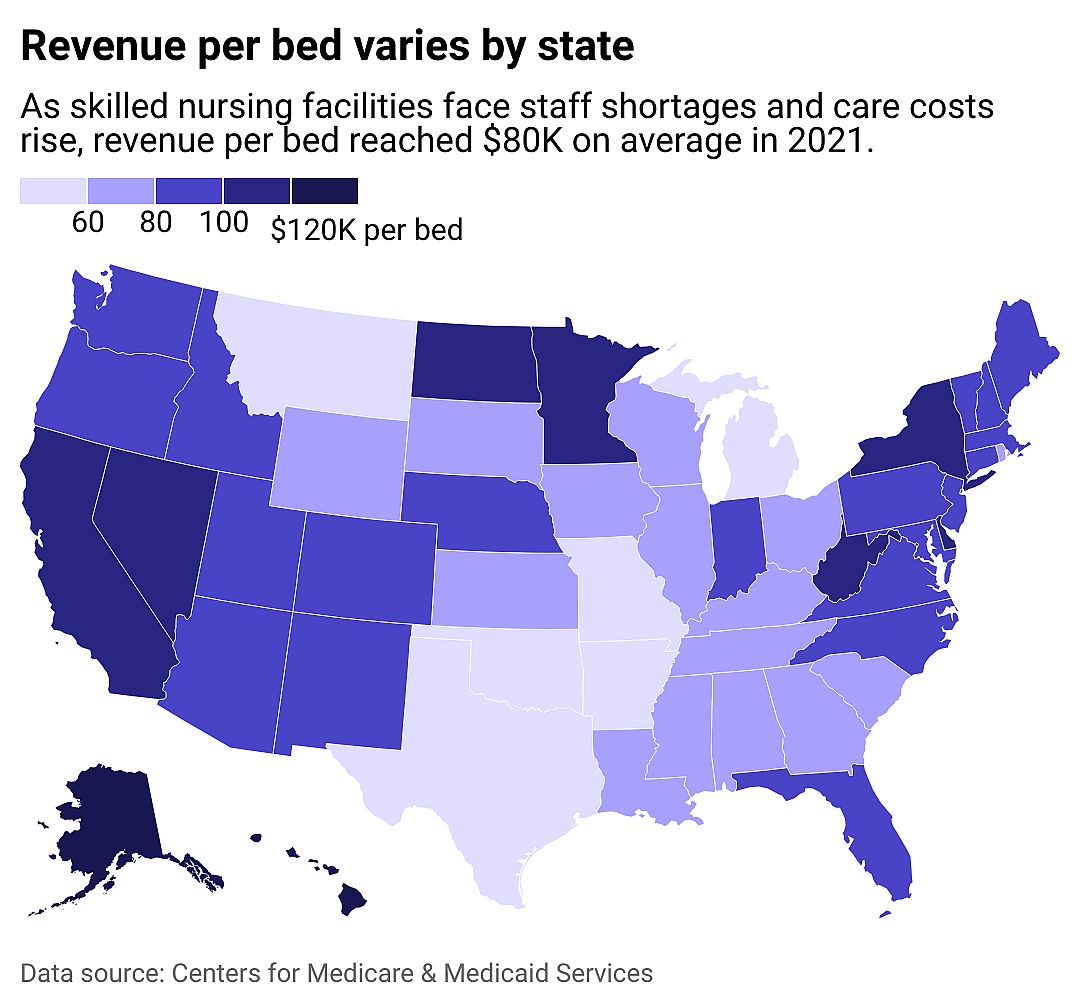
The cost of care in SNFs varies widely across the nation. Alaska has the highest health care costs in the nation, in part due to the state's low population and subsequent smaller pool of trained medical professionals. Facilities in rural communities may also end up paying much more for utilities like electricity and heat, and costs can be higher if they need to stay in a hospital.
Alaska also has the fewest skilled nursing beds per capita in the U.S. To help address the growing SNF crisis in America's northernmost state, lawmakers approved a proposal for the construction of a $48 million, 150-bed skilled nursing facility in Anchorage in the spring of 2023.
Like Alaska, SNFs in Hawaiʻi are likely so expensive because many basic necessities like utilities and food tend to be more expensive on the island than on the mainland. Hawaiʻi also has a severe shortage of health care professionals of all kinds, especially nurses. A 2021 report from the Hawaii State Center for Nursing found that the state had roughly 300 to 400 fewer nurses than necessary to meet demand.
To counter rising costs, representatives in Hawai'i and Alaska are pushing for the adoption of the Equitable Payments for Nursing Facilities Act of 2023. If passed, the act would authorize a cost-of-living adjustment for SNFs in states with notably higher operating costs.
New York, Washington D.C., and Delaware also came in near the top of the list; the reasons for their high costs are harder to tease out. However, one major challenge facing SNFs is a nationwide nursing shortage.
New York alone is expected to face a shortage of nearly 40,000 nurses by 2030. The cost of staffing SNFs has also increased by 20% over the last two years, up from 12% the previous year. This sharp increase may be due to staffing shortages among the many medical professionals employed by these facilities, including registered nurses, physician assistants, and physical therapists. Part-time certified nursing assistants who provide crucial services in SNFs are also experiencing high turnover rates, which may point to facilities offering too few or too many hours.
Despite the financial and logistical obstacles facing SNFs, there are signs of improvement on the horizon. Government spending bumps, like those recently introduced by CMS, will help reduce the cost burden for some people seeking care and help stabilize SNF bottom lines.
Occupancy rates in SNFs are also rising steadily. What's more, if the Equitable Payments for Nursing Facilities Act is passed, it could help to standardize costs across state lines.
Health care researchers are also testing new ways to provide care in places lacking sufficient skilled nursing facilities. In one ongoing study, researchers from the UMass Chan Medical School are examining the feasibility and efficacy of providing at-home, post-hospital skilled nursing care to 650 patients.
As the population ages, Americans will need more care—and more solutions.
Story editing by Alizah Salario. Additional editing by Kelly Glass. Copy editing by Kristen Wegrzyn.