
TurboTenant
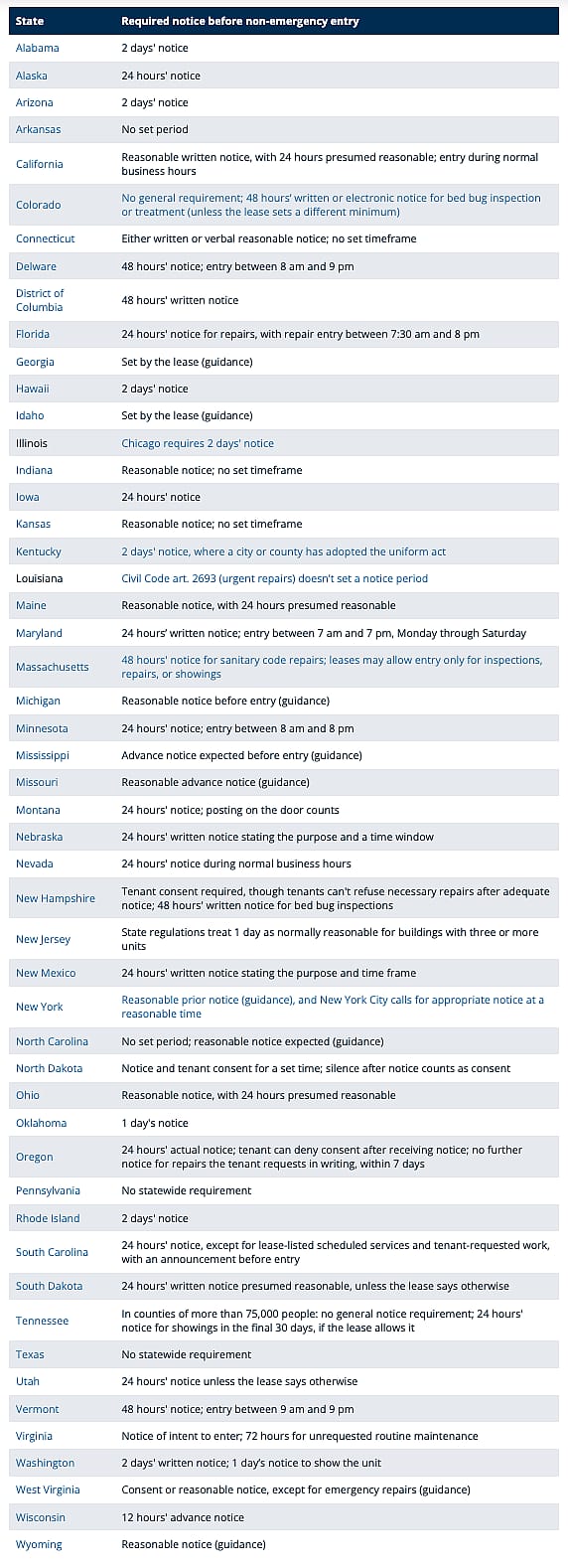
1 / 1How state landlord entry laws compare across the country
Emergencies are the near-universal exception to advance notice requirements, though the exact definition of an emergency may vary. For example, Arizona and Delaware allow landlords to enter at any time in an emergency, while Vermont requires a reasonable belief that a person or property is in imminent danger.
Legal disclaimer: Treat the numbers in this table as baselines. Several only mark what the law presumes is reasonable notice, and some statutes define non-emergency exceptions, like repairs the tenant requested, that the table doesn't list.
Rows marked "guidance" come from state agency, court, bar, or legal aid guidance rather than a statute that sets a notice period. Ideally, landlords should give a little more warning than the minimum and say plainly why they're coming and when they'll be there. A tenant who knows when the plumber is due can plan around the visit, and extending that courtesy costs the landlord nothing.
What Landlords Should Hand Over on Move-In Day
Landlord customer service starts the day the keys change hands and a tenant moves in. A smooth transition sets the tone for the whole lease, and a detailed onboarding process helps a landlord avoid phone calls about where to pay rent or how to shut off a leaking water pipe.
On the first day of the lease, the tenant should walk away with:
- A signed lease, including how to submit maintenance requests and which problems count as emergencies
- A dated condition record with photos that the landlord and tenant both sign
- The locations of the water shutoff, the electrical panel, and the furnace filter
- A phone number that reaches an actual person who can answer their questions
- The rent due date, the grace period, and accepted payment methods
A filled-out condition report earns its keep at move-out, once the security deposit is on the line. Dated photos let both sides confirm whether damage occurred during the tenancy or was already there when the tenant moved in. These documents can make all the difference in small-claims or eviction court.
Rejecting Unreasonable Tenant Requests
Even the most attentive landlord has limits, and sooner or later they'll have to turn down an unreasonable tenant request. Even when a landlord has good reason to refuse a tenant's request, they should explain the decision respectfully, as a careless refusal could raise concerns about retaliation or fair housing violations.
Putting each step of a refusal in writing gives a landlord something to point to if the tenant pushes back. Here's how to properly decline a request and document the decision:
- Acknowledge the request the day it comes in and note the date in writing.
- Restate what the tenant asked for (using their own words), so the answer responds to what they actually requested.
- Give the decision and the reason in writing, pointing to a specific lease clause or law.
- Name what will happen instead (if anything) and by when.
- Follow up on the date named to confirm the matter is closed.
Getting the dates right matters for legal reasons, too. California, for instance, protects tenants from landlord retaliation after they organize or file complaints, and its main rule covers the period up to 180 days after a tenant makes a good-faith habitability complaint or repair request.
During that timeframe, a landlord can't retaliate against a tenant who's current on rent by raising the rent, cutting services, pushing the tenant to move out, or otherwise attempting to take back the rental property. A dated paper trail of every rent increase and tenant message gives a landlord something concrete to show if a retaliation claim comes up.
Rent Increases and Lease Renewals
A rent increase or upcoming lease renewal often influences whether a tenant stays or moves out, so for a landlord it can be a make-or-break moment for tenant retention. Though household mobility fell to a record low in 2024, a tenant weighing a renewal is still a customer deciding whether to buy again, so those conversations take some finesse.
Landlords need to price a rent increase high enough that they still earn money from rent, but low enough that the tenant doesn't feel compelled to move out.
A move-out brings turnover costs like cleaning and painting, marketing, a new round of screening, and lost rent while the unit sits empty. Vacant rentals nationwide had a median asking rent of $1,531 a month in the second quarter of 2026, so one empty month at that rent means $1,531 in lost income before counting any cleaning or marketing bills.
When it's time to raise rent, landlords should send a rent-increase notice stating the new amount and effective date so the new number doesn't catch the tenant off guard. The notice must also go out as far in advance as state and local law requires.
Landlord Customer Service Is Worth Getting Right
Whether a landlord owns one unit or dozens, the tenant is the customer, and the landlord is responsible for the service they receive from move-in to move-out. When that service slips, the cost usually shows up as tenant turnover, or disputes that better attention to detail could have prevented. When landlords get it right, dependable customer service pays off through lease renewals and fewer vacancies.
Dialed-in landlord customer service also starts with smoother processes before a tenancy begins. A reliable tenant screening approach helps landlords place solid renters, and a property management system with an intuitive dashboard saves landlords from rummaging through old texts to find an important document.
Once a tenant moves in, repairs offer another chance to get the details right. Before entering the unit, landlords can look up their state's entry rule in the table above, check whether their city adds its own, and make sure the lease's entry provisions comply with both.
Landlords should also log every repair request with the date it arrived and the date the work was finished, then follow up with the tenant once the work is completed. That kind of thoughtful follow-through shows tenants their concerns matter, which is ultimately what good customer service is all about.