Lendio
1 / 2How the ERC works
The Employee Retention Credit is a refundable tax credit for qualifying employee wages. The credit is based on payroll taxes rather than income taxes, so you can still receive the credit even if you paid no income taxes in 2020 or 2021.
The best part is because it is refundable, it's possible to receive money back beyond what you originally paid in payroll taxes. So if you qualify for $50,000 under the ERC, but only paid $10,000 in payroll taxes, you would still receive the full $50,000 refund from the IRS. Bear in mind there is a small non-refundable portion of the ERC that is limited to the amount you actually paid in employee Social Security and Medicare taxes.
How much money will my small business get from the ERC?
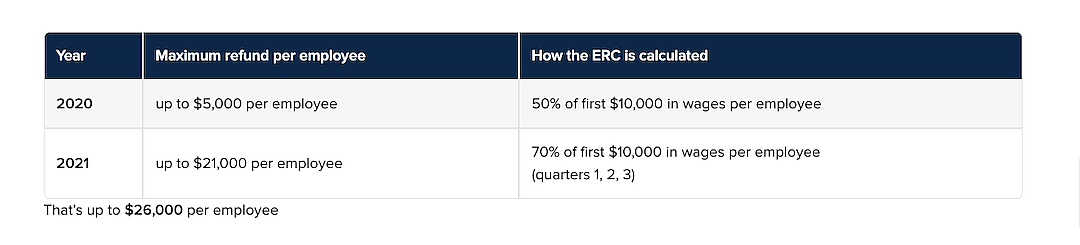
For tax year 2020, eligible small businesses can claim 50% of the first $10,000 in wages per employee through the Employee Retention Credit. This adds up to a maximum of $5,000 per worker, and you can apply for this credit now in 2023.
For the first 3 quarters of 2021, eligible small businesses can claim up to 70% of the first $10,000 in wages per quarter for each employee. This amounts to $21,000 per employee.
In total, a small business could potentially receive $26,000 in credits per employee kept employed through 2020 and 2021. Keep in mind that the IRS defines certain health care expenses as part of an employee's wages.
Is my small business eligible for the ERC?
While businesses of all sizes can benefit from ERC, the program favors small businesses over larger employers. You can find out here if you qualify for the ERC and the fastest way to claim your credit.
Number of full-time employees
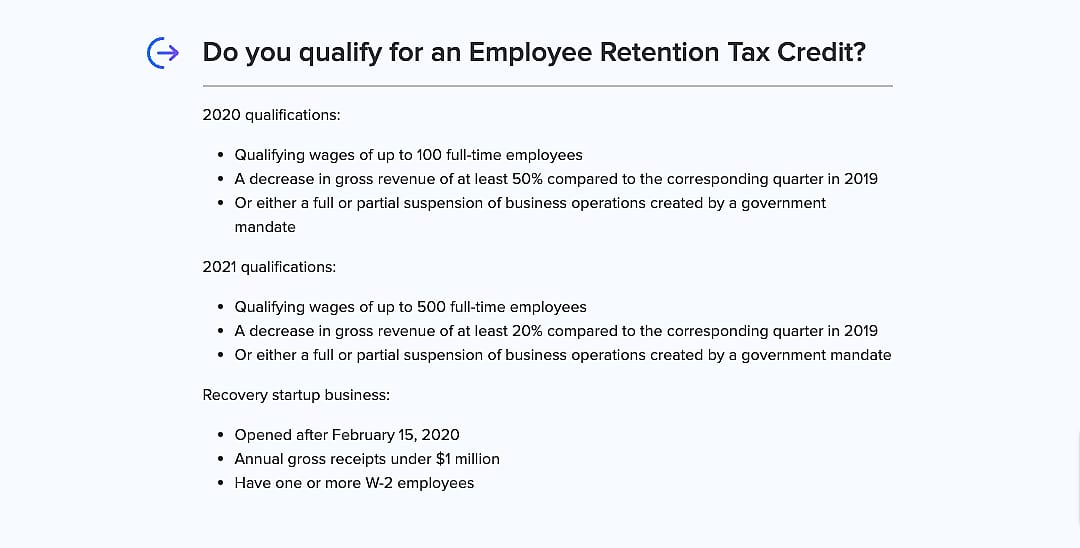
For tax year 2020, a small business is defined as a business that averaged 100 or fewer full-time monthly employees in 2019. For tax year 2021, the definition is expanded to include businesses that averaged 500 or fewer full-time monthly employees in 2019.
Larger employers can claim the ERC but only for wages and some healthcare costs paid to employees who did not work.
For small businesses, you can claim the credit for all employees whether they worked or not.
Government-mandated full or partial suspension
Now, to be eligible for the ERC, your business must have been impacted by either a government-mandated lockdown or a decrease in revenue.
If your business was impacted by a full or partial suspension of operations because of a government COVID-19 order during any quarter, you can qualify. This includes restrictions on hours or capacity. This area of eligibility criteria is complex, so work with a vendor who is familiar with government orders, their impact, and the timeframe they were enacted.
A few examples of a qualifying business include:
- A business that was ordered to fully suspend operations
- An essential business that remained open but had government-mandated limited hours or capacity, such as a restaurant that could use fewer tables.
- A business whose suppliers experienced shutdowns and were unable to make deliveries
- A business that had to shut down a portion of the business due to government mandates
Significant decline in gross receipts
Your business can also qualify if it experienced a "significant decline" in gross receipts as defined by the IRS. For tax year 2020, a significant decline means gross receipts for a quarter are less than 50% compared to the same period in 2019. For the first 3 quarters in 2021, it means quarterly gross receipts are less than 80% compared to the same period in 2019.
For the first 3 quarters of 2021, if your business did not see a 20% decline in gross receipts compared to 2019, businesses can also elect to use the immediately preceding quarter for comparison. This means that if a business's Q2 of 2021 isn't eligible compared to Q2 of 2019, it can instead use Q1 of 2021 and compare it to Q1 of 2019 to meet eligibility.
Recovery startup business
If you have a newer business, the ERC was amended in 2021 by The American Rescue Plan to even let you gain access. So-called "recovery startup businesses" can apply for the credit for Q3 and Q4 of 2021. Recovery startup businesses are defined as ones that opened after February 15, 2020, and have annual gross receipts under $1 million. As long as you meet these two criteria and have one or more W2 employees, you don't have to meet the other eligibility requirements. The maximum a recovery startup business can receive is $50,000 in ERC per quarter.