Automoblog
1 / 2People did move from bigger cities to smaller ones
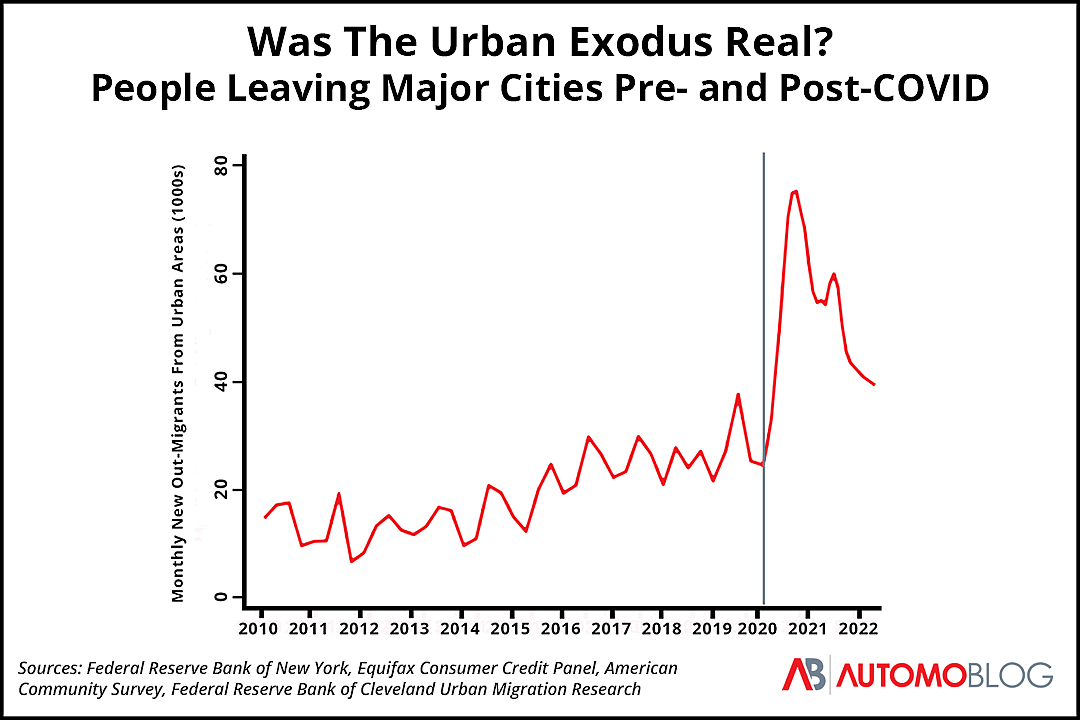
Over the last three years, the narrative that people left big cities to move to smaller neighborhoods during and after COVID-19 circulated widely in major U.S. media outlets. While there are nuances to that narrative, the fundamental conclusion has some validation.
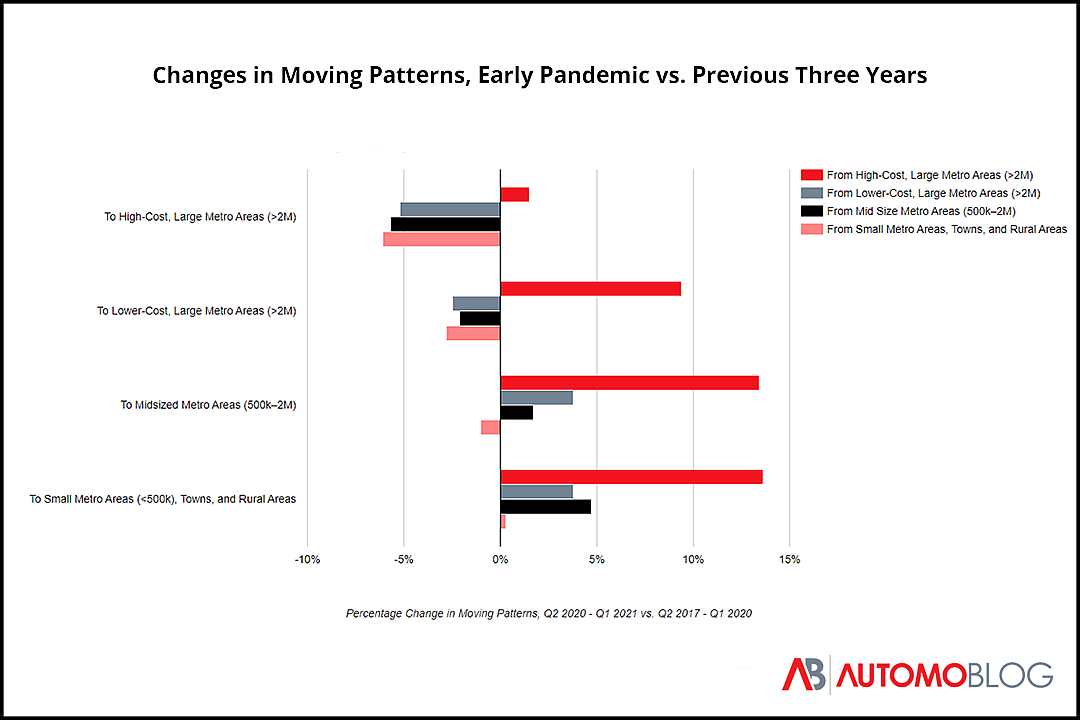
The Federal Reserve Bank of Cleveland conducted a periodic study on the topic, collecting and synthesizing data from the Federal Reserve Bank of New York Consumer Credit Panel/Equifax Data, American Community Survey, National Association of Realtors, and other entities. The Q1 2021 edition of the study compared "migrations" from the first year of the pandemic to those of the three years prior.
The study defines four categories of locales:
- High-cost, large metropolitan areas with populations greater than 2 million (hereto referred to as "large expensive metros")
- Lower-cost, large metropolitan areas with populations greater than 2 million (hereto referred to as "less expensive large metros")
- Mid-size metropolitan areas with populations between 500,000 and 2 million (hereto referred to as "mid-size metros")
- Small metro areas with populations of fewer than 500,000, including rural areas and towns (hereto referred to as "smaller cities, towns, and rural areas")
Between Q2 2020 and Q1 2021, smaller cities, towns, and rural areas experienced an increase in move-ins from every other category compared to the previous three years. These areas also saw the largest increase in move-ins – at 13.6% – from large, expensive cities of any category.
Mid-size cities saw a decrease in move-ins from smaller cities, towns, and rural areas in the first year of the pandemic. Yet they saw an increase from every other category, including a 13.4% increase in move-ins from large, expensive cities.
Professionals say the data aligns with their experience
The data paints a relatively clear picture of these moving trends. However, that picture can often be incomplete when based on data alone.
Savov's job has given him unique and direct insight into moving patterns in the U.S. When we spoke to him, he told us that his personal experience and his company's data more or less lines up with what the research found.
"We saw an increase in shipments to older towns and cities, as well as more remote locations throughout the country," he said. "This was likely due to the desire for more space and distance from others during the early stages of the pandemic."
The trend is something real estate agent Yannick Lloyd can attest to. Lloyd is based in North Carolina's "Triangle" region – an area that includes Chapel Hill, Durham, Raleigh, and several smaller towns and suburbs in between. The Triangle was one of several less expensive large metros that saw significant growth in the early stages of the pandemic.
As a real estate agent, Lloyd works closely with people who move into the area. This gives him a more intimate insight into why people made the decision to move to the Triangle. He said that for most people, cost was one of the biggest driving factors.
"Relocation [to the Triangle] from larger cities has definitely increased in recent years," Lloyd told Automoblog. "Economic shifts made people reconsider the value of larger cities. Affordability is still a large selling point for the Triangle. Although prices have increased in the area, homes in the Triangle are much more affordable than larger cities in the Tri-State Area and the West Coast."
Move outs also provide insight
There was an increase of 9.4% in moves to less expensive large cities from large, expensive cities during the period. However, move-ins from every other category decreased.
But the story isn't just about where people from larger cities were moving to during the period, it's also about where they were not moving to these cities from. There was a slight positive change in moves from high-cost large metro areas with populations greater than 2 million to other metro areas in that category.
However, there was a significant drop in moves to large, expensive cities from every other category. This includes a 6.1% decrease in the number of people moving to these cities from smaller cities, towns, and rural areas.
Savov said that his internal auto shipping data supports this part of the narrative as well. "This trend [of increased shipments to towns and rural areas] continued for much of the year [2020], with many individuals and families seeking out less crowded areas to live and work in."
Lloyd pointed out that many of these moves have been made possible by the ability to work from home. He said that this newfound capability, combined with rising costs, has made moves out of big cities an attractive option for many people.
"More people have had the freedom to work remotely since the pandemic," said Lloyd. "Cost of living has become a priority since 2020 due to inflation."
The narrative of an "urban exodus" is complicated
This set of data compiled by the Federal Reserve Bank of Cleveland from the first year of the pandemic provides a compelling argument for the popular narrative of an "urban exodus," but it doesn't tell the whole story. Another way journalists and researchers track moving data is through monitoring U.S. Postal Service change-of-address forms.
This data adds an important facet to the story. While it indicated a slight uptick in the submission of permanent change-of-address forms, it also revealed a far greater increase in the submission of temporary change-of-address forms.
These trends suggest that many of the moves that happened in the first year of the pandemic were not permanent moves. So while people were leaving large, expensive cities, many of them were doing so with the idea that they would return.