The Hechinger Report
1 / 1Finding a future focus for humanities
"What I was observing around me in Silicon Valley and more generally was a world that was missing that story," said Virginia Tech's Jaitly, a former technology entrepreneur and founder of a venture capital firm whose own undergraduate degree was in history. "The superpowers of the future emanate from the humanities: introspection and imagination, storytelling and story-listening, critical thinking."
He purposely picked "leadership" instead of "humanities" for the name of the program, he said. "To me, 'leadership' is a high-impact word to show and not tell the power of the humanities."
With a $1.25 million grant from the Mellon Foundation, Emory University is helping faculty members redesign humanities courses to emphasize their relevance, said Barbara Krauthamer, dean of its College of Arts and Sciences. "We're not denying the reality of career readiness, of real-world application and of the context of the world we live in now, which is increasingly technological and changing rapidly," Krauthamer said.
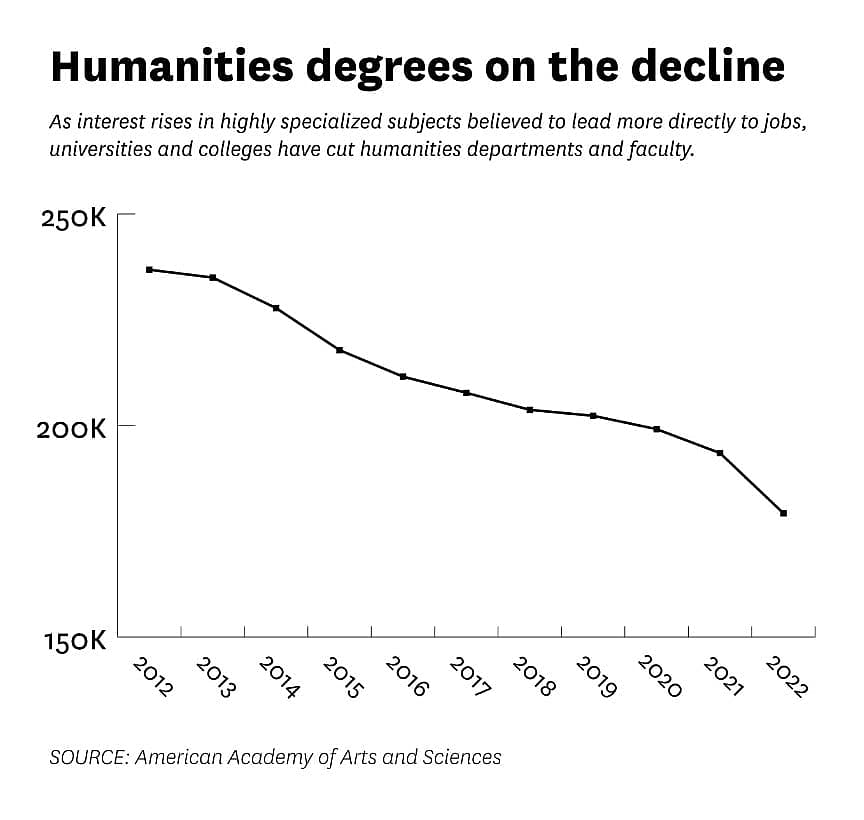
Central Michigan University in the fall began to offer a bachelor's degree modeled on the University of Arizona's, in "public and applied liberal arts." It was added after the number of incoming students there who listed their intended majors as English, humanities and foreign languages fell from 179 in 2019 to zero in 2022 and 2023, according to university figures.
That trend "has a lot to do with the fact that even at a regional public [university], you need to know how you're going to pay the bills after you're done," said Christi Brookes, assistant dean of the College of Liberal Arts and Social Sciences. "It's a question we've ignored."
The new degree connects humanities courses with the "applied fields" of entrepreneurship and environmental studies. Future combinations are planned with fashion and game design.
The traditional argument for the humanities, Brookes said, has been, " 'Well, it will make you a better citizen and person.' But what was left out was, 'What does that look like on a day-to-day basis?' What we're trying to do is say, 'Here's the connection.' "
Another way some universities are doing that is by showcasing the successes of former humanities students.
The liberal arts college at Georgia Tech serves up a litany of alumni success stories on its website. Arizona's College of Humanities has produced a video of graduate testimonials; it features a senior counsel at Netflix, a principal investigator for the first NASA mission to return rock samples from an asteroid, the head of corporate strategy at the meal-delivery service Blue Apron, a diplomat, a Broadway actor and Golden State Warriors head coach Steve Kerr.
When they see examples like these, "You can see the parents visibly relaxing," said Judd Ruggill, head of Arizona's Department of Public and Applied Humanities.
The video is part of a relentless recruiting effort here, which ranges from a pop-up "humanities cafe" on the campus mall where faculty and advisers mingle with prospective majors to a mandatory two-day recruitment workshop training graduate teaching assistants to pick out humanities prospects among the students in required general-education courses. "Talent-spotting," the college calls it.
"I think they know we need that push," said senior Liliana Quiroz, who added Italian to her anthropology major after being prodded by a faculty member. Even then, she said, "My parents didn't quite understand the benefits. There wasn't that understanding of the skill sets that represented."
But when she got an internship in a marketing department, she realized her humanities experience made her "confident enough to figure it out as I went." She used self-reliance she learned taking on the challenge of a new language, Quiroz said, and analytical skills she developed reading literature in the original Italian.
Howe, the University of Arizona French and business double major, may not have initially thought French would help her get a job. She simply liked it and wanted to improve her skills — something else that advocates of the humanities say is being lost as colleges keep dropping these programs.
"I definitely discovered ways that it helped me in my finance career later on, but at the outset it was my passion that drove me to French," she said.
Fellow senior Peyton Broskoff combined business administration with applied humanities. She also took a humanities course for which she teamed up with other students to revitalize a community library. That taught her "intercultural competence — just being able to understand and work with people." It will help her in a future job, she said. "If you can market to different people, that means you can sell more products."
Arturo Padilla signed up for a joint program in religious studies for health professionals. The son of indigenous Mexican parents, he plans to use what he is learning to combine traditional wellness and healing with modern medical practices.
Maxwell Eller has gotten something simpler from his major in classics. "It helped my attention span in a world of YouTube and Instagram," said the University of Arizona senior. "I felt my knowledge was pretty shallow. I wanted to wrestle with ambiguities." And learning the grammatical structures of Latin and Greek helped him in his volunteer work teaching English to women in Afghanistan.
While their incomes in the 10 years after graduation are below the median of all college graduates, students who go to liberal arts colleges, over the long term, earn a total of about $200,000 more according to the Georgetown Center on Education and the Workforce.
With little overhead, the humanities are also comparatively cheap to teach. Producing a credit hour in English or philosophy costs only a little more than half of what it costs to produce a credit hour in engineering, a study for the University of North Carolina System by Deloitte and the Burning Glass Institute found.
Still, humanities departments at public universities including Arizona's are funded based on the number of students they enroll, making their recovery a matter of survival.
"At some point, we had to do something," said Matt Mars, a professor in Arizona's Department of Public and Applied Humanities. "If we think innovation is important, then we need to be innovative."
It may take more than that. Some legislators who control the budgets of public universities and colleges have been skeptical of the value of humanities departments, especially those that house such subjects as gender and ethnic studies.
Some humanities faculty also bristle at the idea that their work is relevant only when combined with more career-oriented disciplines, said Durand, at the University of Arizona. "But you have to be aligned with your students," he said.
Younger humanities faculty "get it," Durand said. "They are willing to do interdepartmental collaboration. They know we can't do things the way we always have."
This story also appeared in The Christian Science Monitor