How Jensen Huang’s return may cost Nvidia
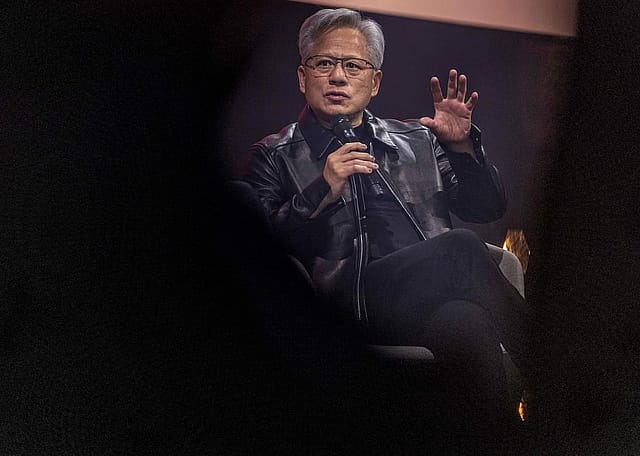
When Nvidia’s board announced that Jensen Huang would return as CEO less than two weeks after he left amid revelations about his extramarital affair with an alleged Chinese spy, the stock market rejoiced. Nvidia stock soared more than 30% on Monday, dragging slumping market indexes like the S&P 500, which rose by almost 5% by market close, up with it.
President Donald Trump was quick to claim credit, publicly acknowledging that he pressured Nvidia’s board to bring Huang back. “I’m doing it for the country. I mean, I watched after the election, I watched our country lose $5 trillion,” Trump said in an interview with CNBC on Monday, referring to stock market declines after the midterms. “If I didn’t get involved, you’d probably have a very sad Nvidia for a long time to come.”
It was the latest example of Trump’s affinity for creating short-term gains in the stock market, and investors who bought the dip were rewarded. Nvidia has nearly regained the market capitalization it lost following Huang’s ouster. But investors may be living in the past. Jensen Huang was only gone for 11 days, but he has already soured public perception of Nvidia, made new enemies on both sides of the aisle in Washington, and damaged his trustworthiness as CEO. In other words, Nvidia is not the same company, and Huang is not the same CEO.
On Oct. 29, the New York Times reported that Huang had been the target of a Chinese spy plot centered on his “close relationship” with Alice Huang, an executive at a Singaporean data center company suspected of smuggling chips to China. On Nov. 8, Nvidia’s board of directors announced plans to investigate the alleged Chinese spy plot against Huang. On Nov. 12, he resigned as CEO. Trump administration members began finger-pointing, and lawmakers from both parties promised investigations.
At this point, the story had unfolded roughly how one might expect. Companies sometimes part ways with CEOs following public scandals, because leaders who show a lack of integrity create risks for their firms, Aaron Hill, a professor at the University of Florida who studies CEO turnover, told The Dispatch. “Take infidelity,” Hill said. “That raises a whole bunch of questions on his capability as a leader, his decision-making quality—Can he be trusted?—so that’s ultimately why a lot of times they remove the person.”
Huang’s lack of judgment worsened what economists call the principal-agent problem, the mismatch in incentives between a party delegating decision-making authority and the party making the decisions. In Huang’s case, shareholders want him to maximize Nvidia’s share price, but he failed to do so when he began an intimate relationship with a potentially Chinese Communist Party-linked customer and created major political and business liabilities for the firm. This imposed a cost on Nvidia stockholders. That’s why, from an economic perspective, Huang’s departure could’ve made sense—even if Nvidia didn’t have much of a succession plan afterward.
“The [principal-agent] problem goes away if he’s no longer the agent, but now he’s back,” Hill said. “Even if nothing else comes out, we’ll look at him differently now, right? He’s not the genius. Now, he’s the philanderer.” Future business partners or customers could be more wary of Nvidia, and top engineers or executives may look to work elsewhere, Hill added.
Huang’s return also creates political risks. The Trump administration has not been subtle in claiming credit for Huang’s reinstatement, which has momentarily sent markets climbing. In doing so, it tied Nvidia to a highly unpopular lame-duck administration. It also tacitly showed that Nvidia’s board believes that having affairs with both a customer and a separate subordinate at the company, and then lying about it, is not a fireable offense. A potential Democratic president in 2029 may not be so ready to laugh off Huang’s indiscretions.
“Democrats smell blood in the water, and in many ways, this is the perfect chum,” Ryan Fedasiuk, a senior fellow at the Foundation for American Innovation covering AI policy, told The Dispatch.
The CEO’s reinstatement will also change the way Nvidia operates in Washington, where Huang has been influential in advocating for the sale of chips to China. Huang has said the U.S. should do so to keep China dependent on U.S.-made chips and discourage it from developing its domestic chip capacity. This argument obviously benefited Nvidia’s bottom line, but Washington seemed content not to bother the golden goose of American retirement accounts. In the weeks since the Huang scandal began, though, U.S. lawmakers have already taken steps to tighten export controls on compute. Nvidia has also said it stopped selling some of its AI chips in China.
“The company has made permanent enemies inside of both the Republican and Democratic parties, lost all public trust in its dealings with respect to China and Southeast Asia and global sales, and tied its mast to just one political party,” Fedasiuk said. “It does seem tremendously risky for shareholders in the long run, as there will be an endless series of investigations now implicating not just Nvidia but some members of the Trump administration.”
Huang is already set to testify before Congress in December, but those endless investigations will expand when Democrats take control next year. Senate Minority Leader Chuck Schumer said Monday that “Democrats will wield their full power to investigate” Huang, the Trump administration, and other Nvidia executives. If those investigations turn up further dirt on Huang, Nvidia’s board will lose the ability to say it held its chief executive accountable. And even if Huang did nothing else untoward, a Democratic Congress is unlikely to overlook the fact that a private company allowed government officials to interfere in its board deliberations.
Still, the world’s largest capital markets have declared Nvidia to be 30% more valuable with post-scandal Huang in charge. That may be partly because, while Nvidia could certainly continue to make and sell chips with Huang gone, it doesn’t seem likely that a successor could match Huang’s PR or dealmaking skills. Huang has been key in constructing Nvidia’s web of circular financing deals whereby it agrees to backstop the financing of its own customers while sometimes also investing in those firms, giving it a reputation as the central bank of AI.
Important to shareholders’ consideration is “Jensen’s role as the chief cheerleader, if you like, of AI as a whole and of Nvidia as the central linchpin to that,” Andrew Ward, a professor at Lehigh University who studies corporate governance, told The Dispatch. “To be able to go out and do these deals with all these other companies … speaking at all of these conferences, keeping Nvidia in the spotlight, the political connections, all of that is largely him.”
Nvidia’s recent turbulence has underscored how deeply intertwined many Americans’ finances have become with a single firm. When Nvidia stock sneezed last week, the entire market caught a cold. Huang’s resignation and return reveal a new reality: It’s going to be extremely tough for Nvidia’s board to force Huang out now. Americans are no longer reliant only on Nvidia but on Jensen Huang.
“I just can’t imagine that they can really fire him now,” Hill said. “He’s kind of untouchable.”
This story was produced by The Dispatch and reviewed and distributed by Stacker.