Joel Eastwood // The Markup
1 / 5The Rating Factors Tell All
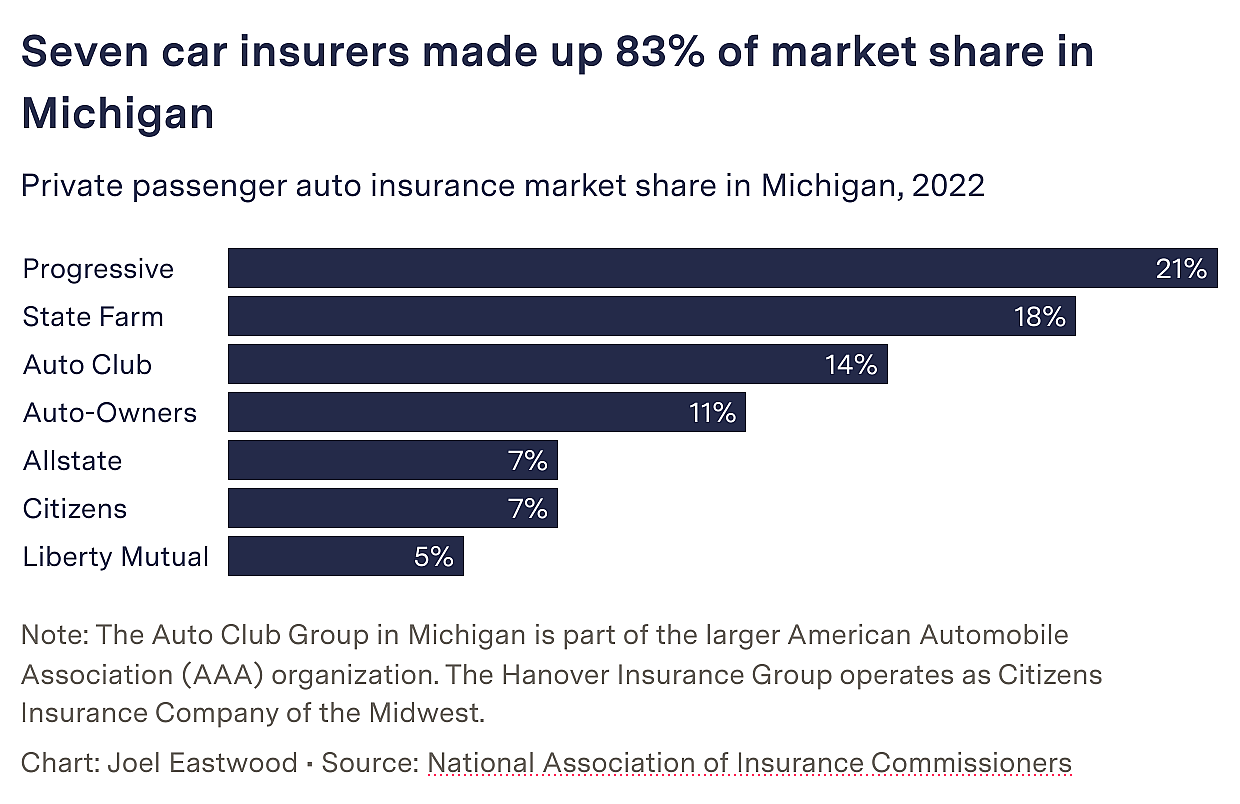
Reviewing over 52,000 pages of rate filings, in which insurers detail how they set premiums for each policyholder, we examined the pricing structures of the seven auto insurance companies responsible for the most personal auto business in Michigan: Allstate, Auto Club, Auto-Owners, Citizens, Liberty Mutual, Progressive, and State Farm. These documents, which insurers are required to file with Michigan's Department of Insurance and Financial Services (DIFS), detail how different policyholder characteristics, called rating factors, lower or raise premiums.
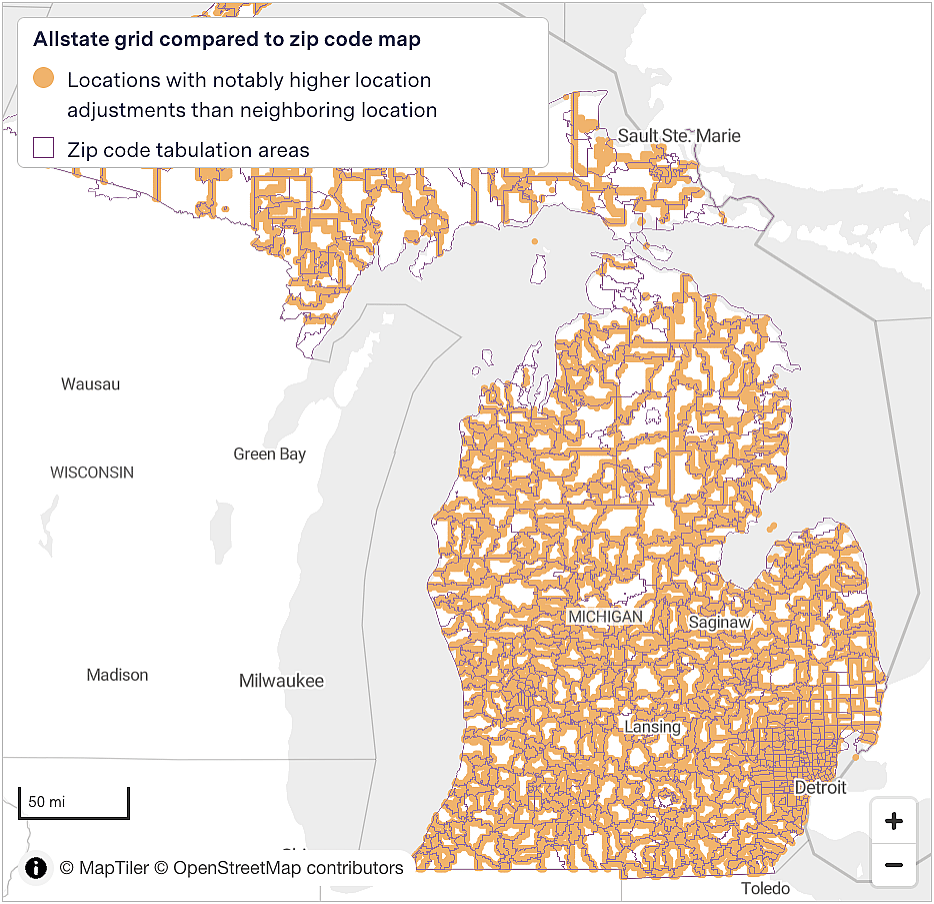
We manually cataloged hundreds of rating factors to identify how each insurer's pricing algorithm took into account a policyholder's location. We calculated a premium rate based solely on location-based factors for each insurer, then compared these rates to each other to weigh how much more or less someone would pay based on where they lived in the state. Our method of isolating the effect of location does not allow us to calculate the final dollar amount drivers saw on their insurance bill. We could, however, use insurers' rating factors to tell us approximately how someone's home address, excluding all other factors, impacted their final insurance premium relative to all other parts of the state.
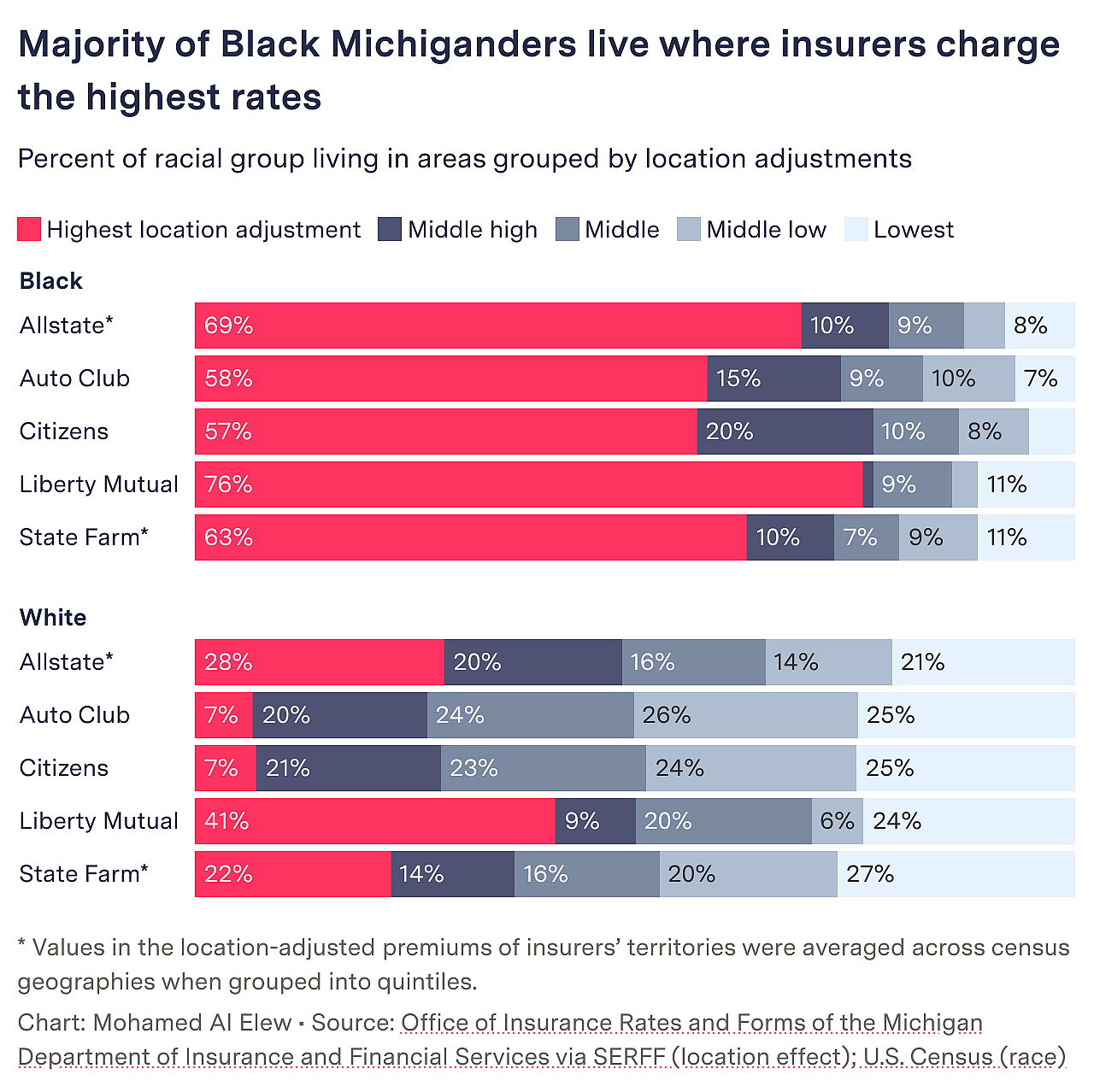
What Alana, Tonya, and Michelle experienced wasn't a fluke. Our analysis showed that for every single one of the state's largest insurers that we were able to evaluate, most Black Michiganders' premiums were dramatically adjusted upward based on where they lived. Averaging across those insurers, nearly two-thirds of Black Michigan residents lived in each company's most expensive 20 percent of the state. Michigan's least expensive locations were, on average, 87 percent white.
In addition to race, we had enough data for three insurance companies to look at income. Despite finding a clear upcharge for drivers living in Black neighborhoods, we did not find a universally clear pattern for drivers living in poorer neighborhoods. While State Farm's pricing algorithm disproportionately charged the highest in poorer areas, Allstate and Liberty Mutual did not.
Prior to publication, we reached out for comment to all seven of the insurance companies whose pricing systems we investigated. The insurers, by and large, ignored our specific questions about rate-setting practices and defended the prices they charged as reflecting the divergent costs associated with insuring drivers from one region to another.
"We believe our pricing accurately reflects the various risks associated with insuring vehicles in different parts of the state," Auto Club spokesperson Adrienne Woodland wrote in a statement.
"We do not utilize, collect or consider information related to an individual's race in underwriting, premium determination or claims settlement practices," Liberty Mutual spokesperson Glenn Greenberg wrote in an email.
Representatives from both Progressive and Citizens directed us to Nicole Mahrt-Ganley, assistant vice president for public affairs at industry group American Property Casualty Insurance Association. "Unfair discrimination in insurance rating—meaning treating consumers with similar risk profiles differently—is uniformly prohibited by state law," she said. "There is a substantial amount of academic research indicating that insurers' use of rating factors does not result in unfair discrimination."
Our investigation is based on a "disparate impact" analysis, meaning we exclusively tested whether the algorithms and policies used by insurance companies resulted in pricing that consistently charged more to predominantly Black areas regardless of whether the racial disparity was intentional. Under the current regulatory system, these rates are all considered to be acceptable, legal practices. Although we did not observe in the documents that we reviewed any references to the racial makeup of an area directly affecting elements in how prices were set, the system has left Black residents of Detroit, the most racially segregated city in the United States, paying more based on where they live.
Laura Hall, communications director for Michigan's Department of Insurance and Financial Services in June 2024, said while the department is unable to comment on any individual company's filings, regulators individually reviewed and approved each of the pricing systems we examined. "On average, DIFS issues nine objections per rate filing, which must be addressed by the company before the product is allowed to be sold to consumers," Hall said.
In Detroit, critics of the city's notoriously steep premiums have pointed fingers at predatory trial lawyers, particularly expensive personal injury protection insurance payouts, and unscrupulous towing companies. "There are full-blown schemes and organizations in Detroit that don't exist in the suburbs," said Eric Poe, CEO of CURE Auto Insurance, who noted that shady fees and related legal costs have cost the company millions, driving up rates for all customers. (CURE is not one of the top seven insurers in Michigan, so it was not part of our analysis.)
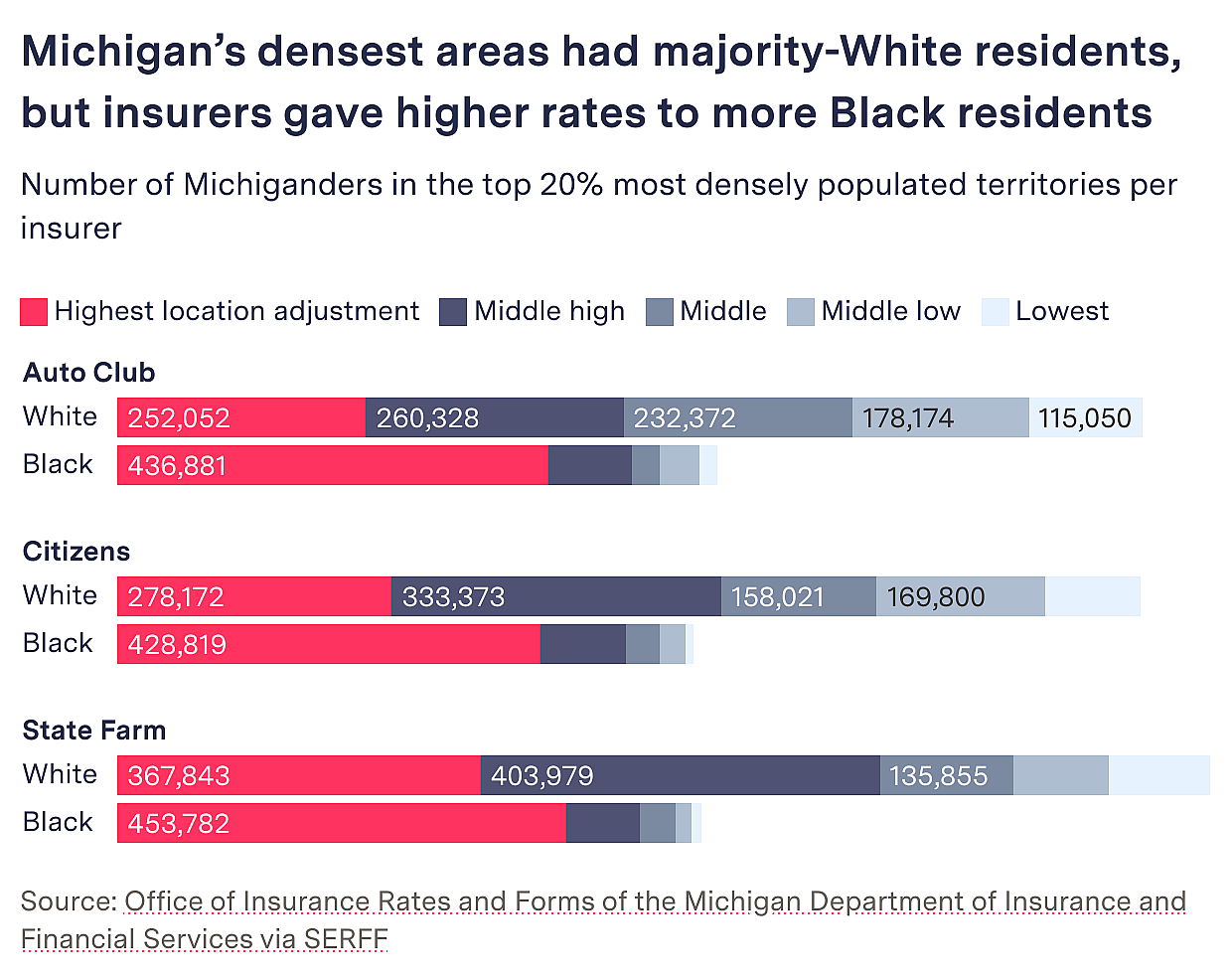
Insurers also told us that population density plays a large role. "Urban areas have a greater population density, along with congested roads and highways," said Woodland, the Auto Club spokesperson, echoing a sentiment shared by Liberty Mutual, Citizens, as well as state regulators. "Increased traffic and pedestrians on crowded roads lead to more crashes and therefore, more claims."