HeyTutor
1 / 1State-by-state breakdown
According to an Associated Press report, the aid to ease the devastation of the coronavirus pandemic was the largest sum of federal money ever sent to elementary and secondary schools. In all, $190 billion poured into districts, beginning in 2020, through the Elementary and Secondary School Emergency Relief Fund. It arrived in three installments, the most recent of which ($122 billion) must be committed by September 2024.
The relief money was expected to pay for programs like summer school, tutoring to help students in danger of falling behind, new teachers, and upgraded air conditioning and heating systems when schools prepared to reopen. But exactly where the money went varied from district to district because Congress imposed few requirements for how it could be spent.
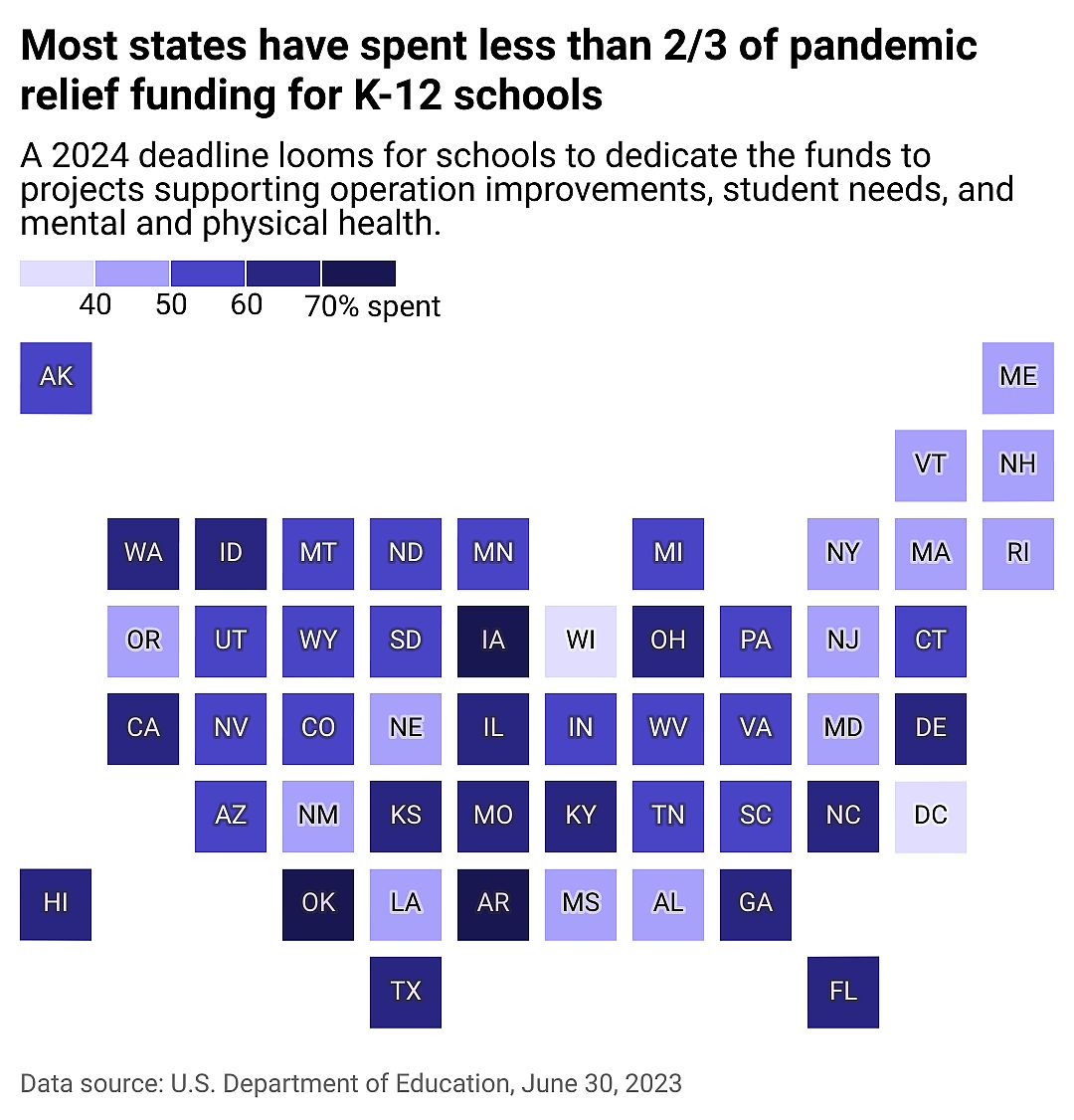
As of June 30, about 58% of funds from the ESSER Fund have been spent, but that rate differs widely by state. At the low end is Wisconsin, at 35.8%; at the top is Arkansas, at 74.4%.
The Edunomics Lab at Georgetown University says schools are now spending about $5 billion monthly, a rate needed to meet the September 2024 deadline. Districts received their funds from their state education departments.
Whether the money has been spent in ways that will tackle those problems is difficult to know.
Twenty states provide no information on what uses their money has been put toward, and many others offer limited data, according to the Edunomics Lab at Georgetown University.
An examination by the education nonprofit The 74 found that districts spent their money on everything from the million-dollar payments to an education consulting firm in the Arlington Independent School District in Texas to masks, testing, and contract tracing in the Memphis-Shelby County Schools in Tennessee.
The 74 also discovered that some districts—instead of spending money on pandemic-related problems—used it to improve their athletic fields or build classrooms.
Detroit, for example, was fixing buildings in disrepair in addition to hiring tutors and teachers, the Associated Press reported. St. Paul, Minnesota, was planning on replacing library books with some of its money.
A 2022 survey by AASA, The School Superintendents Association, found that districts were focusing their spending on education, whether for reading specialists, instructional material, or enrichment programs. But there were changes from the year before. Allocations for tutoring, technology, and social and emotional learning all dropped compared to spending in 2021.
Urban districts were spending on instructional materials, suburban districts on tutoring and specialized staff, and rural districts on instructional materials and school meal programs.
The pandemic aid is more than four times what the federal government usually spends on schools in a year. The Edunomics Lab projects that, once it ends, school districts must cut their annual spending by $60 billion. On average, spending per student will fall by $1,200.
When asked by The School Superintendents Association, 57% of the districts surveyed said they would end or cut back summer and enrichment programs; 53% would drop social workers, reading specialists, and other specialized staff; and 44% would stop paying staff for working longer hours.
Story editing by Ashleigh Graf. Copy editing by Paris Close.