Sahar Coston-Hardy Photography/Playful Learning Landscapes
1 / 2Education in 'surround-sound'
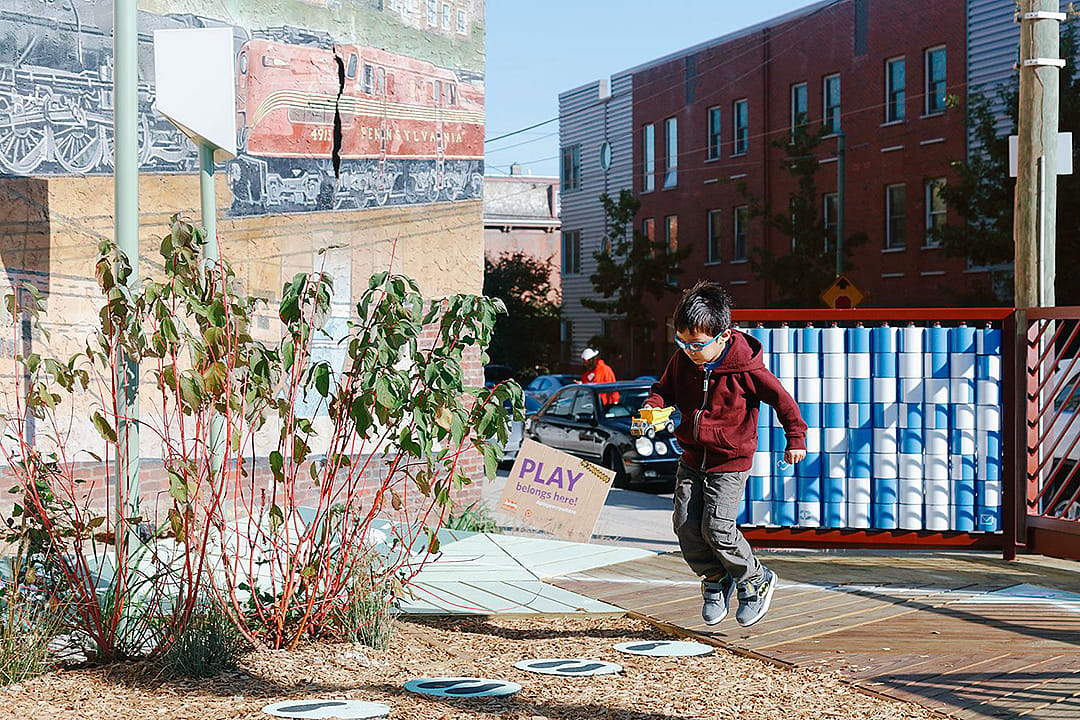
Photo: A child plays at the Urban Thinkscape installation in west Philadelphia's Belmont neighborhood.
Playful learning advocates are quick to emphasize that these interventions are limited, not meant to replace school but support it.
"The reality is that kids, particularly in their earliest years, only spend about 20% of their waking hours in those formal learning environments," said Lytle. "And so the idea is: How can we capitalize on that other 80%?"
That key question long puzzled a pair of researchers in the Philadelphia area: Temple University's Kathy Hirsh-Pasek and the University of Delaware's Roberta Michnick Golinkoff, who have spent nearly 15 years studying the centrality of play and non-school factors in children's learning. Much of the bedrock theory for this effort comes from their research.
"We are increasingly learning that education is a 'surround-sound' issue," Hirsh-Pasek said. "It's not an issue that stays behind brick walls, but it seeps out into the community."
Any effort that aims to educate must do three things, she maintains: It should be culturally aligned with families' backgrounds, follow the science of how children actually learn, and measure what matters to families.
Humans learn best, Hirsh-Pasek noted, when we're active and engaged, usually with other people. School lessons are typically passive, she said, and not really built around meaningful questions. "I mean, frankly, I don't care if the train is traveling 30 miles an hour and the ball drops off the train. Learning abstract content is important, but we learn more deeply and in ways that 'stick' when examples are meaningful. We can do better."
When it comes to measurement, Hirsh-Pasek said schools typically don't focus enough on what families want most: Good communication skills, creativity, critical thinking, and knowing the basics. They want their kids to be able to learn from failure and cultivate what's become known as a "growth mindset," persevering in the face of hardship.
Lytle, who oversees Playful Learning work from her office in Seattle, studied with Hirsh-Pasek at Temple in the 2000s. At the time, Hirsh-Pasek was becoming one of the first early childhood researchers to take play seriously, at a time when the larger field of education was focused laser-like on basic skills.
"It's something that serious researchers didn't get into," Lytle said, "but she thought it was really important. She sometimes says 'play' used to be a four-letter word."
The work that followed laid out not only playful learning's theoretical framework, but helped researchers see how much kids are learning as they play.
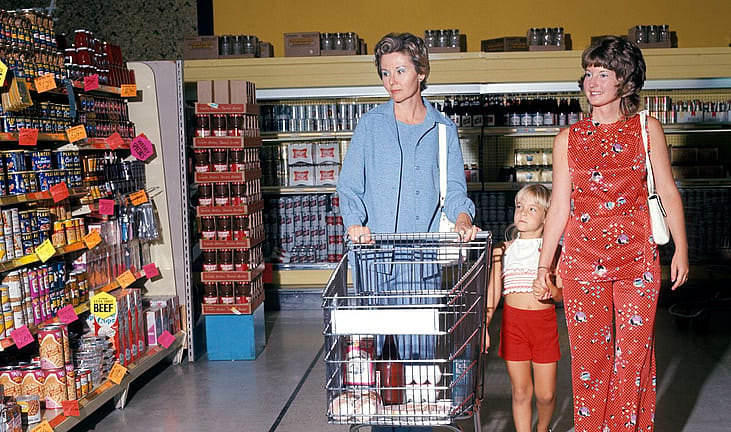
As with the grocery store signage, a 2018 study on the bus stop installation found that families had longer conversations there than at a neighborhood playground, and that they talked more about STEM topics such as numbers, fractions, patterns, and measurement. A follow-up 2020 study found that both caregivers and kids put their phones away while at the site.
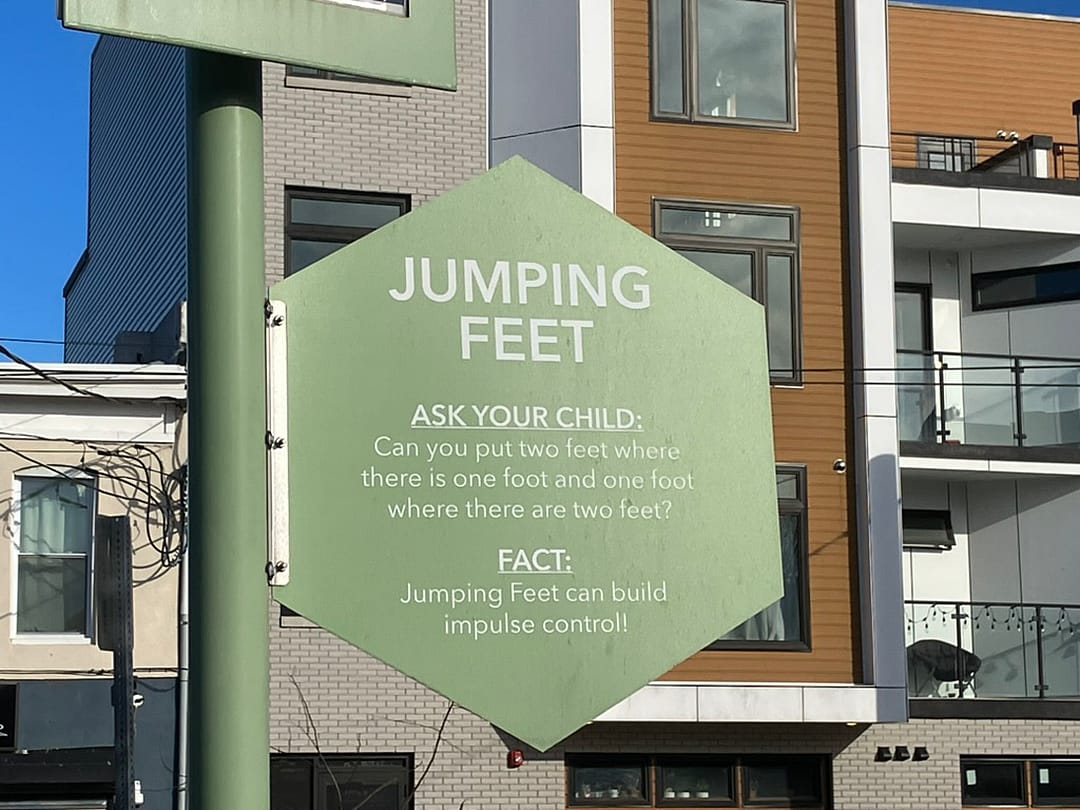
But as steeped in delight as it is, the work isn't without thorny real-world challenges, as when Lytle recently gave a journalist a tour of Philly's Urban Thinkscape, one of the city's earliest successes from 2017, and one that serves as a model for how educators and developers can transform formerly neglected stretches of pavement.
The space, in a set of busy crossroads, bristles with wooden-plank walkways and activities like the one-foot/two-foot hopscotch, word and picture puzzles built on protective railings, and a steel sculpture that, at midday, reveals shadows of hidden objects on the ground beneath.
But as Lytle showed a visitor around, a neighborhood man approached and asked if she was there to help with the rats.
Not quite sure how to react, Lytle said she was simply touring the space, but the man persevered, saying the ground beneath the installation was "full of rats. Big rats."
Matter-of-factly, Lytle replied, "O.K. That's good to know." She suggested contacting an official who oversees the property, adding, "I think we're working on relocating this, actually."
She later said the network has actually begun encouraging communities to keep repurposing spaces like these as they age.