SoFi
1 / 3Retirement Plans Offered by Employers
There are typically two types of retirement plans offered by employers:
- Defined contribution plans (more common): The employee invests a portion of their paycheck into a retirement account. Sometimes, the employer will match up to a certain amount (e.g. up to 5%). In retirement, the employee has access to the funds they've invested. 401(k)s and Roth 401(k)s are examples of defined contribution plans.
- Defined benefit plans (less common): The employer invests money for retirement on behalf of the employee. Upon retirement, the employee receives a regular payment, which is typically calculated based on factors like the employee's final or average salary, age, and length of service. As long as they meet the plan's eligibility requirements, they will receive this fixed benefit (e.g. $100 per month). Pension plans and cash balance accounts are common examples of defined benefit plans.
Here are the specific types of plans employers usually offer.
401(k) Plans
A 401(k) plan is a type of work retirement plan offered to the employees of a company. Traditional 401(k)s allow employees to contribute pre-tax dollars, where Roth 401(k)s allow after-tax contributions.
- Income taxes: If you choose to make a pre-tax contribution, your contributions may reduce your taxable income. Additionally, the money will grow tax-deferred and you will pay taxes on the withdrawals in retirement. Some employers allow you to make after-tax or Roth contributions to a 401(k). You should check with your employer to see if those are options.
- Contribution limit: $22,500 in 2023 and $23,000 in 2024 for the employee; people 50 and older can contribute an additional $7,500.
- Pros: Money is deducted from your paycheck, automating the process of saving. Some companies offer a company match. There is a significantly higher limit than with Traditional IRA and Roth IRA accounts.
- Cons: With a 401(k) plan, you are largely at the mercy of your employer—there's no guarantee they will pick plans that you feel are right for you or are cost-effective for what they offer. Also, the value of a 401(k) comes from two things: the pre-tax contributions and the employer match. If your employer doesn't match, a 401(k) may not be as valuable to an investor. There are also penalties for early withdrawals before age 59 ½, although there are some exceptions, including for certain public employees.
- Usually best for: Someone who works for a company that offers one, especially if the employer provides a matching contribution. A 401(k) retirement plan can also be especially useful for people who want to put retirement savings on autopilot.
- To consider: Sometimes 401(k) plans have account maintenance or other fees. Because a 401(k) plan is set up by your employer, investors only get to choose from the investment options they provide.
403(b) Plans
A 403(b) retirement plan is like a 401(k) for certain individuals employed by public schools, churches, and other tax-exempt organizations. Like a 401(k), there are both traditional and Roth 403(b) plans. However, not all employees may be able to access a Roth 403(b).
- Income taxes: With a traditional 403(b) plan, you contribute pre-tax money into the account; the money will grow tax-deferred and you will pay taxes on the withdrawals in retirement. Additionally, some employers allow you to make after-tax or Roth contributions to a 403(b); the money will grow tax-deferred and you will not have to pay taxes on withdrawals in retirement. You should check with your employer to see if those are options.
- Contribution limit: $22,500 in 2023 and $23,000 in 2024 for the employee; people 50 and older can contribute an additional $7,500 in both of those years. The maximum combined amount both the employer and the employee can contribute annually to the plan is generally the lesser of $66,000 in 2023 and $69,000 in 2024, or the employee's most recent annual salary.
- Pros: Money is deducted from your paycheck, automating the process of saving. Some companies offer a company match. Also, these plans often come with lower administrative costs because they aren't subject to Employee Retirement Income Security Act, or ERISA, oversight.
- Cons: A 403(b) account generally lacks the same protection from creditors as plans with ERISA compliance.
- To consider: 403(b) plans offer a narrow choice of investments compared to other retirement savings plans. The IRS states these plans can only offer annuities provided through an insurance company and a custodial account invested in mutual funds.
Solo 401(k) Plans
A Solo 401(k) plan is essentially a 1-person 401(k) plan for self-employed individuals or business owners with no employees, in which you are the employer and the employee. Solo 401(k) plans may also be called a Solo-k, Uni-k, or One-participant k.
- Income taxes: The contributions made to the plan are tax-deductible.
- Contribution limit: $22,500 in 2023 and $23,000 in 2024, or 100% of your earned income, whichever is lower, plus "employer" contributions of up to 25% of your compensation from the business. The 2023 total cannot exceed $66,000, and the 2024 total cannot exceed $69,000. (On top of that, people 50 and older are allowed to contribute an additional $7,500 in 2023 and 2024.)
- Pros: A solo 401(k) retirement plan allows for large amounts of money to be invested with pre-tax dollars. It provides some of the benefits of a traditional 401(k) for those who don't have access to a traditional employer-sponsored 401(k) retirement account.
- Cons: You can't open a solo 401(k) if you have any employees (though you can hire your spouse so they can also contribute to the plan as an employee—and you can match their contributions as the employer).
- Usually best for: Self-employed people with enough income and a large enough business to fully use the plan.
SIMPLE IRA Plans (Savings Incentive Match Plans for Employees)
A SIMPLE IRA plan is set up by an employer, who is required to contribute on employees' behalf, although employees are not required to contribute.
- Income taxes: Employee contributions are made with pre-tax dollars. Additionally, the money will grow tax-deferred and employees will pay taxes on the withdrawals in retirement.
- Contribution limit: $15,500 in 2023 and $16,000 in 2024. Employees aged 50 and over can contribute an extra $3,500 in 2023 and in 2024, bringing their total to $19,000 in 2023 and $19,500 in 2024.
- Pros: Employers contribute to eligible employees' retirement accounts at 2% their salaries, whether or not the employees contribute themselves. For employees who do contribute, the company will match up to 3%.
- Cons: The contribution limits for employees are lower than in a 401(k) and the penalties for early withdrawals—up to 25% for withdrawals within two years of your first contribution to the plan—before age 59 ½ may be higher.
- To consider: Only employers with less than 100 employees are allowed to participate.
SEP Plans (Simplified Employee Pension)
This is a retirement account established by a small business owner or self-employed person for themselves (and if applicable, any employees).
- Income taxes: Your contributions will reduce your taxable income. Additionally, the money will grow tax-deferred and you will pay taxes on withdrawals in retirement.
- Contribution limit: For 2023, whichever is lower: $66,000 or 25% of earned income; for 2024, $69,000 or 25% of earned income, whichever is lower.
- Pros: Higher contribution limit than IRA and Roth IRAs, and contributions are tax-deductible for the business owner.
- Cons: These plans are employer contribution only and greatly rely on the financial wherewithal and available cash of the business itself.
- Usually best for: Self-employed people and small business owners who wish to contribute to an IRA for themselves and/or their employees.
- To consider: Because you're setting up a retirement plan for a business, there's more paperwork and unique rules. When opening an employer-sponsored retirement plan, it generally helps to consult a tax advisor.
Profit-Sharing Plans (PSPs)
A profit-sharing plan is a retirement plan funded by discretionary employer contributions that gives employees a share in the profits of a company.
- Income taxes: Deferred; assessed on distributions from the account in retirement.
- Contribution limit: The lesser of 25% of the employee's compensation or $66,000 in 2023. (On top of that, people 50 and older are allowed to contribute an additional $7,500 in 2023.) In 2024, the contribution limit is $69,000 or 25% of the employee's compensation, whichever is less. Those 50 and up can contribute an extra $7,500 in 2024.
- Pros: An employee receives a percentage of a company's profits based on its earnings. Companies can set these up in addition to other qualified retirement plans, and make contributions on a completely voluntary basis.
- Cons: These plans put employees at the mercy of their employers' profits, unlike retirement plans that allow employees to invest in securities issued by other companies.
- Usually best for: Companies who want the flexibility to contribute to a PSP on an ad hoc basis.
- To consider: Early withdrawal from the plan is subject to penalty.
Defined Benefit Plans (Pension Plans)
These plans, more commonly known as pension plans, are retirement plans provided by the employer where an employee's retirement benefits are calculated using a formula that factors in age, salary, and length of employment.
- Income taxes: Deferred; assessed on distributions from the plan in retirement.
- Contribution limit: Determined by an enrolled actuary and the employer.
- Pros: Provides tax benefits to both the employer and employee and provides a fixed payout upon retirement that many retirees find desirable.
- Cons: These plans are increasingly rare, but for those who do have them, issues can include difficulty realizing or accessing benefits if you don't work at a company for long enough.
- Usually best for: Companies that want to provide their employees with a "defined" or pre-determined benefit in their retirement years.
- To consider: These plans are becoming less popular because they cost an employer significantly more in upkeep than a defined contribution plan such as a 401(k) program.
Employee Stock Ownership Plans (ESOPs)
An employee stock ownership plan is a qualified defined contribution plan that invests in the stock of the sponsoring employer.
- Income taxes: Deferred. When an employee leaves a company or retires, they receive the fair market value for the stock they own. They can either take a taxable distribution or roll the money into an IRA.
- Contribution limit: Allocations are made by the employer, usually on the basis of relative pay. There is typically a vesting schedule where employees gain access to shares in one to six years.
- Pros: Could provide tax advantages to the employee. ESOP plans also align the interests of a company and its employees.
- Cons: These plans concentrate risk for employees: An employee already risks losing their job if an employer is doing poorly financially. By making some of their compensation employee stock, that risk is magnified. In contrast, other retirement plans allow an employee to invest in stocks in other securities that are not tied to the financial performance of their employer.
457(b) Plans
A 457(b) retirement plan is an employer-sponsored deferred compensation plan for employees of state and local government agencies and some tax-exempt organizations.
- Income taxes: If you choose to make a pre-tax contribution, your contributions will reduce your taxable income. Additionally, the money will grow tax-deferred and you will pay taxes on the withdrawals in retirement. Some employers also allow you to make after-tax or Roth contributions to a 401(k).
- Contribution limit: The lesser of 100% of employee's compensation or $22,500 in 2023 and $23,000 in 2024; some plans allow for "catch-up" contributions.
- Pros: Plan participants can withdraw as soon as they are retired at any age, they do not have to wait until age 59 ½ as with 401(k) and 403(b) plans.
- Cons: 457 plans do not have the same kind of employer match as a 401(k) plan. While employers can contribute to the plan, it's only up to the combined limit for individual contributions.
- Usually best for: Employees of governmental agencies.
Federal Employees Retirement System (FERS)
The Federal Employees Retirement System, or FERS, consists of three government-sponsored retirement plans: Social Security, the Basic Benefit Plan, and the Thrift Savings Plan.
The Basic Benefit Plan is an employer-provided pension plan, while the Thrift Savings Plan is most comparable to what private-sector employees can receive.
- Income taxes: Contributions to the Thrift Savings Plan are made before taxes and grow tax-free until withdrawal in retirement.
- Contribution limit: The contribution limit for employees is $22,500 in 2023, and the combined limit for all contributions, including from the employer agency, is $66,000. In 2024, the employee contribution limit is $23,000, and the combined limit for all contributions, including those from the employer, is $69,000. Also, those 50 and over are eligible to make an additional $7,500 in "catch-up" contributions in both 2023 and 2024.
- Pros: These government-sponsored plans are renowned for their low administrative fees and employer matches.
- Cons: Only available for federal government employees.
- Usually best for: Federal government employees who will work at their agencies for a long period; it is comparable to 401(k) plans in the private sector.
Cash-Balance Plans
This is another type of pension plan that combines features of defined benefit and defined contribution plans. They are sometimes offered by employers that previously had defined benefit plans. The plans provide an employee an "employer contribution equal to a percent of each year's earnings and a rate of return on that contribution."
- Income taxes: Contributions come out of pre-tax income, similar to 401(k).
- Contribution limit: The plans combine a "pay credit" based on an employee's salary and an "interest credit" that's a certain percentage rate; the employee then gets an account balance worth of benefits upon retirement that can be paid out as an annuity (payments for life) or a lump sum. Limits depend on age, but for those over 60, they can be more than $250,000.
- Pros: Can reduce taxable income.
- Cons: Cash-balance plans have high administrative costs.
- Usually best for: High earners and business owners with consistent income.
Nonqualified Deferred Compensation Plans (NQDC)
These are plans typically designed for executives at companies who have maxed out other retirement plans. The plans defer payments—and the taxes—you would otherwise receive as salary to a later date.
- Income taxes: Income taxes are deferred until you receive the payments at the agreed-upon date.
- Contribution limit: None
- Pros: The plans don't have to be entirely geared around retirement. While you can set dates with some flexibility, they are fixed.
- Cons: Employees are not usually able to take early withdrawals.
- Usually best for: Highly-paid employees for whom typical retirement plans would not provide enough savings compared to their income.
Multiple Employer Plans
A multiple employer plan, or MEP, is a retirement savings plan offered to employees by two or more unrelated employers. It is designed to encourage smaller businesses to share the administrative burden of offering a tax-advantaged retirement savings plan to their employees.
These employers pool their resources together to offer a defined benefit or defined contribution plan for their employees.
Administrative and fiduciary responsibilities of the MEP are performed by a third party (known as the MEP Sponsor), which may be a trade group or an organization that specializes in human resources management.
Compare Types of Retirement Accounts Offered by Employers
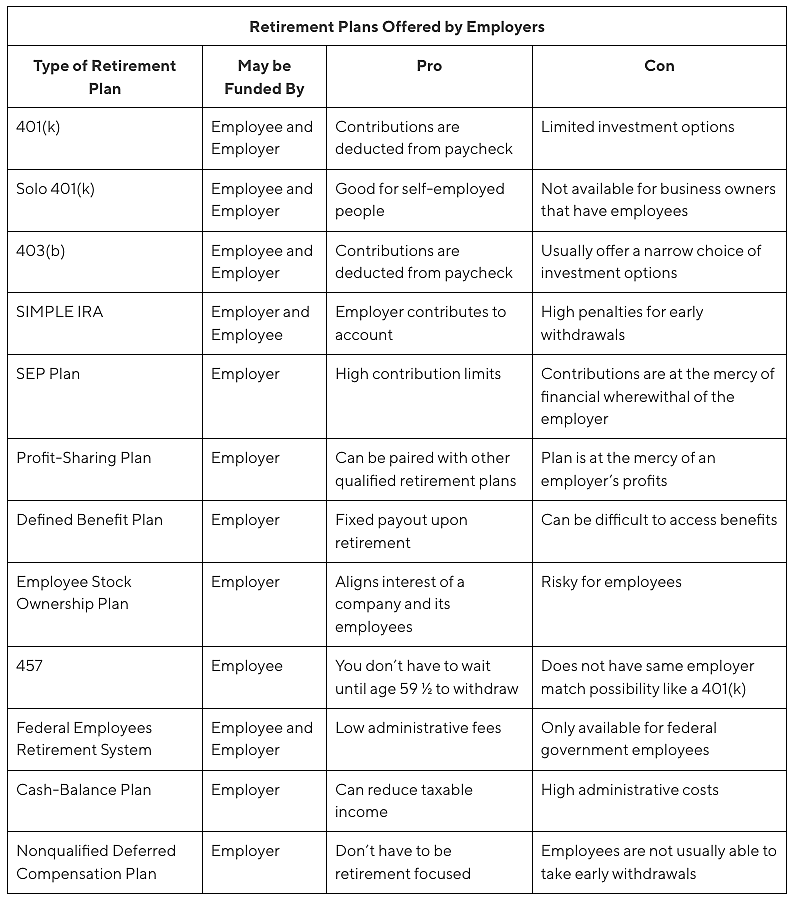
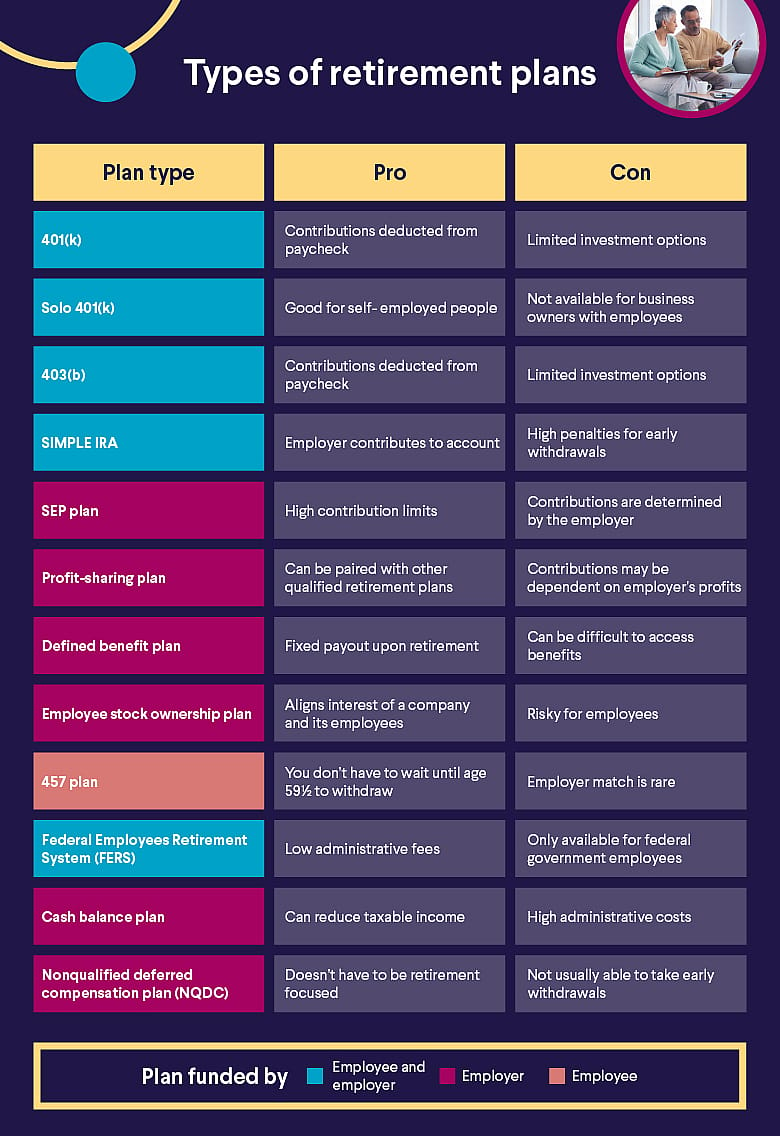
To recap retirement plans offered by employers: