The 74
1 / 3A battle over civics
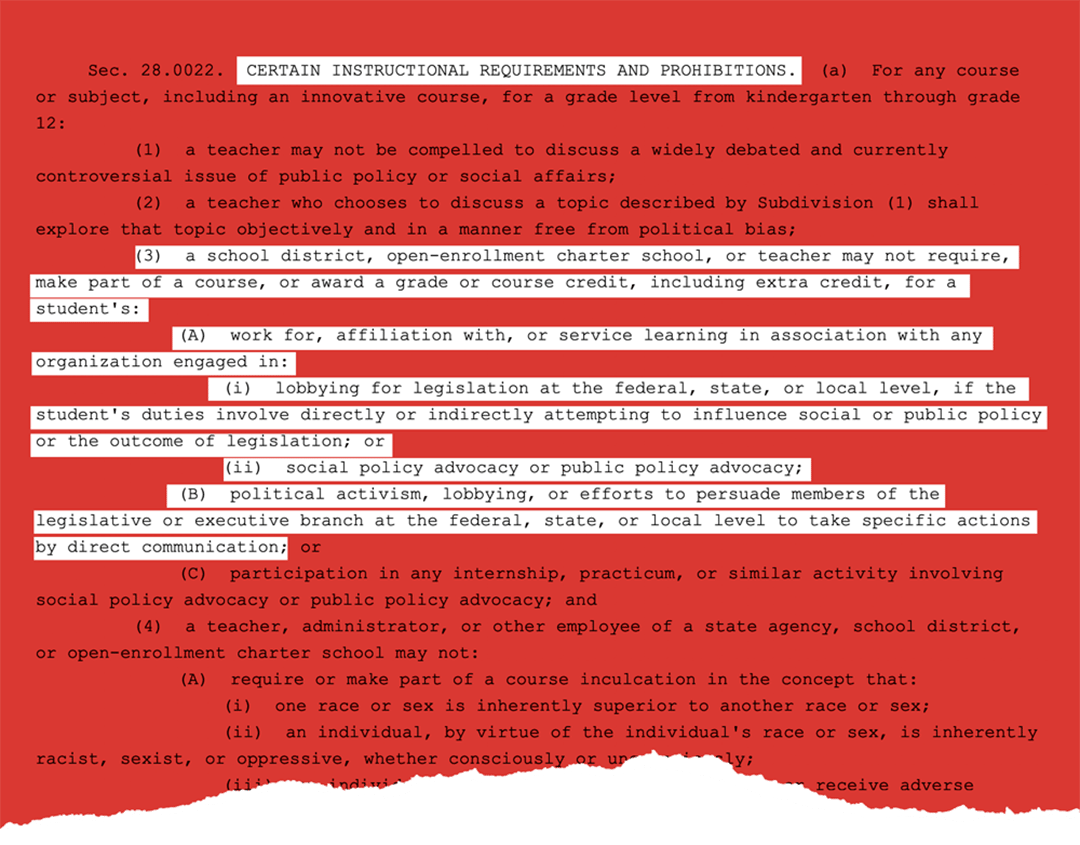
The sections of the 2021 law limiting civic engagement pull directly from model legislation authored by the conservative scholar Stanley Kurtz, whose extensive writings seek to link an approach called "action civics" — what he calls "woke civics" — with leftist activism and critical race theory. Critical race theory is a scholarly framework examining how racism is embedded in America's legal and social institutions, but became a right-wing catch-all term for teachings on race in early 2021.
Kurtz argues the practice is a form of political "indoctrination" under the "deceptively soothing" heading of civics, a cause long celebrated on both the right and the left.
The action civics model was popularized by the nonprofit Generation Citizen and is used in over a thousand classrooms across at least eight states. It teaches students about government by having them pick a local issue, research it and present their findings to officials.
The central philosophy is that "students learn civics best by doing civics," Generation Citizen Policy Director Andrew Wilkes said.
Generation Citizen's method has been studied by several academic researchers who found participants experienced boosted civic knowledge and improvements in related academic areas like history and English.
Kurtz, however, contends the projects "tilt overwhelmingly to the left."
"Political protest and lobbying ought to be done by students outside of school hours, independently of any class projects or grades," he said in an email to The 74.
Civics experts, however, argued otherwise.
The notion that "it's activism happening in classrooms … that's just so far from the truth," said Kei Kawashima-Ginsberg, director of the Center for Information and Research on Civic Learning and Engagement at Tufts University in Boston.
Rep. Steve Toth and Sen. Bryan Hughes, the GOP lawmakers who sponsored the 2021 anti-CRT legislation, did not respond to requests for comment.
The 74 reviewed over three dozen action civics projects in Texas from before the 2021 legislation and found that the vast majority dealt with hyperlocal, nonpartisan issues.
Students most often took up causes like bullying, youth vaping, movie nights in the park or bringing back student newspapers. A handful in Austin and nearby Elgin could be considered progressive, including projects dealing with gun control or school admissions prioritizing diversity, topics educators said students selected based on their own interests.
Under the 2021 law, all of those projects now must avoid contact with elected officials. The restrictions have resulted in initiatives more contained to schools themselves like advocacy for less-crowded hallways or longer lunch periods, educators said.
"This particular legislation … ties [students'] hands as to how involved they can get while in high school," said Armando Orduña, the Houston executive director of Latinos for Education.
His own political awakening, he said, came three decades ago growing up in Texas when a teacher assigned him 10 hours of volunteering on a political campaign of his choice. He opted to work on the 1991 Houston mayoral campaign of Sylvester Turner, then a young state representative who lost his bid that year but went on to become the city's mayor in 2016.
"Back then, the attitude was how to fight teenage apathy regarding politics and now it's quite the other way around," Orduña said. Now politicians are working to "tamp down the next generation of leaders."
Young progressives have become a considerable force in American politics, fueling recent electoral wins in the Wisconsin Supreme Court, the Chicago mayoral race and a base-rousing standoff in the Tennessee legislature. In the eyes of some members of the GOP, their activism is seen as a threat.