Jen Fifield for Votebeat
1 / 2To address concerns about speed, county expands staff
The speed of ballot counting is a politically charged issue, especially in swing states like Arizona. Concerns that began in earnest in 2020 over how long it took Maricopa County to finish counting the presidential election results grew dramatically in 2022, as Hobbs and GOP opponent Kari Lake awaited their results. Lake's claim that the county was intentionally slow-rolling the results to perpetrate election fraud attracted national attention.
The fact is, many large voting jurisdictions take a week or more to tabulate mail ballots, but depending on the volume of those ballots and the overall margins in the race, that wait doesn't raise many concerns, because the outcome of the race doesn't hinge on those votes.
In swing states like Arizona, these lingering, last-to-be-counted ballots command much greater attention. Statewide races here have become tighter in recent elections, and the number of voters waiting until Election Day to drop off their ballots has grown, leaving a larger percentage of the state's results outstanding on election night. By 2022, nearly 1 in 5 voters cast their ballot this way. That's about 290,000 ballot envelopes to scan, voter signatures to verify, envelopes to open and ballots to count.
Lake's allegations drew more attention to the long wait in 2022. But Maricopa County was actually counting just about as fast as it typically does. County officials posted final results 13 days after the 2022 election, roughly in line with the average of 12.5 days in statewide elections since 2006. The counting timeline has not increased even as the number of votes cast has doubled.
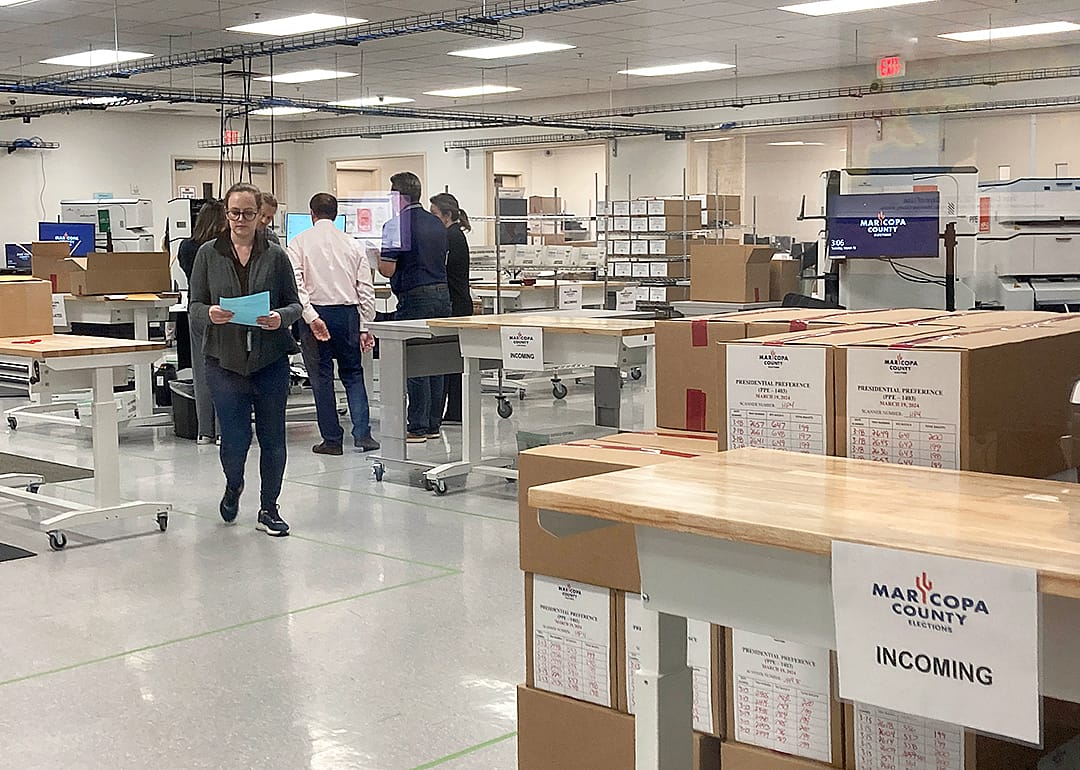
Still, county officials started looking at how to further speed up the process. The county has spent millions since 2022 tearing down walls in its counting room and other spaces within its election center. It's also set up trailers as temporary buildings for use during elections.
The space can now fit considerably more people to work in the areas where there were "bottlenecks," Jarrett said. In the upcoming election, the number of workstations available for verifying voter signatures on mail ballots will be 45, nearly double the 25 stations available in 2022. There will be 75 work stations for processing boards — the two-member bipartisan teams who open ballot envelopes to prepare ballots for counting — up from 55 in 2022. And there will be twice as many bipartisan teams reviewing voter selections on ballots where machines can't determine the voter's intent.
The county doubled the number of high-speed ballot-counting machines at its central counting location, too, meaning that it can tabulate votes twice as fast.
On Runbeck's end, it plans to have enough staff on election night to run two or even three of its high-speed scanning machines at once.
Even with these changes, Jarrett and Valenzuela are hesitant to make promises about how much faster, if at all, counting may go this year.
It all depends on how many people wait until Election Day to vote. And Jarrett is estimating Election Day mail ballot drop-offs will increase from about 290,000 in 2022 to 350,000 in 2024.
To address concerns about transparency, Runbeck makes changes
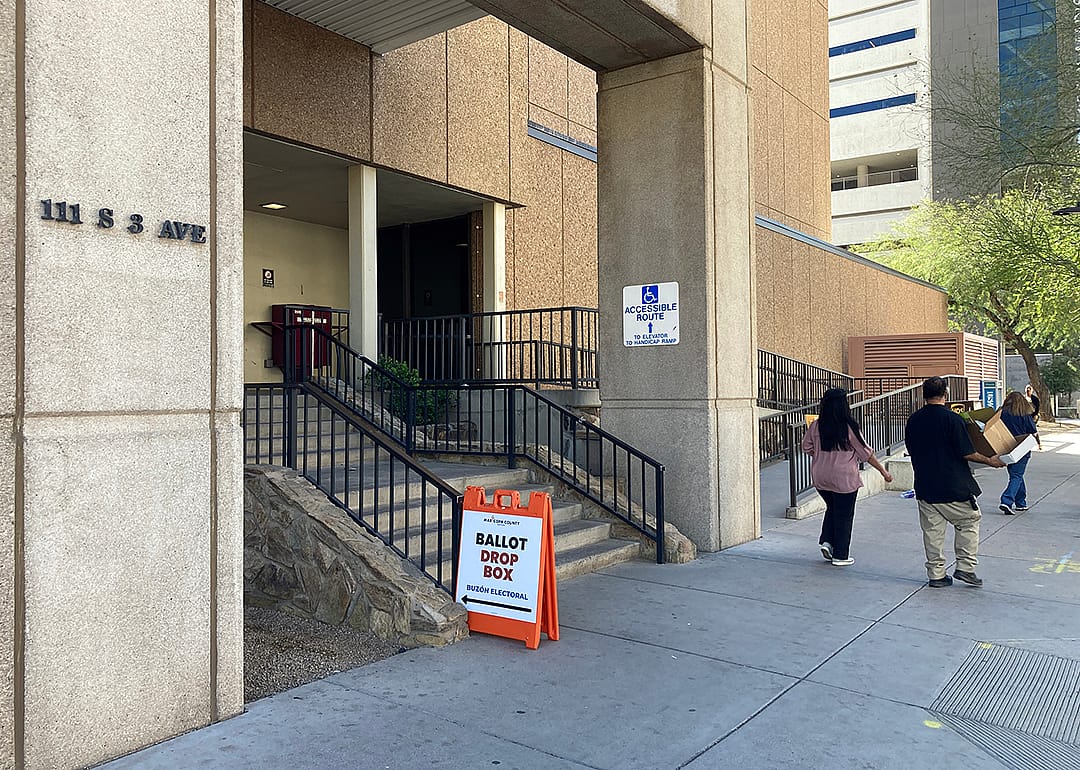
In Arizona, polls close at 7 p.m. Typically, it's 9 p.m. or later when the first shipment of Maricopa County's Election Day drop-offs make it to Runbeck.
Before that, poll workers need to pack the ballots up at 200 or more voting locations, and county workers need to pick them up from drop boxes and bring them to the county's central counting facility. Under camera surveillance and with bipartisan observers, workers arrange the envelopes face-forward in trays. Then the trays are packed in cages with locks and rolled onto trucks waiting outside the warehouse.
As all that happens, it's mostly quiet in the Runbeck warehouse, located down a winding road in an industrial area near Phoenix's Sky Harbor International Airport.
Runbeck, one of the largest ballot printers in the nation, will print ballots here for 49 counties across the country in 2024, and ship more than 13 million ballots directly to voters. But on election night, only Maricopa County's cast ballots will come through here.
The night of the presidential preference election, Runbeck workers eat pizza in the breakroom and watch a movie as they wait for the envelopes to arrive.
On a whiteboard on the wall near the envelope scanning machine, employees have written down guesses of how many ballot envelopes there will be for them. The guesses can range widely, and no one has ever gotten it exactly right, said senior vice president of operations Bryan Dandurand. Tonight, one guess is 10,000. Another is 48,729.
When the ballots do arrive, the warehouse starts buzzing. Observers from each party follow the caged ballots from the truck loading zone to the envelope scanners, each 80 feet long and 6 feet high. Security guards, from Runbeck and Maricopa County, watch over the envelopes at every step. Multiple workers confirm ballot transfer numbers at multiple steps.
Once the signatures and barcodes on about 10,000 ballot envelopes are scanned, Runbeck sends the county a file with the photos. County workers then use those photos to start comparing voter signatures with registration records. If workers end up challenging a signature, Runbeck uses the machines to separate those envelopes into separate trays before they are returned to the county.
In all, about 30,000 envelopes come through the warehouse on the night of the presidential preference election, right in the middle of the range of guesses on the whiteboard.
Maricopa County picks up the ballots from Runbeck after they are scanned, opens the envelopes and counts the votes inside once they are back at its central counting facility.
Seeing all of these security protocols in place at Runbeck in person for the first time, Democratic Party observer Ed Giebel said he was even more confident in the process, and even more disturbed by the "wild claims" he has heard about widespread voting fraud.
"It's not like you can inject 5,000 ballots into the process," Giebel said.
Yet, that's effectively what Lake alleged in 2022. And while there has been no physical evidence to support that claim, the allegation has forced Runbeck and the county to take even more steps to increase transparency.
In 2022, Lake's legal team noticed that on ballot-tracking documents, the county had recorded an incorrect estimate of Election Day mail ballot drop-offs before the ballots were shipped to Runbeck.
The county hadn't counted the exact number of these ballots before shipping them to Runbeck, and historically never has. Instead, it has estimated the number of ballots it was sending to the warehouse based on the number of trays they packed.
But Lake said in court that the incorrect estimate was proof that there were tens of thousands of ballots illegally inserted at this facility. Also, a witness told the judge that Runbeck employees had been casting ballots on site.
Courts repeatedly rejected Lake's claims for lack of evidence, and her attorneys were eventually sanctioned for falsely claiming that it was an "undisputed" fact that 35,563 ballots were injected to the results at Runbeck.
Jeff Ellington, CEO of Runbeck, has since told Votebeat these claims have led to harassment and threats against him. But Dandurand said that their employees have been mostly isolated from all this.
He talks in great length about the efforts that Runbeck takes to hire employees who call out errors when they see them and understand the importance of integrity when processing ballot envelopes.
Yet, the pressure to tighten processes hasn't let up.
After the 2022 election, State Rep. Alex Kolodin and State Sen. Wendy Rogers, both Republicans, led an investigative committee in the legislature that pushed Runbeck to provide greater transparency into its process. Earlier this year, Runbeck signed an agreement with state lawmakers to provide for more transparency in ballot tracking and political party observer rules.
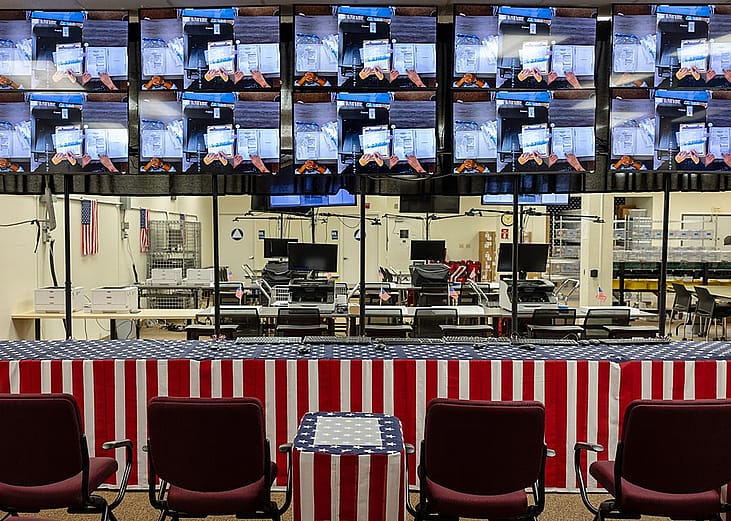
The ballot tracking forms now make clear when numbers are estimates, and when they are exact machine counts. There will be more political party observers allowed, and these observers will have access to a room where they can watch TV screens that show all ballot activity in the building live. And Runbeck will no longer allow employees to cast their own ballots on site, Dandurand said.
Also, under a new law, poll workers will try to get an exact count of the number of these ballots on site at their location, before they are transferred to the county for sorting, then to Runbeck for scanning. Kolodin pushed for this new rule hoping it would avoid the incorrect county estimates, but election officials worry that any inaccuracies will lead to more fraud claims.
Kolodin said that after his investigation, he is "a lot less concerned about Runbeck" than he was before, and he is glad Runbeck agreed on new transparency measures.
"Eyes on the process is always the best way to avoid problems," he said.
Still, Kolodin said many of his constituents are concerned that the ballots they cast go through Runbeck afterward. He sees a few good arguments for doing the work in house.
Involving Runbeck in the chain of custody creates more opportunities for errors or bad actors, he said. He is also concerned that private contractors can more easily push back against public records laws.
Indeed, in 2022, a judge denied a public-records request from an advocacy organization allied with Lake to force Runbeck to turn over security video footage. Runbeck has since agreed to let lawmakers review its video.
Kolodin said if the county did the ballot scanning work instead, there would be "better legal teeth for oversight for ordinary members of the public."