Elena Cox // Stacker
1 / 2Contributions speak to one part of a complex story
Campaign contributions alone don't capture the full extent of a presidential candidate's political support, and other Republicans argued that Trump's drop in fundraising with suburban voters doesn't indicate that he'll lose their support at the ballot box.
A spokesperson for the Trump campaign did not respond to a Newsweek request for comment.
Trump could still see an uptick in donations in suburbs in the final months before the election. The former president raised less money than Biden in the first months of 2024, but his fundraising has increased recently, driven by supporters outraged over his conviction in a New York hush money trial. Trump has said the charges were politically motivated. His sentencing date is July 11.
Anger on the right over the conviction helped the Trump campaign and Republican National Committee raise $141 million in May. The Biden campaign and Democratic National Committee raised a combined $85 million last month, the second straight month that Trump raised more money than Biden.
Still, Democratic and Republican strategists and others told Newsweek that Trump's challenge to raise as much money in suburban America, in particular, was a sign his legal problems and conservative positions on issues such as abortion were taking a toll.
Suburbs used to be "more Republican donor-centric," said Scott Falmlen, a senior adviser to the Biden campaign in North Carolina. But now, "there's a segment of Trump donors who are not giving to Trump anymore."
'Disaffection with Trump clear'
Fundraising in North Carolina illustrates Trump's challenge with the relatively moderate suburban voters he'll need to carry battleground states in November.
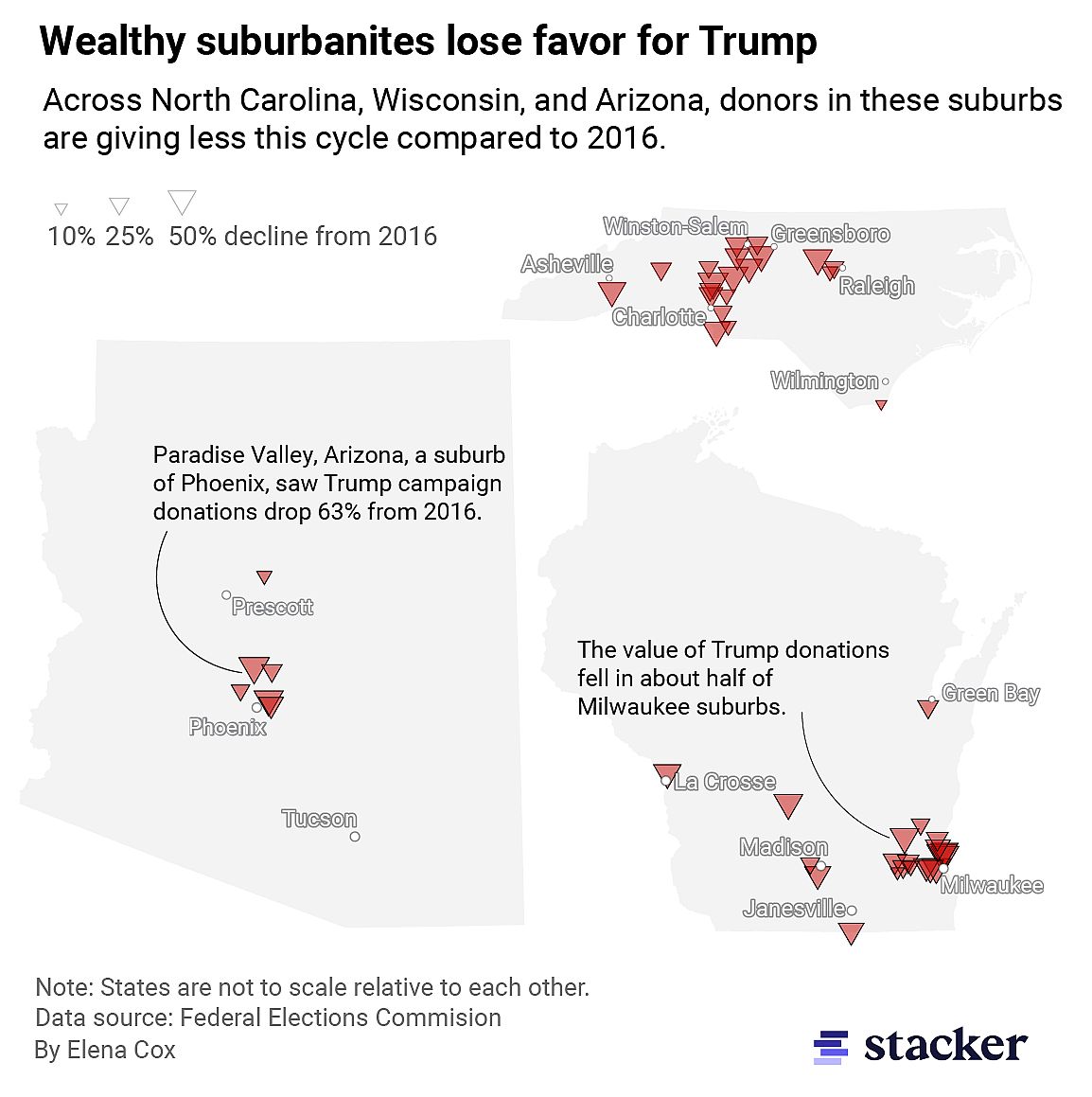
Trump's fundraising totals are down from his 2016 totals across the greater Charlotte Metropolitan Area, which includes suburban communities such as Davidson, a popular college town a 30-minute drive north of the state's largest city.
In nearby Mooresville, the Trump campaign has raised just $42,114, down 60% from the $105,120 it raised there during the 2016 election. Trump's fundraising is also down 49% in Waxhaw and 25% in Cornelius, among other Charlotte-area suburbs — as well as in the suburbs outside of other major North Carolina cities, including the capital Raleigh, Durham, and Asheville.
Trump has seen an uptick in donations from small, sparsely populated rural communities across the state, as well as in some suburbs like Tucker's hometown of Gastonia. But that hasn't been enough to offset the drop off in fundraising in bigger suburbs with growing numbers of moderate voters.
"People are moving here at such a rapid rate that it's shifting [the politics]. They tend to be that moderate voter set," said Renee Garner, a member of the board of commissioners of Matthews, a suburb of Charlotte that's turned from red to purple in the Trump years.
Tucker, who is now registered as an independent, has organized a grassroots effort to convince moderate Republicans who are alienated from Trump to vote for Biden in November.
"There's a lot of us who I think are politically homeless," he said.
Trump's shrinking donations in the state's suburbs, combined with a similar drop in large cities—the campaign's fundraising totals are down by 41% in Raleigh and 27% in Charlotte—has helped even the fundraising playing field in a traditional Republican stronghold.
Overall, the Trump and Biden campaigns both received $2.42 million in individual contributions in North Carolina this election cycle through the first quarter, with Biden narrowly beating Trump by about $1,000.
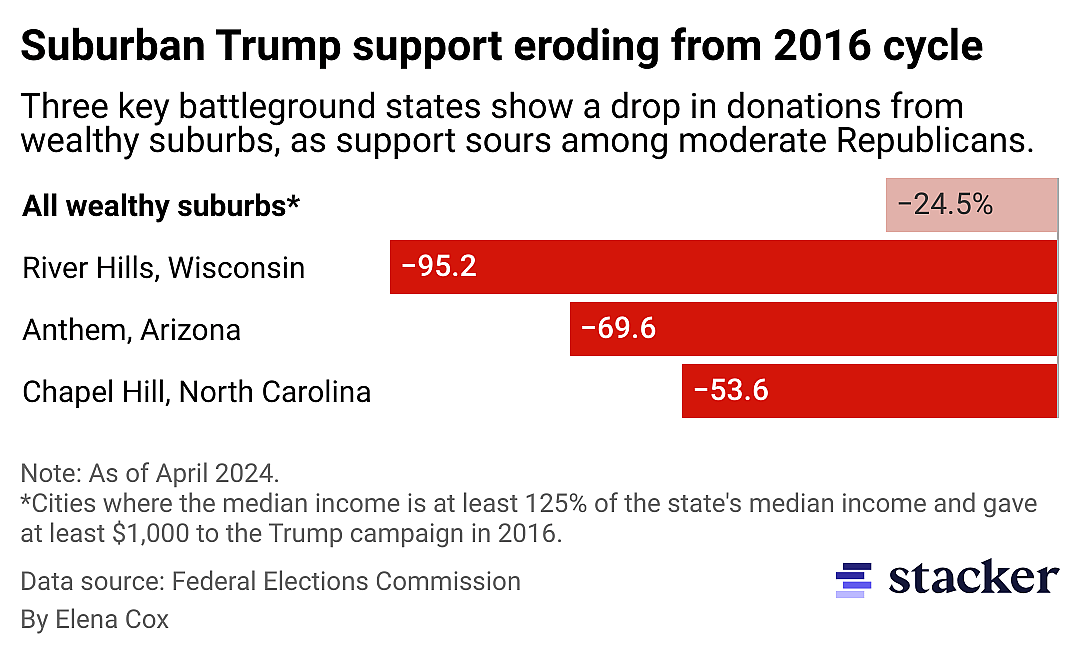
Stacker's analysis for Newsweek counted all the individual donations made directly to the Biden and Trump campaigns in North Carolina, Wisconsin, and Arizona, as well as any contributions made in those states to political action committees and other outside groups who then transferred the funds to the campaigns.
It compared the total contributions the Trump campaign has received so far this election cycle, including during the primaries, with the contributions his campaign received during the primary and general elections in 2016. Suburban areas were identified using the federal government's data on population size and median household income.
Biden benefited from the fact that, unlike Trump, he did not have to run a competitive primary race this year. But the side-by-side comparison of 2016 and 2024 makes clear how some suburban voters in North Carolina—and other battleground states—have closed their wallets for Trump this time around as he makes his third run at the White House.
The dead-even money race in North Carolina is especially revealing given its history as a solid red state where Republicans could count on a wide turnout and fundraising advantage in rural and exurban areas, where they were more competitive with Democrats in the suburbs.
In 1980, Ronald Reagan beat Jimmy Carter in Charlotte's Mecklenburg County by one point. In 2020, Biden beat Trump there by 35 points. Reagan beat Carter by less than one point in Wake County; four decades later, Biden carried Raleigh and its suburbs by 26 percentage points over Trump.
Barack Obama is the only Democrat to win North Carolina since 1976. But since Obama's 2008 win, the subsequent three elections have all been decided by fewer than four percentage points, forcing Republicans to compete in North Carolina to avoid an upset win. Biden almost delivered a surprise win there in 2020, losing to Trump by just 1.3 points.