SmartAsset
1 / 1Top 10 Most Livable Small Cities
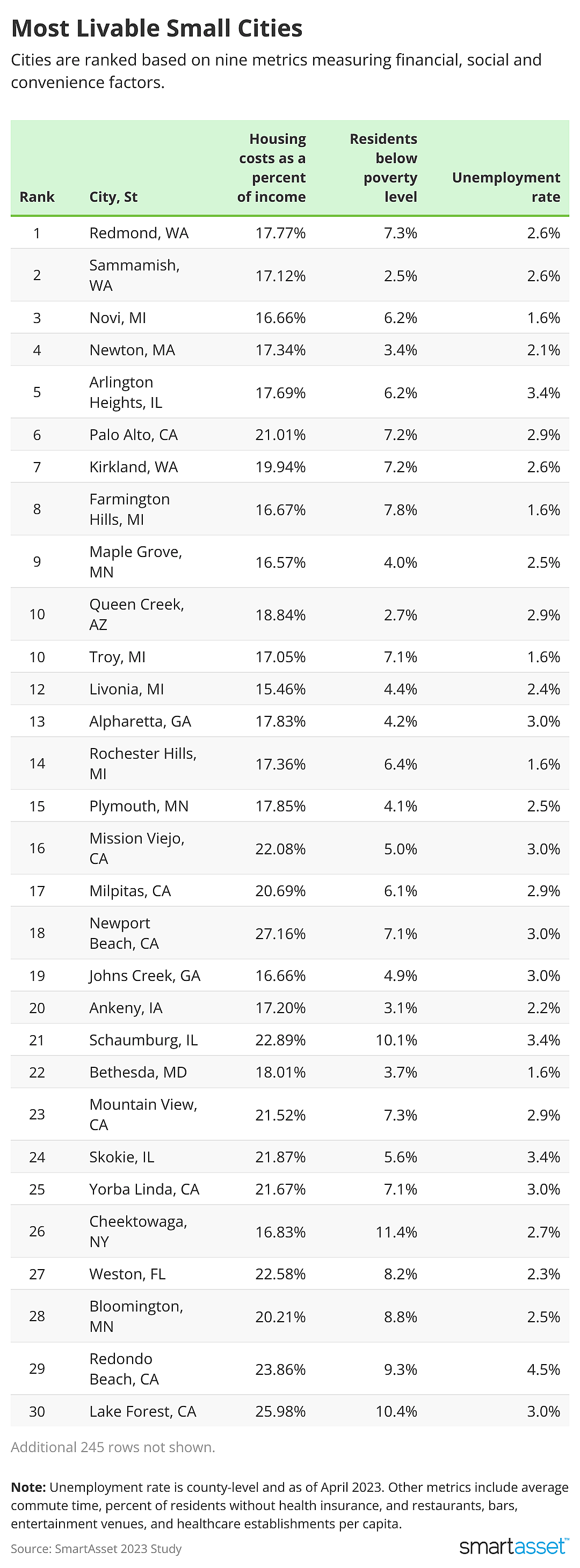
Cities are ranked based on nine metrics measuring financial, social and convenience factors.
1. Redmond, WA
Redmond, home to approximately 76,000 people, ranks as the most livable small city in America. Only 1.93% of residents don't have health insurance, which gives Redmond the 10th-lowest uninsured rate across our study. This Seattle suburb also ranks 24th for bars. Meanwhile, housing costs are 17.77% of the median household income – lower than almost 90% of cities evaluated.
2. Sammamish, WA
Sammamish, located about 20 miles east of Seattle, has the third-lowest percentage of residents living below the poverty level (2.5%). Average housing costs eat up just 17.12% of the median income in Sammamish, which is less than 93% of the cities that we evaluated. Meanwhile, only 2.52% of residents in this city of over 66,000 people don't have health insurance (20th best).
3. Novi, MI
Novi, which has the third-lowest unemployment rate across our study (1.6%), is also home to one of Michigan's largest shopping destinations, Twelve Oaks Mall. Average housing costs in this Detroit suburb comprise just 16.66% of the median income, which ranks eighth lowest among all 275 cities we studied.
4. Newton, MA
Only 1.05% of Newton residents don't have health insurance – third lowest across our study. Located about 11 miles west of Boston, Newton also has the ninth-lowest percentage of residents living below the poverty line (3.4%). Housing costs add up to just 17.34% of the median household income, which is better than nearly 92% of the cities we evaluated.
5. Arlington Heights, IL
Arlington Heights ranks highly for its number of bars, restaurants and healthcare facilities. Located about 25 miles northwest of Chicago, Arlington Heights ranks third overall for bars, 15th for both dining and entertainment establishments and 17th for healthcare facilities. Specifically, the city's Metropolis Performing Arts Centre is well-regarded for its production of plays, musicals, concerts and other events.
6. Palo Alto, CA
Less than 1% of people in Palo Alto don't have health insurance, giving this Silicon Valley city the highest coverage rate across our study. Home to more than 66,000 people, Palo Alto ranks 40th for dining establishments and 45th for healthcare facilities. The city is also home to prestigious Stanford University.
7. Kirkland, WA
The third of three Seattle suburbs in the top 10, Kirkland is located on the shores of Lake Washington and offers a plethora of water-based recreational activities. This city, with more than 92,000 people, ranks 28th for bars and 41st for dining establishments, both of which help boost its livability score.
8. Farmington Hills, MI
Farmington Hills, located due east of Novi, is tied for the third-lowest unemployment rate (which is measured at the county level). Housing costs in this city of 83,000 people are also relatively affordable, comprising just 16.67% of the median household income (10th lowest). Lastly, the city ranks 21st overall for health insurance coverage, as only 2.59% of residents go without it.
9. Maple Grove, MN
Maple Grove, located approximately 17 miles northwest of Minneapolis, has the seventh-lowest housing costs compared to the median income (16.57%). Only 2.41% of residents don't have health insurance (15th lowest), while just 4% of people live below the poverty line (16th lowest).
T-10. Queen Creek, AZ
Queen Creek, a city of nearly 70,000 people southeast of Phoenix, has the fourth-lowest poverty rate across our study (2.7%). Queen Creek also ranks 16th for healthcare establishments and 20th for entertainment establishments. People who call Queen Creek home have easy access to the San Tan Mountain Regional Park, which features miles of hiking and biking trails across thousands of acres of Sonoran desert.
T-10. Troy, MI
Like Novi and Farmington Hills, Troy is located in Oakland County, Michigan, which has the third-lowest unemployment rate across our study. Average housing costs are just 17.05% of the median household income, lower than nearly 94% of the cities we studied.
Data and Methodology
To find the most livable small cities in America, SmartAsset compared 275 cities with at least 65,000 people but fewer than 100,000 across the following metrics:
- Concentration of entertainment establishments. This is the number of arts, entertainment and recreation establishments as a percentage of all establishments in a county. Data comes from the Census Bureau's 2020 County Business Patterns Survey.
- Concentration of bars. This is the number of bars as a percentage of all establishments in a county. Data comes from the Census Bureau's 2020 County Business Patterns Survey.
- Concentration of restaurants. This is the number of restaurants as a percentage of all establishments in a county. Data comes from the Census Bureau's 2020 County Business Patterns Survey.
- Concentration of healthcare establishments. This is the number of healthcare and social assistance establishments as a percentage of all establishments in a county. Data comes from the Census Bureau's 2020 County Business Patterns Survey.
- Housing costs as a percentage of household income. This is the median housing costs divided by median household income. Data comes from the Census Bureau's 2021 5-year American Community Survey.
- Percentage of residents below the poverty line. Data comes from the Census Bureau's 2021 5-year American Community Survey.
- Unemployment rate. Data comes from the Bureau of Labor Statistics and is for April 2023. This is measured at the county level.
- Percentage of residents without health insurance. Data comes from the Census Bureau's 2021 5-year American Community Survey.
- Average commute time. This measures a worker's average commute time in minutes. Data comes from the Census Bureau's 2021 5-year American Community Survey.
This story was produced by SmartAsset and reviewed and distributed by Stacker Media.