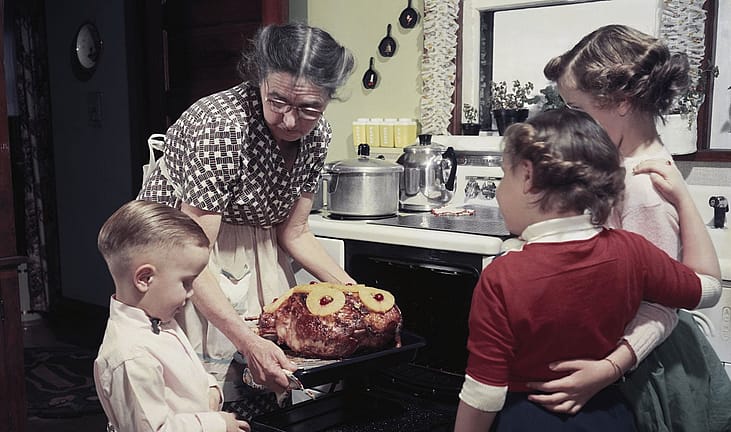
In 1953, an American neighborhood could tell you plenty about the people who lived there. Shiny sedans lined the streets, corner stores displayed their latest bargains, and families gathered around television sets that were quickly becoming the center of home entertainment.
The arrival of TV Guide in April 1953 reflected television's growing popularity, while drive-in theaters and local diners offered plenty of reasons to leave the house. A trip to the beauty salon, a birthday party, or a Saturday afternoon downtown could be an occasion worth photographing. Clothes were carefully chosen, cars were unmistakably 1950s, and even the most ordinary street corner had its own personality.
Beyond those familiar routines, the country was entering a new chapter. Dwight D. Eisenhower became the 34th president in January, taking office as Cold War tensions continued to shape American politics. By July, the Korean War armistice had brought three years of fighting to a halt, although the conflict remained unresolved. Back home, the economy was reshaping daily life, with suburban neighborhoods expanding and consumer goods becoming an increasingly visible part of American households.
This collection focuses on those smaller moments. Rather than concentrating on the politicians, conflicts, and famous faces that defined the headlines, these 27 photographs explore the places people visited, the things they wore, and the routines that filled their days. Together, they reveal what everyday life looked like in America in 1953, one candid moment at a time.
This collection draws on archival photographs and personal snapshots shared online. Dates, locations, and other details associated with user-submitted images come from the original posts and have not been independently verified.
EndersGame_Reviewer // Reddit
1 / 27A family portrait on a California Chevrolet
Who needs a photography studio when there's a Chevrolet parked outside? This California family found a more interesting place to pose in 1953, with the parents and two children perched along the back of their pale green car. The father's polished shoes, the mother's cropped trousers, and the little girl's red coat give the picture plenty of character.
Even the black-and-yellow California license plate adds a period detail. Nobody seems particularly concerned about sitting on the trunk, which makes the whole scene feel more like a spontaneous family moment than a carefully arranged portrait.
UrbanAchievers6371 // Reddit
2 / 27The crowds and neon signs of Times Square
A sea of pedestrians fills Times Square's sidewalks, where movie marquees, towering advertisements, and yellow taxis compete for attention. The Globe Theatre is showing "Hell Raiders of the Deep," while an enormous Pepsi-Cola sign stands alongside an advertisement for Admiral televisions and appliances.
By the early 1950s, the neighborhood was already famous for its brightly lit entertainment district, with movie theaters playing a major role in its identity. Amid the commercial spectacle, New Yorkers in business suits, hats, and summer dresses navigate the crowds, each seemingly headed somewhere different.
H. Armstrong Roberts/ClassicStock // Getty Images
3 / 27A family gathers around the television in 1953
A family of four settles in front of a wooden console television in March 1953, as a clown surrounded by balloons fills the small screen. Mom watches from an armchair, Dad sits on a leather ottoman, and the two children pull their chairs right up to the set. A month later, TV Guide published its first national issue, a sign of how quickly television was becoming the center of American living rooms.
Electrical-Aspect-13 // Reddit
4 / 27A family camping trip in Cloudcroft, New Mexico
Everyone gathers around a small campfire during this 1953 family trip to Cloudcroft, New Mexico. A woman crouches beside the flames to prepare food while two girls stand nearby, one enjoying a snack. Behind them, other family members gather beside a parked car surrounded by trees.
The colorful skirts, casual summer clothes, and simple cooking setup capture a relaxed afternoon outdoors. With rocks arranged around the fire and supplies unpacked from the car, the family has turned a wooded clearing into a temporary gathering place.
Denver Post // Getty Images
5 / 27A telephone call with a little extra equipment
Denver Post reporter Bob Byers tries out the Army's new "handi-talkie" while sitting with waitress Marie Aleck at a Denver tavern in March 1953. Holding the bulky communication device close to his face, Byers demonstrates how reporters could use portable equipment to phone in a story without relying on a conventional telephone.
The photograph was taken as the updated walkie-talkie was being introduced to Army Reserve groups across Colorado. Between Byers' broad smile, Aleck's amused expression, and the drinks on the table, the demonstration looks as much like a lighthearted moment at the bar as a glimpse of emerging communication technology.
Bob Grannis // Getty Images
6 / 27Behind the microphone at a Nashville radio station
A microphone marked WSOK sits between two women in a Nashville recording studio in 1953, where a conversation about Carnation milk has become part of the day's programming. Behind them, shelves packed with records remind viewers of the work that went into radio broadcasting before digital playlists and automated programming.
The photograph also highlights Black women in an industry where their contributions often received less recognition than those of their male counterparts.
Electrical-Aspect-13 // Reddit
7 / 27A hands-on science lesson in California
How much force does it take to pull a stack of textbooks up a wooden ramp? Three elementary school students in Mission Hills, California, are finding out for themselves on April 1, 1953.
At San Jose Elementary School, a boy carefully handles a spring scale attached to the books while two girls watch the experiment unfold. The classroom walls are covered with diagrams of inclined planes and other scientific concepts, hinting at the day's lesson.
Fox Photos // Getty Images
8 / 27Waiting for a slice of birthday cake in 1953
A group of children crowds around a small table on June 29, 1953, waiting for their share of a frosted birthday cake. One boy carefully handles the cutting while the girl beside him rests her chin in her hand, smiling as she watches. Polka-dot hair bows, smocked dresses, and short-sleeved collared shirts give the party a distinctly early-1950s look, but the anticipation on the children's faces is timeless.
GaGator43 // Reddit
9 / 27Cairo Mary keeps order at a San Pedro bar
Some customers needed a little help finding the exit at Shanghai Red's in San Pedro, California. In this 1953 photograph, a bouncer known as Cairo Mary takes matters into her own hands, firmly guiding a man toward the door by the back of his trousers.
Her puff-sleeved blouse, long skirt, and tattooed arm make her an unmistakable presence, while another patron remains seated at the bar, apparently unconcerned by the commotion.
AxlCobainVedder // Reddit
10 / 27Dressed for a bank opening in Austin
White gloves, pearl necklaces, and carefully styled hair were all part of dressing for a special occasion in 1953. At the opening reception for Capital National Bank in Austin, Texas, two women share a cheerful exchange in a lobby furnished with modern chairs and striking patterned carpeting.
The woman on the left has already removed her gloves and holds a drink, while her companion keeps hers neatly folded in her hands. Their elaborate dresses suggest an event where making a good impression mattered, and the relaxed conversation hints at the social side of an occasion otherwise devoted to banking business.
bil-sabab // Reddit
11 / 27Jeri Smith takes on the timber competition
A chainsaw, a massive log, and an audience watching every move. Jeri Smith had her work cut out for her at the 1953 Timber Days Festival in Sutherlin, Oregon, where she won the ladies' logging contest. Wearing rolled-up jeans and a short-sleeved blouse, Smith tackles the enormous trunk as spectators gather around the competition area.
Oregon's timber industry played a central role in the state's economy and communities, and local festivals celebrated the skills of the people who worked with wood. Smith's victory offered a particularly memorable display of those skills, proving that handling a chainsaw wasn't exclusively a man's job.
Southern University and A&M College // Getty Images
12 / 27Learning and playing at Southern University
Storybooks share the spotlight with wooden blocks in this nursery school classroom at Southern University in Baton Rouge, Louisiana. While several children sit at small tables and look through books, four others have settled on the floor to play together. Two teachers supervise the activities, offering guidance without interrupting the children's curiosity.
The classroom belonged to the laboratory school at Southern University and A&M College, a historically Black institution whose educational programs served the surrounding community. The photograph preserves the welcoming atmosphere of a 1953 early childhood classroom.
Kurt Hutton // Getty Images
13 / 27An afternoon under the dryers in 1953
A row of women sits beneath gleaming dome hair dryers at a beauty salon in 1953, their hair wrapped and pinned as they wait for their sets to finish. Two pass the time reading newspapers and magazines, while the woman in the middle stares straight at the camera. A weekly trip to the salon was a standard part of many women's routines, and the long stretch under the dryer made it a natural time to catch up on the news.
HawkeyeTen // Reddit
14 / 27Ford tractors ready for the fields
Rows of Ford tractors stand outside the company's Highland Park plant in Michigan in 1953, lined up in neat formation and ready for use in the fields. The facility had already made automotive history decades earlier, when Ford introduced its moving assembly line there in 1913, transforming how it manufactured automobiles.
By the early 1950s, Highland Park had become an important center for Ford's tractor production, extending the company's manufacturing expertise beyond automobiles. The rows of nearly identical machines waiting outside offer a glimpse of the industrial scale behind America's increasingly mechanized farms.
OtherwiseTackle5219 // Reddit
15 / 27Putting a personal spin on the poodle skirt
An Eiffel Tower, a rotary telephone, and a whimsical illustration might seem like an unlikely combination, but all three found their way onto fashionable skirts in 1953. Each woman in this photograph wears a different design, showing how much personality you could add to a simple, full-skirted silhouette. Fitted tops and heels complete the outfits, giving the playful decorations a polished finish.
Although the poodle skirt became one of the decade's most recognizable fashion trends, these variations show that its appeal extended well beyond the familiar canine motif. The woman in the middle even lifts her skirt slightly, drawing attention to its generous shape.
Far-Note5060 // Reddit
16 / 27Learning languages through headphones at Georgetown
At Georgetown University in Washington, D.C., in 1953, foreign language lessons involved headphones, individual listening stations, and notebooks ready for written exercises. Separated by tall wooden partitions, students could focus on recorded speech and practice their comprehension without disturbing their neighbors.
The university's commitment to international education was already well established: its School of Foreign Service, founded in 1919, had helped make the study of languages and global affairs an important part of campus life. For these students, mastering another language meant listening closely, taking notes, and repeating the process until unfamiliar words began to make sense.
Bettmann // Getty Images
17 / 27Moviegoers put on 3D glasses in 1953
A packed theater audience peers through cardboard 3D glasses in 1953, the year the format became Hollywood's hottest gimmick. A mother grins as her daughters react beside her, one nervously biting her finger and the other covering her mouth in surprise. Studios rushed out 3D features that year, including Warner Bros.' "House of Wax," hoping eye-popping effects would lure audiences away from their new television sets.
Charles "Teenie" Harris // Getty Images
18 / 27A century of mornings in a Pittsburgh kitchen
At 100 years old, Lucy Slater still has a familiar household task: grinding coffee by hand. Photographed in her kitchen in Ben Avon, Pennsylvania, in April 1953, she stands beside a well-worn counter, operating a manual grinder surrounded by cooking pots, cups, and other everyday essentials.
The room's wooden walls, large sink, and aging cabinets speak to a home where practicality takes precedence over decoration. Electric kitchen appliances were becoming increasingly common in midcentury America, but many households still relied on older tools.
Jim Heimann // Getty Images
19 / 27Behind the counter at a 1950s soda fountain
Chocolate syrup, cold milk, and a row of paper cups are all within easy reach as a waitress prepares a drink at a soda fountain in 1953. Wearing a crisp white uniform and cap, she works the dispenser behind a long stainless-steel counter equipped with mixing machines and refrigerated cabinets.
Cartons of Carnation milk sit beside a container of Hershey's syrup, two familiar names in American kitchens. Soda fountains had long been popular gathering places in the United States, serving everything from milkshakes to ice cream sodas. Here, the polished equipment and neatly arranged supplies offer a look at the work behind those sweet treats.
PeteHealy // Reddit
20 / 27Three generations together in Chicago
Three generations of a Chicago family pose together outside a brick home in 1953. A baby bundled in a warm outfit sits between a smiling mother and grandmother, reaching out with both arms as the women lean in close. Their coats and the baby's bonnet suggest a chilly day, though the family seems happy to spend a few moments outdoors.
The photograph captures an ordinary family gathering, with the house's brick walls, basement window, and small front lawn providing a familiar neighborhood backdrop. Rather than a formal studio portrait, the relaxed expressions and the baby's lively pose give this snapshot a spontaneous, personal feel.
AxlCobainVedder // Reddit
21 / 27A well-stocked Penn Fruit supermarket in Philadelphia
Not a shopping cart or customer in sight, just perfectly arranged shelves stretching across the sales floor of a Penn Fruit supermarket at Oregon Avenue and 20th Street in Philadelphia, in 1953. Photographed for the company's annual report, the store features potted plants decorating the aisles, while stacks of canned goods and boxed products create eye-catching displays.
As supermarkets expanded across postwar America, self-service shopping and increasingly elaborate merchandising transformed the weekly grocery trip. Penn Fruit's spotless interior offers a particularly polished example of that changing retail experience.
AxlCobainVedder // Reddit
22 / 27A family portrait outside a Newport Beach home
Six people gather on the front steps of a white house in Newport Beach, California, in 1953. Three men and three women stand in two rows, dressed in a mix of casual shirts, tailored trousers, and patterned clothing. Behind them, a simple front door, shuttered windows, and neatly trimmed lawn frame the family-style portrait.
The photograph offers a glimpse of residential life in the city as the region's suburban neighborhoods grew rapidly. With no elaborate backdrop or special occasion apparent, the group has turned an ordinary front entrance into a setting for a keepsake photograph.
pioggiadestate // Reddit
23 / 27A playful moment at an Esso station in North Carolina
Two men exchange playful gestures at an Esso service station in Forest City, North Carolina, in 1953. One wears a work uniform with the company's familiar oval logo, while the other smiles beneath a driver's cap. According to the original Reddit post, the man in the Esso uniform is the contributor's father, photographed while joking around on the job.
Service stations were a familiar part of American roadside life in the 1950s, offering fuel and basic automotive services as car ownership expanded. This candid exchange captures a lighter moment during the workday, when a little humor could interrupt the usual routine.
UPI // Getty Images
24 / 27Picking out flowers on a Harlem sidewalk
Fresh bouquets are getting plenty of attention outside Harlem's Abyssinian Baptist Church, where two elegantly dressed women stop at a flower vendor's cart in 1953. Their decorative hats, tailored coats, and carefully chosen shoes suggest they're dressed for a special occasion, while the vendor helps them examine the flowers on display.
Located on West 138th Street, Abyssinian Baptist Church was already a prominent institution in Harlem's religious and community life. The wooden cart, parked automobiles, and neighborhood buildings complete a street scene in which a simple flower purchase becomes a charming moment of everyday New York life.
A glimpse of Virginia City's historic streets
Parked cars, wooden storefronts, and a mountain backdrop frame a street scene in Virginia City, Nevada, in 1953. Outside the Bucket of Blood Saloon, a large painted advertisement promotes Sierra beer and souvenirs, while a row of midcentury automobiles lines the road. The colorful storefront stands out against the rugged hills surrounding the town.
Virginia City rose to prominence during the 19th-century Comstock Lode silver boom, becoming one of Nevada's best-known mining communities. By the 1950s, its Old West heritage had become part of its appeal, with historic saloons and preserved buildings reminding visitors of the town's mining past.
morganmonroe81 // Reddit
26 / 27The early morning routine of a milkman
A milkman from Roberts Dairy bends down to complete an unusually large delivery at a family's home in 1953. Twelve quart-sized bottles of milk are lined up along the front walkway, while the deliveryman, wearing a dark uniform and cap, arranges the order near the porch. His delivery vehicle is parked in the background.
The photograph, taken for a local newspaper, captured a delivery large enough to raise a few questions. Who needed three gallons of milk at once, and what were they planning to do with it? Whatever the reason, the neatly arranged bottles turned an ordinary doorstep delivery into a moment worth photographing.
Bob Grannis // Getty Images
27 / 27A busload of summer camp memories
A group of children and their camp counselors pose in front of a school bus before heading to summer camp in Nashville, Tennessee, in 1953. Getting everyone to look at the camera was apparently no small task. Some children smile, others seem distracted, and one boy has found a particularly good vantage point in the bus doorway.
Summer camps offered a welcome change from the classroom, filling children's days with outdoor activities, games, and opportunities to make new friends. Judging by the assortment of caps, jackets, and excited expressions, this group was already bringing plenty of personality along for the ride.
More from Stacker