Spokeo
1 / 2How higher education builds social networks
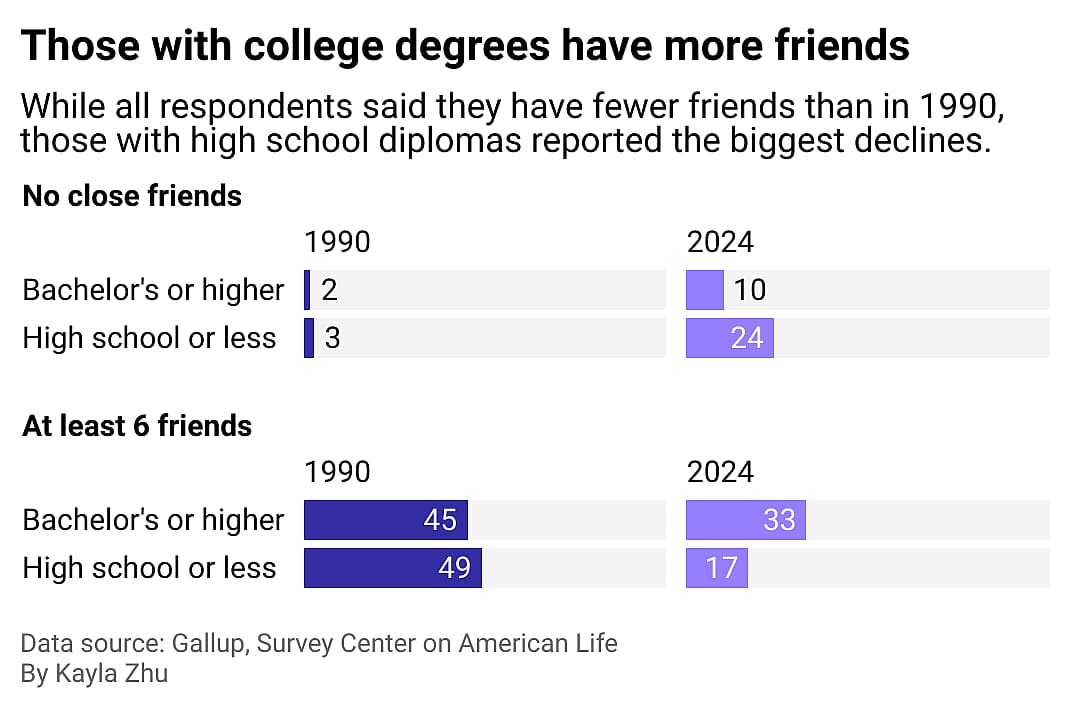
A four-year college degree is much more than a "piece of paper," according to Daniel Cox, director of the Survey Center on American Life. The college experience provides a rich social environment for fostering important lifelong friendships.
"It's an incredibly important social experience," Cox told Stacker. "You learn how to socialize. You are put in a variety of different settings. You're allowed to connect with various different types of people."
Cox notes that despite demanding course loads, most college students have considerable free time for socializing. The structured college environment and on-campus living, in some cases, fosters long-term social benefits. Many college graduates point to their college years as the period when they formed their most important and formative relationships, Cox said.
College as a social launchpad
According to the American Social Capital Survey, college graduates are more likely to have at least six close friends, at 25% versus 17%. Roughly 1 in 3 Americans have three to four close friends, and 1 in 4 have six or more close friends.
College life also often includes participation in nonacademic activities like clubs, cultural activities, sports, and political organizations. These activities usually provide opportunities to develop social and emotional skills and build relationships and teamwork while navigating diverse social environments.
Meanwhile, distinct from the social benefits of college, Cox pointed to the decline in membership in labor unions and religious communities, two institutions that historically fostered social connections among Americans who did not pursue higher education. Union membership dropped to an all-time low of 7% in 2024, down from a peak of around 1 in 3 American workers in the 1950s.
"As people spent less time in these [unions and religious organizations] places, they were less involved in these communities, and their opportunities to build close and lasting relationships with people in their community deteriorated," Cox said.
Civic engagement and community ties by education level
Americans without a college degree have less social engagement overall. Nearly 4 in 5 (79%) of those with a high school diploma or less say they rarely or never volunteer in their community. Additionally, 3 in 4 seldom or never attend local events or community meetings, and about 2 in 3 (65%) rarely or never participate in social gatherings.
Meanwhile, Americans with higher education levels are more likely to participate in civic organizations; college graduates are nearly three times as likely to join nonreligious community groups, according to the survey. Meanwhile, Americans without college degrees participate minimally, if at all, in civic life.
College graduates are also more likely to join hobby or activity groups than their counterparts (25% versus 9%), participate in neighborhood associations or community groups (24% versus 9%), and take part in sports leagues or workout groups (16% versus 5%).