Swimply
1 / 1Public pools are more common in eastern US cities
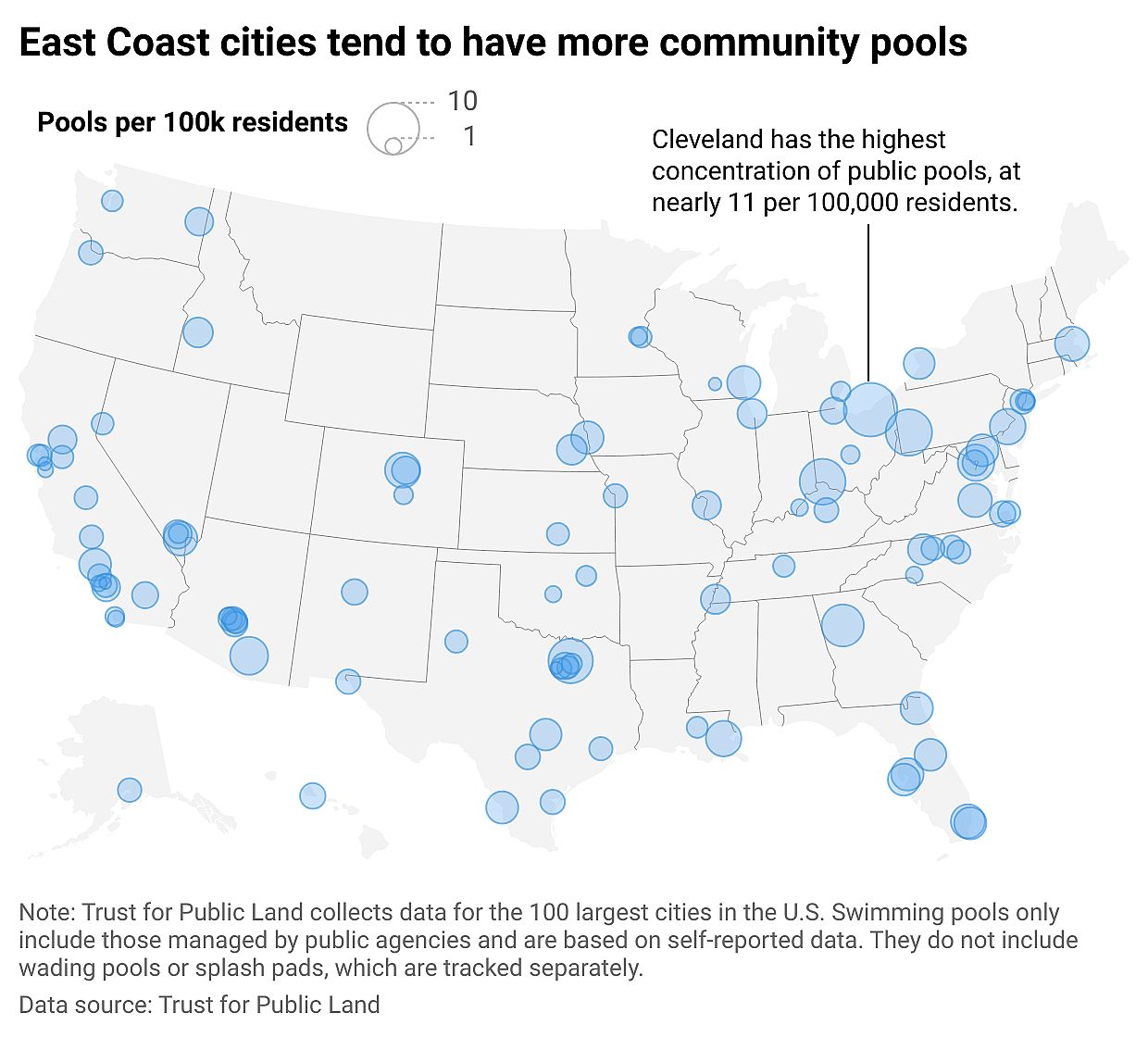
Cities on the eastern half of the U.S. tend to have higher concentrations of public pools. Even the YMCA, a leader in community swim programs, is most prevalent in eastern states, with much lower concentration in the South, in the Mountain Region, and on the West Coast.
Of the 100 cities measured in the public pool data, 13 had fewer than one public pool per 100,000 residents. Anaheim, California, and Forth Worth, Texas, are tied for having the fewest community pools per capita, at just 0.3 pools per 100,000 residents.
In Orange County, where Anaheim is located, fewer than half of the county's 34 cities have at least one public pool that isn't located at a school. In 2014, Fort Worth closed five of its seven pools, all of which were located in low-income Black or Hispanic neighborhoods. The city's 2008 aquatics master plan found the pools slated for closure were losing roughly $30,000 each year, at a cost to the city of hundreds of thousands of dollars.
Madison, Wisconsin, and Fremont, California, came in just behind Anaheim and Forth Worth, with 0.4 pools for every 100,000 residents. Cleveland topped the list for having the most public pools per capita, with 10.8 for every 100,000 residents.
With fewer public resources, nonprofits—most notably the YMCA—have provided lower-cost swimming options to people who can't afford or don't have access to privatized facilities. Some also access pools through local gyms, though these typically offer exercise-focused forms of swimming rather than the casual dips characteristic of public pools.
Many areas with limited pool access have developed splash pads or spray parks—less expensive water features to provide a place for people to play and cool off. Others have natural water bodies with public beaches and swim areas, which are available for free. For instance, Seattle has three major swimmable lakes, as well as public beaches along the Puget Sound. San Diego, known as California's Beach City, has few public pools but an abundance of public beaches. Texas has a strong "swimming hole" culture, with natural springs and manufactured lakes spread throughout the state.
These swimming areas create free and natural areas for residents to cool off, but they do come with some added danger. Unlike public pools, many aren't monitored by lifeguards—even those with murky water, rocks, currents, sudden drop-offs, vegetation, and aquatic wildlife. Still, with added caution and preparation, these water bodies can provide much-needed relief on hot days.
Some cities are taking creative approaches to expand pool access. In 2023, Louisville, Kentucky, provided funding for people to get free summer passes for the YMCA and an amusement park. New York's SWIMS capital grant program infuses $150 million into safe swimming opportunities for New Yorkers, including $90 million for municipal swimming projects in underserved communities. Among them, the city plans to install a floating pool within one of the city's rivers or bays.
Public pools have also had to innovate to attract people and ensure their continued operations. Some are adding aquatic play equipment amid necessary renovations, like in Alva, Oklahoma. In Excelsior Springs, Missouri, city officials added an inflatable dome to make the city's outdoor pool available year-round, and others are using COVID-era federal funds earmarked for outdoor recreation to revive their pool facilities.
Story editing by Nicole Caldwell. Copy editing by Paris Close. Photo selection by Lacy Kerrick.