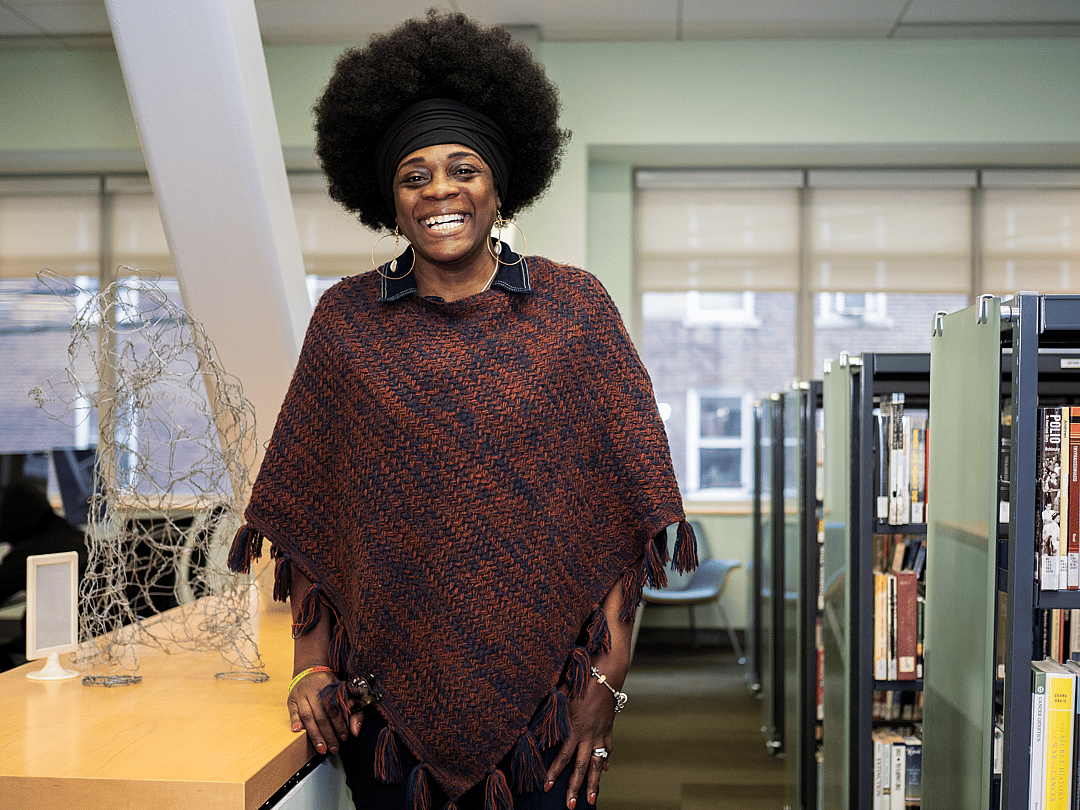
Yunuen Bonaparte for The Hechinger Report
1 / 3Student-parents and their children can be mutual motivators
Parents with children comprise a huge potential market for colleges and universities looking for ways to make up for the plummeting number of 18- to 24-year-olds and states' growing need for workers to fill jobs requiring a college education. Many of these parents already have some college credits. More than a third of the 40.4 million adults who have gone to college but never finished have children under age 18, according to the Institute for Women's Policy Research, or IWPR.
"If you want to serve adult learners, which colleges see as their solution to enrollment decline, you have to serve student-parents," said Su Jin Jez, CEO of California Competes, a nonpartisan research organization that focuses on education and workforce policies.
Another reason student-parents are more visible now: The COVID-19 pandemic reminded Americans how hard it is to be a parent generally, never mind one who is juggling school on top of work and children.
"A lot of the current energy has come from the focus on child care crises," said Theresa Anderson, a principal research associate at the nonprofit research organization the Urban Institute. "Student-parents are at the intersection of that."
There's also new attention to the benefits for children of having parents who go to college.
"The greatest impact on a child's likelihood to be successful is the education of their parents," said Teresa Eckrich Sommer, a research professor at Northwestern University's Institute for Policy Research.
Lori Barr dropped out of college when she got pregnant at 19, but went back as a mother and ultimately got a master's degree. With her son, Minnesota Vikings linebacker Anthony Barr, she later co-founded a scholarship organization for single student-parents in California and Minnesota called Raise The Barr.
"Whatever we're doing to support the parent directly impacts the child," Barr said. "A parent can't be well if the child's not well, and vice versa."
The effect works two ways, Sommer said. In a study she co-authored of an unusual program that gives college scholarships to both high school students and their parents in Toledo, Ohio, the Institute for Policy Research found that students and parents alike performed at or above average, despite what Sommer noted were financial challenges and limited academic preparation.
"Call it mutual motivation. The children helped the parents with technical issues. The parents helped the children with time management," she said. "We think of kids as a barrier to student success. We have to turn that on its head. Kids are a primary motivator to student success."
Tayla Easterla was enrolled at a community college near Sacramento, California, when her daughter was born prematurely four years ago; she took her midterms and finals in the neonatal intensive care unit. "I just found that motherly drive somewhere deep inside," said Easterla, 27, who now is majoring in business administration at California Polytechnic State University, San Luis Obispo.
Krystle Pale is about to get her bachelor's degree from the University of California, Santa Cruz. When she looks at her children who live with her, who are 5, 7, 12 and 13, "I want better for them. I just want them to have a better life," said Pale, choking up.
Sydney Riester, of Rochester, Minnesota, who is about to earn her dental assistant associate degree, also said her children — ages 3, 6 and 7 — were foremost in her planning. "These kids need me, and I need to get this done for them," Riester said.
There's a surprising lack of information about whether students in college have dependent children. Most institutions never ask. That is also slowly changing. California, Michigan, Oregon and Illinois have passed legislation since 2020 requiring that public colleges and universities track whether their students are also parents. A similar federal measure is pending in Congress.
"Ask community college presidents what percentage of their students are parents, and they'll say, 'That's a really good question. I'll get back to you,'" said Marjorie Sims, managing director of Ascend at the Aspen Institute, one of a growing number of research, policy and advocacy organizations focusing on student-parents.
Nearly one in four undergraduate and nearly one in three graduate students, or more than 5.4 million people, are parents, the Urban Institute estimates. More than half have children under age 6, according to the IWPR.
Seventy percent of student-parents are women. Fifty-one percent are Black, Hispanic or Native American. Student mothers are more likely to be single, while student fathers are more likely to be married.
Among student-parents who go to college but drop out, cost and conflicts with work are the most-stated reasons, various research shows; 70 percent have trouble affording food and housing, according to the Hope Center for College, Community, and Justice at Temple University.
Student financial aid is based on an estimated cost of attendance that includes tuition, fees, books, supplies, transportation and living expenses, but not expenses related to raising a child. The out-of-pocket cost of attending a public university or college for a low-income parent can be two to five times higher than for a low-income student without children, according to the advocacy group The Education Trust.
A student-parent would have to work 52 hours a week, on average, to cover both child care and tuition at a public university or college, EdTrust says. A separate analysis by California Competes found that students in that state who have children pay $7,592 per child a year more for their education and related expenses than their classmates who don't have kids.
But "when they apply for financial aid, they get financial aid packages as if they don't have children. It's ludicrous," said Jez, at California Competes.
Forty-five percent of student-parents who dropped out cited their need to provide child care as a significant cause, a survey released in February found. Yet the number of colleges and universities with on-campus child care has been dropping steadily, from 1,115 in 2012 to 824 today, federal data shows. That's a decline of 291 institutions, or 26 percent.
Fewer than four in 10 public and fewer than one in 10 private, nonprofit colleges and universities have on-campus child care for students, an analysis by the think tank New America found. Ninety-five percent of those campus child care centers that existed in 2016 — the most recent year for which data is available — had waiting lists, and the number of children on the average waiting list was 82, according to the IWPR. Other students couldn't afford the cost.
"Colleges and universities that enroll student-parents should be committed to serving their needs," said Christopher Nellum, executive director at EdTrust-West and himself the son of a student-mother who ultimately dropped out and enlisted in the military, finding it was easier to be a parent there than at a community college. "It's almost willful neglect to be accepting their tuition dollars and financial aid dollars and not helping them succeed."
Even where child care is available and spots are open, it's often too expensive for students to manage. More than two-thirds of student-parents in Washington State said they couldn't afford child care, a state survey last year found. About half of student-parents nationwide rely entirely on relatives for child care.