The Hechinger Report
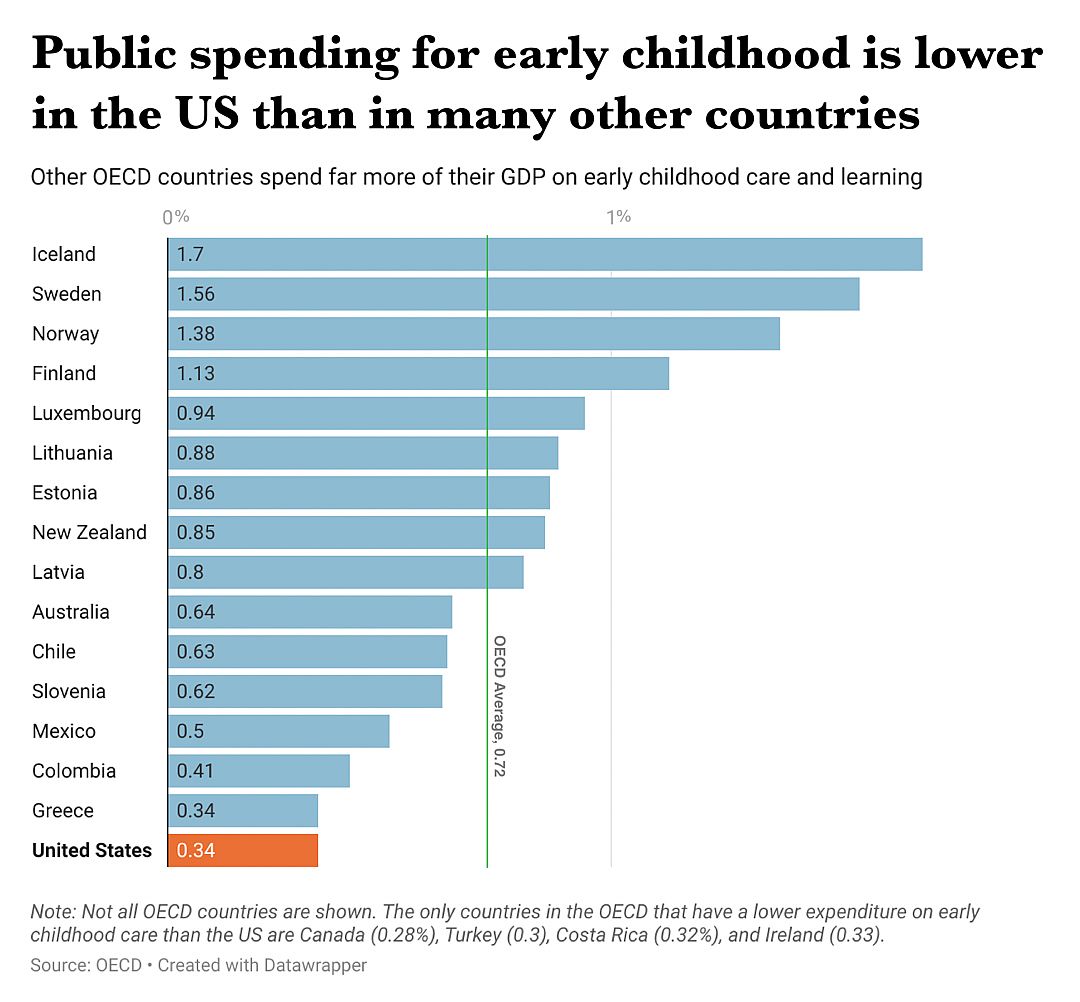
1 / 2In the US, congressional support for child care has been tough to find, leaving the country far below many developed nations
Any way you look at it, America's child care system is in crisis. After years of underinvestment and an end to pandemic-era aid, the industry is struggling. Child care teachers have fled for higher-paying jobs; parents face years-long wait lists; and families face insurmountable costs even for mediocre care.
The last major effort to significantly expand federal funding of child care in the U.S. — a proposal in President Joseph Biden's Build Back Better legislation in 2021 — was dropped from the final version of the act. Legislation introduced in February 2023 that would have provided $10-a-day child care to many American families failed to progress. Although greater investment in child care has some bipartisan support in the U.S., many lawmakers have balked at the cost. Some continue to say the government should have no place in child care, arguing that it is a private responsibility. Others suggest that universal access to child care is a communist policy, or that mothers should always stay home with their children. That's in spite of the fact that America relies on working parents to keep schools and many services open.
In Canada, experts and advocates were "very effective at conveying the idea that child care is an important part of the overall well-being of the province and the nation," Haspel added. "They hammered it home over and over and over again."
The new national system passed Parliament as part of the nation's budget in June 2021 and has been rolling out over the past two years. Participation is voluntary for provinces and territories. But all have signed on to access the federal dollars, which are presently given with no requirement that provinces invest their own money. Eventually, Canadian officials hope to achieve a 50/50 cost share with provinces and territories, but no money was required at the onset of the initiative. (America, in contrast, requires states to match funds for its current federal program aimed at lowering costs for low-income families.)
Each province or territory has control over many of the details of the Canada-wide program, like setting annual goals for expanding child care spots and early educator pay scales, as well as deciding whether for-profit centers are included in their system. Money flows to the provincial governments, which then have their own systems for providing funding directly to the child care programs. By 2026, the country intends for Canada-wide to be universal in fact as well as name — with 250,000 new spots and parents paying no more than an average of $10 a day for care.
While the system's biggest effects likely won't be seen until it expands, there are signs of progress. Nationwide, nearly half of the provinces and territories offer regulated child care for an average of $10 a day, or less. In Newfoundland and Labrador, the federal funds have also supported the creation of a new, full-day, year-round pre-K pilot program. In New Brunswick, the province upped early childhood educator wages. In British Columbia, the federal infusion of funds has bolstered the work the province was already doing to bring more public funding into the child care industry. The province used the federal money it received to pay for 1,271 child care spaces between 2021 and 2022.
Child care programs say there are benefits to having access to more public funds. At Huckleberry, the program Marisol Petersen's son attends in Gibsons, the board of directors saw signing onto the province's $10 a Day plan as an opportunity to lower fees for parents without having to also lower wages for teachers. Huckleberry was also able to get $32,000 in additional funding from the province to hire a program manager to oversee budgets and support daily operations.