Yunuen Bonaparte for The Hechinger Report
1 / 1Students Drive Campus Sustainability Efforts with Real-World Projects
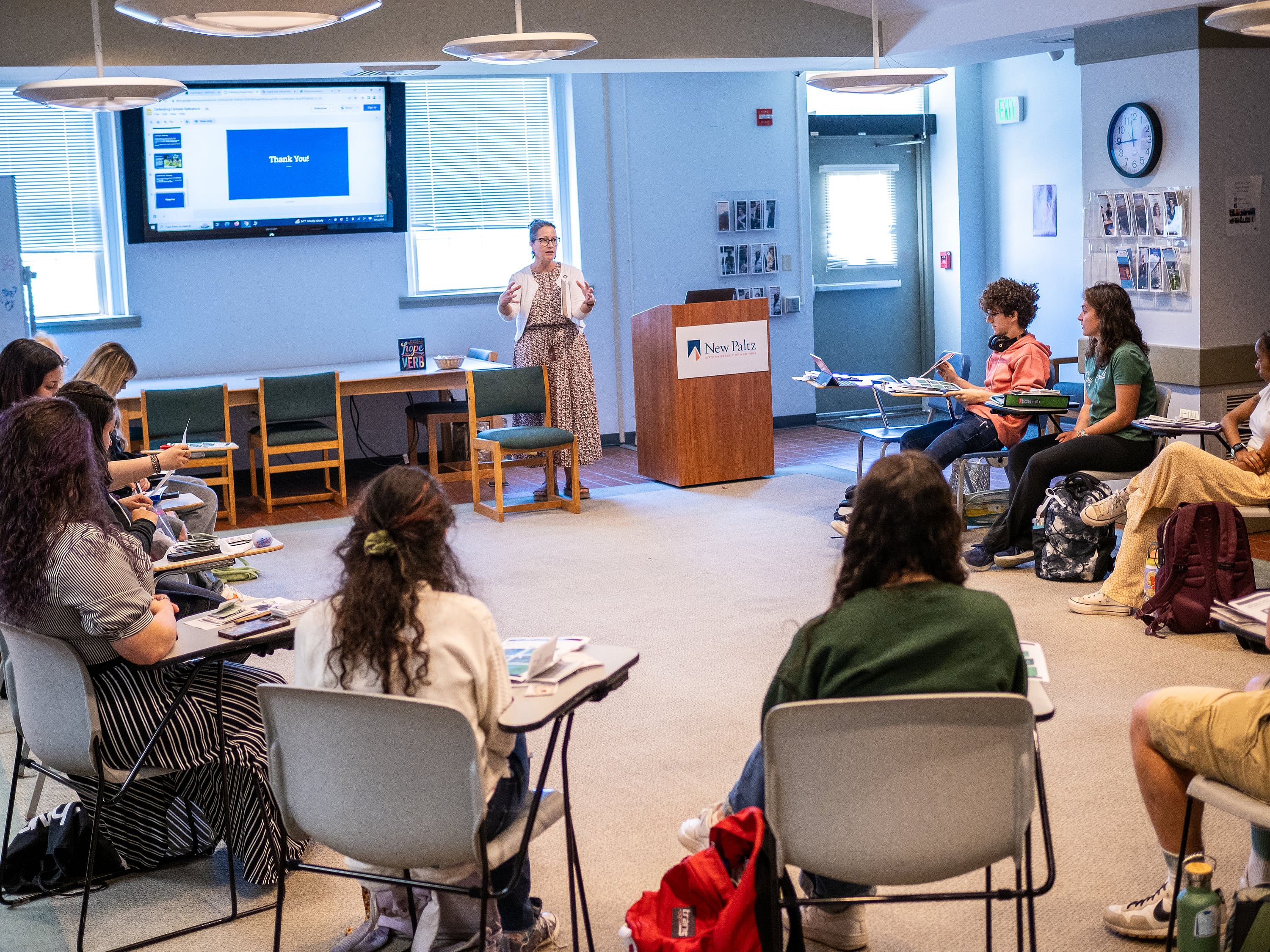
One day this May, Andrea Varga, pictured above, an associate professor of theatre design and a sustainability fellow, listened as the students in her honors Ethical Fashion class presented their final projects. Varga's class covers the environmental harms of the global fashion industry (research suggests it is responsible for at least 4% of greenhouse emissions worldwide, or roughly the total emissions of Germany, France, and the United Kingdom combined). For their presentations, her students had developed ideas for reducing fashion's toll, on the campus and beyond, by promoting thrifting, starting "clothes repair cafes," and more.
Jazmyne Daily-Simpson, a student from Long Island scheduled to graduate in 2025, discussed expanding a project started a few years earlier by a former student, Roy Ludwig, to add microplastic filters to more campus washing machines. In a basement laundry room in Daily-Simpson's dorm, two washers are rigged with the contraptions, which gradually accumulate a goopy film as they trap the microplastic particles and keep them from entering the water supply.
Ludwig, a 2022 graduate who now teaches Earth Science at Arlington High School about 20 miles from New Paltz, took Varga's class and worked with her on an honors project to research and install the filters. A geology major, he'd been shocked that it took a fashion class to introduce him to the harms of microplastics, which are found in seafood, breast milk, semen, and much more. "It's an invisible problem that not everyone is thinking about," he said. "You can notice a water bottle floating in a river. You can't notice microplastics."
Around campus, there are other signs of the living lab model. Students in an economics class filled the entryway of a library with posters on topics such as the lack of public walking paths and bike lanes in the surrounding county and inadequate waste disposal in New York State. A garden started by sculpture and printmaking professors serves as a space for students to learn about plants used to make natural dyes that don't pollute the environment.
In the business school classroom, Sheridan, the associate professor, had kicked off the student presentations by explaining to an audience that included campus facilities managers and local green business leaders how the course, called Introduction to Managing Sustainability, originated when grad students pitched the idea in 2015. The projects are powered by a "green revolving fund," which accumulates money from cost savings created by past projects, such as reusable to-go containers and LED light bulbs in campus buildings. Currently the fund has about $30,000.
"This class has two overarching goals," said Sheridan, who studied anthropology and sustainable development as an undergraduate before pursuing a doctorate in business. The first is to localize the United Nations global goals for advancing sustainability, he said, and the second is "to prove that sustainability initiatives can be a driver for economic growth."
In addition to the solar canopy project, students presented proposals for developing a reusable water bottle program, creating a composter and garden, digitizing dining hall receipts, and organizing a bikeshare. They gamely fielded questions from the audience, many of whom had served as mentors on their projects.
Jonathan Garcia, a third-year business management major on the composting team, said later that he'd learned an unexpected skill: how to deal with uncooperative colleagues. "We had an issue with one of our teammates who just never showed up, so I had to manage that, and then people elected me leader of the group," he said later. "I learned a lot of team management skills."
The solar panel team had less drama. Its members interviewed representatives from the New York State Energy Research and Development Authority, Central Hudson Gas & Electric, and a local company, Lighthouse Solar, along with Mitten and other campus officials. Often, they met three times a week to research and discuss their proposal, participants said.
Lominski, the senior, plans to enroll this fall in a graduate program at the SUNY College of Environmental Science and Forestry, in Syracuse. Before Sheridan's class, he said, he had little specific knowledge of how solar panels worked. The course also helped him refine his project management and communication skills, he said.
His solar panel teammate Madeleine Biles, a senior majoring in management, transferred to New Paltz from SUNY Binghamton before her sophomore year because she wanted a school that felt more aligned with her desire to work for a smaller, environmentally minded business.
An avid rock climber whose parents were outdoor educators, she'd developed some financial skills in past business classes, she said, but the exercises had always felt theoretical. This class made those lessons about return on investment and internal rate of return feel concrete. "Before, it was just a bunch of formulas where I didn't know when or why I would ever use them," she said.
This summer, Biles is interning with the Lake George Land Conservancy, and hopes to eventually carve out a career protecting the environment. While she said she feels fortunate that her hometown of Lake George, in New York's Adirondack region, isn't as vulnerable as some places to climate change, the crisis weighs on her.
"I think if I have a career in sustainability, that will be my way of channeling that frustration and sadness and turning it into a positive thing," she said.
She recently got a taste of what that might feel like: In an email from Sheridan, she learned that her team's canopy project was chosen to receive the startup funding. The school's outgoing campus facilities chief signed off on it, and, pending approval from the department's new leader, the university will begin the process of constructing it.
"It's cool to know that something I worked on as a school project is actually going to happen," said Biles. "A lot of students can't really say that. A lot of projects are kind of like simulations. This one was real life."