Ayurella Horn-Muller for Grist
1 / 3Florida's Water Woes—Rising Demand, Shrinking Supply
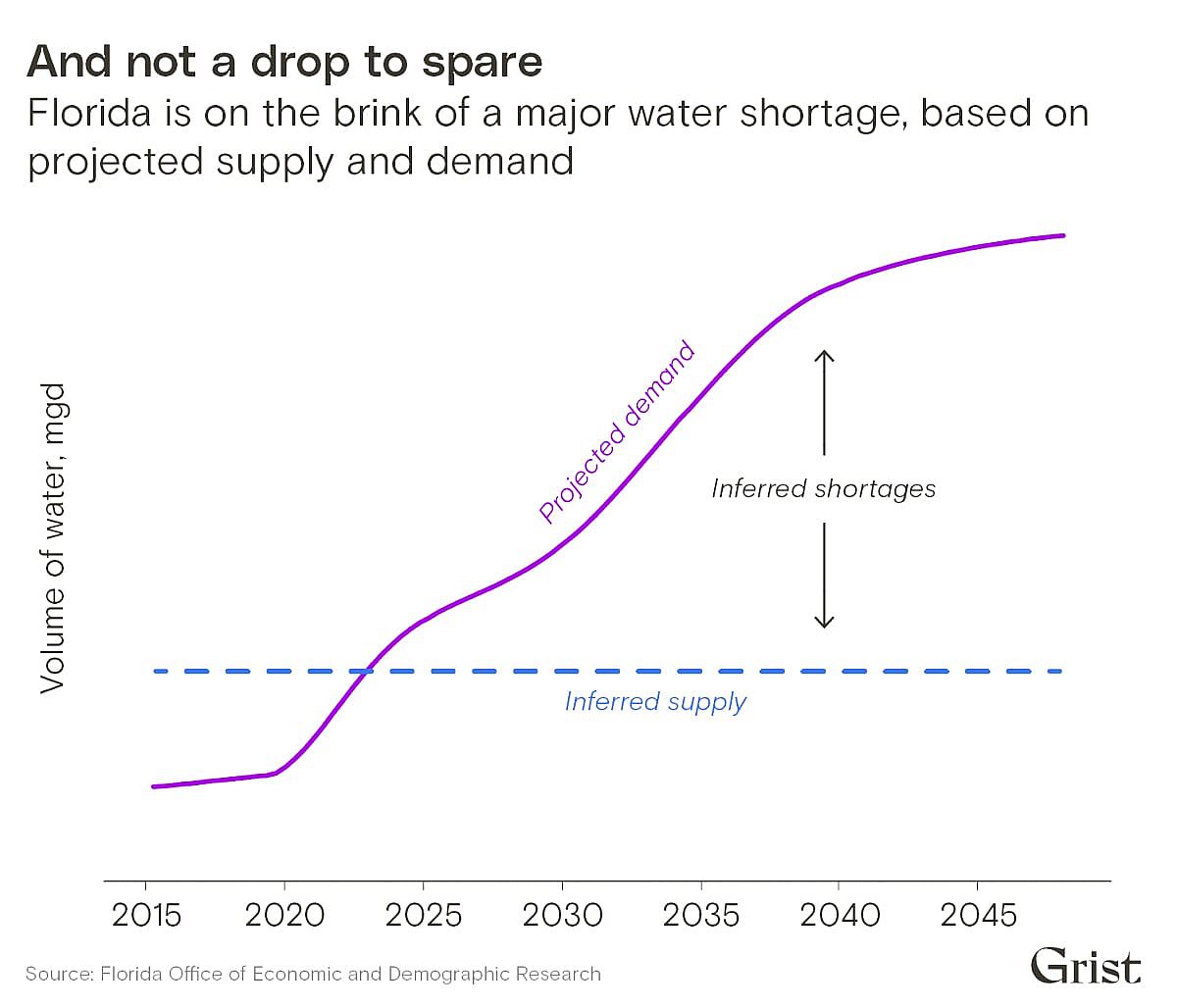
Like many places worldwide, the dwindling freshwater availability in Florida is being exacerbated by a warming atmosphere. Sea levels in the state's coastal regions have already risen dramatically in the last few decades, pushing salt water into the groundwater and creating an impotable brackish mixture that is costly to treat. A report released last summer by the Florida Office of Demographic Research found that the state may experience a water supply shortage as soon as this year, with the problem escalating in coming decades.
Florida's groundwater supply is the primary source of drinking water for roughly 90% of the state's 23 million inhabitants, and is vital for agricultural irrigation and power generation. Public use by households, municipalities, and businesses accounts for the largest depletion of groundwater in Florida, while agriculture is responsible for at least a quarter of withdrawals.
Virtually all of Florida's groundwater comes from the state's expansive network of aquifers, a porous layer of sediment that underlies the peninsula. When it rains, water soaks into the ground and gets trapped in gaps in the rock formation—providing an underground reserve of fresh water that humans can tap into with wells and pumps.
But most Floridians live near large population centers—like Miami and Tampa—where the freshest aquifer water is too deep to access or too salty to be readily used. With nearly 900 people moving to Florida each day, the Sunshine State is only continuing to grow, fueling a thirsty rush for new housing developments.
The future of the state's water has long looked bleak, and a ballooning population is ramping up an already-fraught situation. As leading policymakers push pro-development agendas and parcels of agricultural land are sold to the highest bidder, districts are grappling with political demands to advance water permits—often at the cost of conservation. The Florida Office of Demographic Research report found that the conservation, infrastructure, and restoration projects necessary to tackle the incoming water deficit will cost some $3.3 billion by 2040, with the state footing over $500 million of that bill. But according to Florida TaxWatch, a government-accountability nonprofit, current water projects and sources of funding aren't coordinated or comprehensive enough to sustain the state's population growth.