Spokeo
1 / 2How adults use phones
Smartphones have become a one-stop shop for users of all ages and demographics to get many of their everyday tasks done, from socializing and checking emails to shopping and managing finances. Nearly two-thirds of Americans with smartphones believe their lives are better thanks to the devices, according to the Gallup poll.
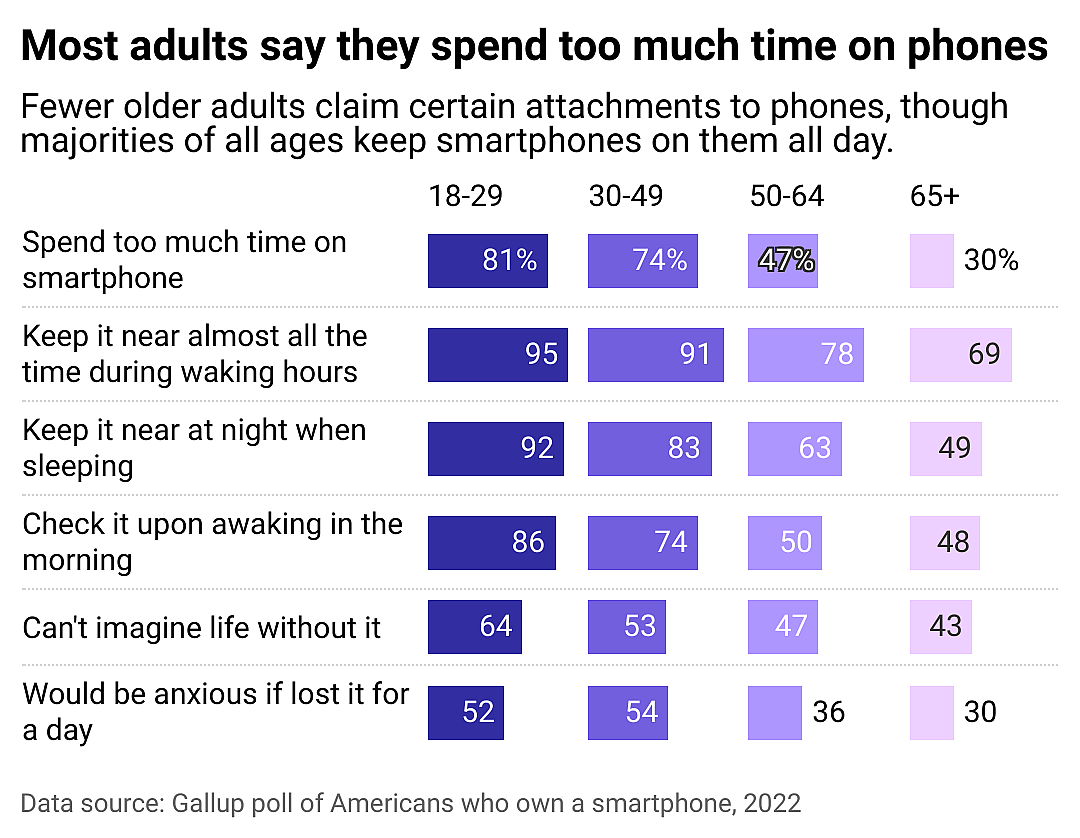
The cohort that believes they use their phones too much, as of 2022, is users between 18 and 29, according to the Gallup poll. But it isn't just 20-somethings who admit to over-usage. Smartphone owners between ages 30 and 49 followed closely behind at 74%. Men and women shared similar usage beliefs, coming in at 56% and 60%, respectively, suggesting that gender has little to do with smartphone usage.
Device usage varies with age and, consequently, life circumstances. Based on the Gallup poll, the older the age range of people surveyed, the less they use their smartphones. However, in recent years, individuals above 50 have increased their usage while their younger counterparts continue to spend even more time online.
A 2023 Pew Research poll found that young individuals between 18 and 29 and middle-aged people between 30 and 49 were the most likely to have smartphones among all age groups. Nearly all respondents (97%) in those age groups had phones, compared to 90% in general. Some who lead especially busy lives even have more than one phone at their disposal.
Natasha Finister, 55, a childcare professional from Hawthorne, California, uses three mobile devices—two to run her business and one for personal use such as keeping up with friends on Facebook. Finister told Stacker she sees the positives and negatives of device use.
Because she runs an essential business, the two business phones act as backups that allow her to be reached at all times. She can leave one device in her place of work for her employees while she takes the other on errands. But it can also be a source of confusion and stress that feels in step with the frenetic pace of modern life. "Sometimes people will call me on all three [phones] or they'll call one, and I won't answer, then the other one will start ringing, so then it gets a little chaotic," Finister said.
Finister, who does not have a TV nor subscription to any cable services, noted her smartphone use went up around 10 years ago as she began using her device for Zoom meetings, tracking her heart rate and other health-related stats, and money-related applications such as Venmo, Zelle, and Cash App. Finister's smartphone use is intricately linked to her daily life, but she also understands its drawbacks. "I could imagine my life without my smartphone, if I didn't work," she said.
A May 2021 review of 84 research studies published in the journal Frontiers in Psychiatry detailed several adverse effects of smartphone use, including personality changes, decreased cognitive processing, and sleep disturbances. These challenges increasingly occur alongside mental health issues such as depression, anxiety, and OCD.