Verbit
1 / 2Let 1,800 flowers bloom
The Stanford report shows a nuanced picture of how the technology sector is changing in light of the AI boom. Overall global corporate investment in AI actually peaked in 2021 and has fallen the past two years, down to $235 billion in 2022 and $189 billion in 2023.
In part, this decline can be attributed to high interest rates. In 2022, central banks around the world started to combat inflation by raising interest rates. This in turn has made companies more hesitant to make as many large-scale investments as they otherwise would have.
But investors may have reason to be wary; many high-profile AI companies have struggled to stay afloat despite producing innovative technology. Take, for instance, Stability AI, the creators of a leading image-generation model. The company raised funds at a $1 billion valuation in 2022 but has struggled to turn a profit. According to reports by Reuters and The Information, the company recently installed a new CEO, raised $80 million, and settled about $400 million in debt.
Inflection AI, the startup behind the chatbot Pi, raised $1.3 billion in 2023 at a $4 billion valuation but has been unable to find a business model. In March 2024, Microsoft, which had previously invested in Inflection AI, all but acquired the company, according to Bloomberg. The Washington-based tech giant agreed to pay Inflection $650 million to license its technology and hire most of its employees.
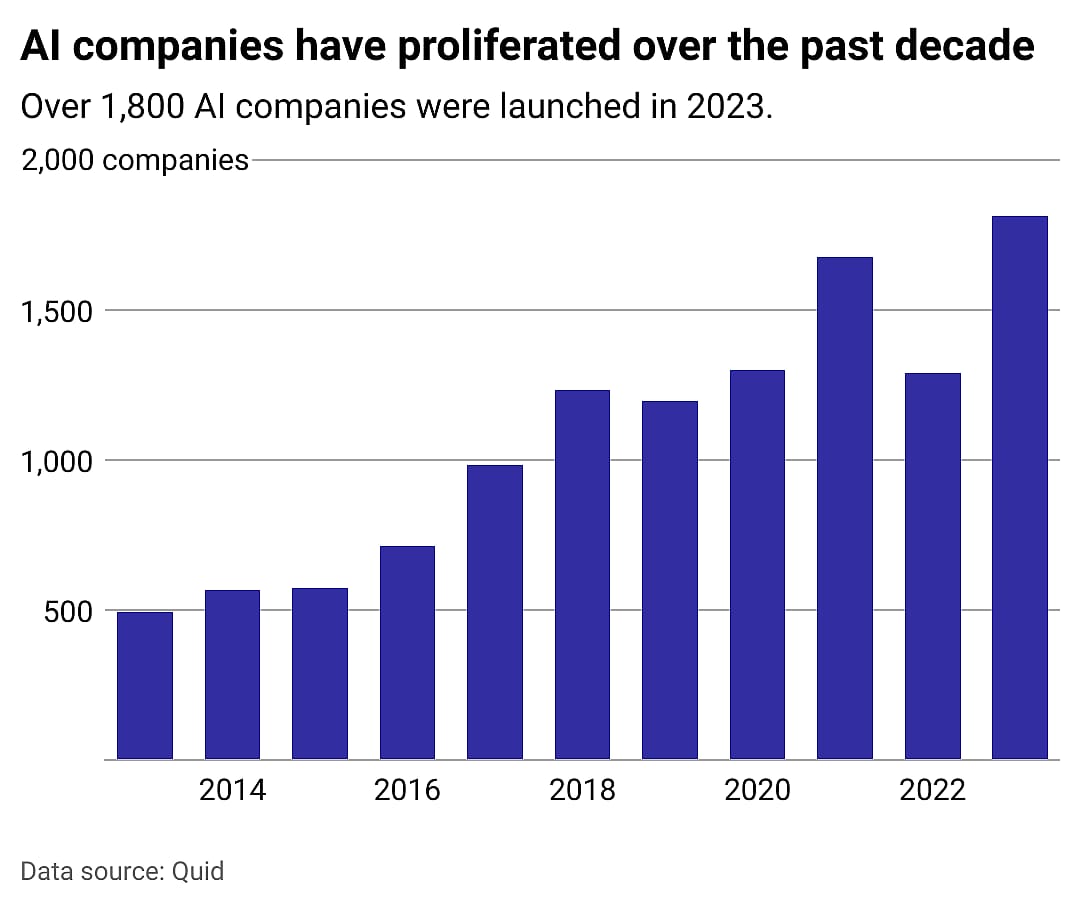
Though overall investments in AI declined, generative AI is an exception to this downturn. Investment in generative systems that create text and images soared to $25 billion in 2023, up from roughly $3 billion a year earlier. Business formation is also trending upward. About 1,800 new AI companies received funding in 2023, an increase of about 40% from 2022.
The U.S. has by far the hottest AI market, accounting for $67 billion of investment in 2023, compared with just $7.8 billion in China and $3.8 billion in the United Kingdom. U.S.-based institutions were behind 61 notable AI models in 2023, compared with China (15), France (8), and Germany (5), according to the Stanford report. America's dominance is not without precedent: The country has led in private AI investment since 2013—a gap that has only widened in recent years.