Truck Parking Club
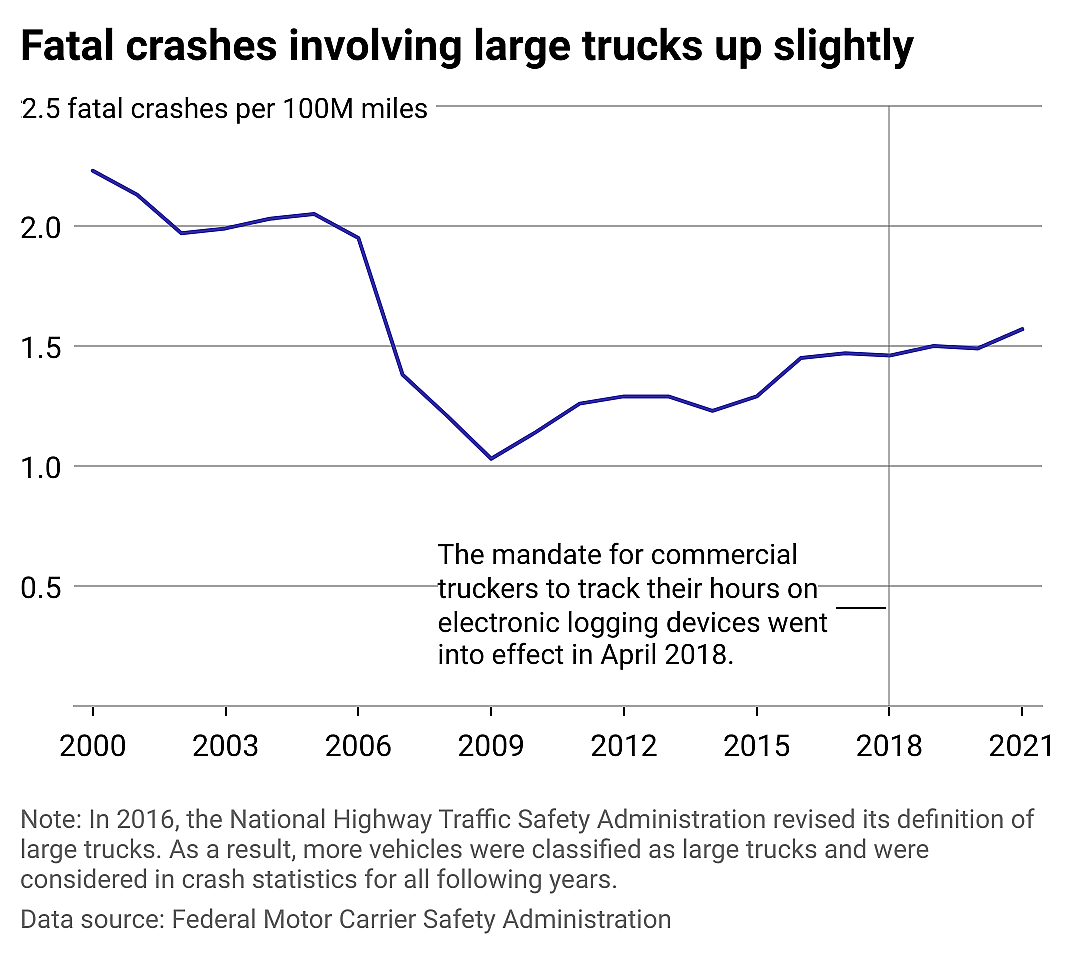
1 / 1Truck-involved fatal crashes up slightly since ELD mandate
Following the enforcement of ELDs on April 1, 2018, federal data shows a decrease in hours of service citations but an increase in accidents for solo drivers or carriers with up to six trucks. For larger companies with more trucks, citations for exceeding the hour limit remained roughly the same, but accidents initially spiked before rising and falling over the following months.
There are a few explanations for this disparity. According to a 2019 report in the S&P Global Market Intelligence Research Paper Series, larger companies were more likely to have implemented ELDs ahead of the mandate—and they had a chance to adapt to the new monitoring technology, while owner-operators and smaller carriers had a steeper learning curve.
Smaller companies also had more skin in the game. With fewer drivers to substitute when they reach a time limit, drivers for smaller companies may take a larger hit for a missed delivery. The ELDs force them to obey hour-of-service limitations. Drivers may, in turn, drive more dangerously by speeding or rapidly changing lanes to dodge traffic.
Remember, drivers are compensated per mile, not hours in the cab; a fast truck is a profitable truck.
"Workers may compensate for this lost income by driving more intensively, namely, covering more miles per hour," according to the authors of the paper. "Unfortunately, this may also incentivize an increase in unsafe driving behavior, which is more tightly correlated to accident rates than hours of service violations."
The researchers cited an increase in unsafe driving violations by owner-operators, which increased between 23% and 33%, and speeding violations, which increased between 23% and 31%, following the mandate.
Other aggravating factors include truck drivers not being paid overtime and going unpaid any time the truck isn't moving toward its end goal, including during fuel and meal breaks, driving miles out of the way to look for parking, which is in scarce supply, and during the lengthy "detention" time when they are waiting to unload their goods.
Additionally, the industry faces a labor shortage, with high attrition among its ranks. According to the Department of Transportation, truck driver turnover rates exceed 90% for large, long-haul carriers and 72% for smaller carriers. That means many in the workforce are new to driving a semi-truck, and a 2020 study by Virginia Tech Transportation Institute shows that inexperienced drivers are more likely to be involved in an accident.
All these factors may have contributed to slightly more fatalities despite regulators' best intentions.
Story editing by Mary Reardon. Additional editing by Kelly Glass. Copy editing by Kristen Wegrzyn.