Verbit // Dom DiFurio
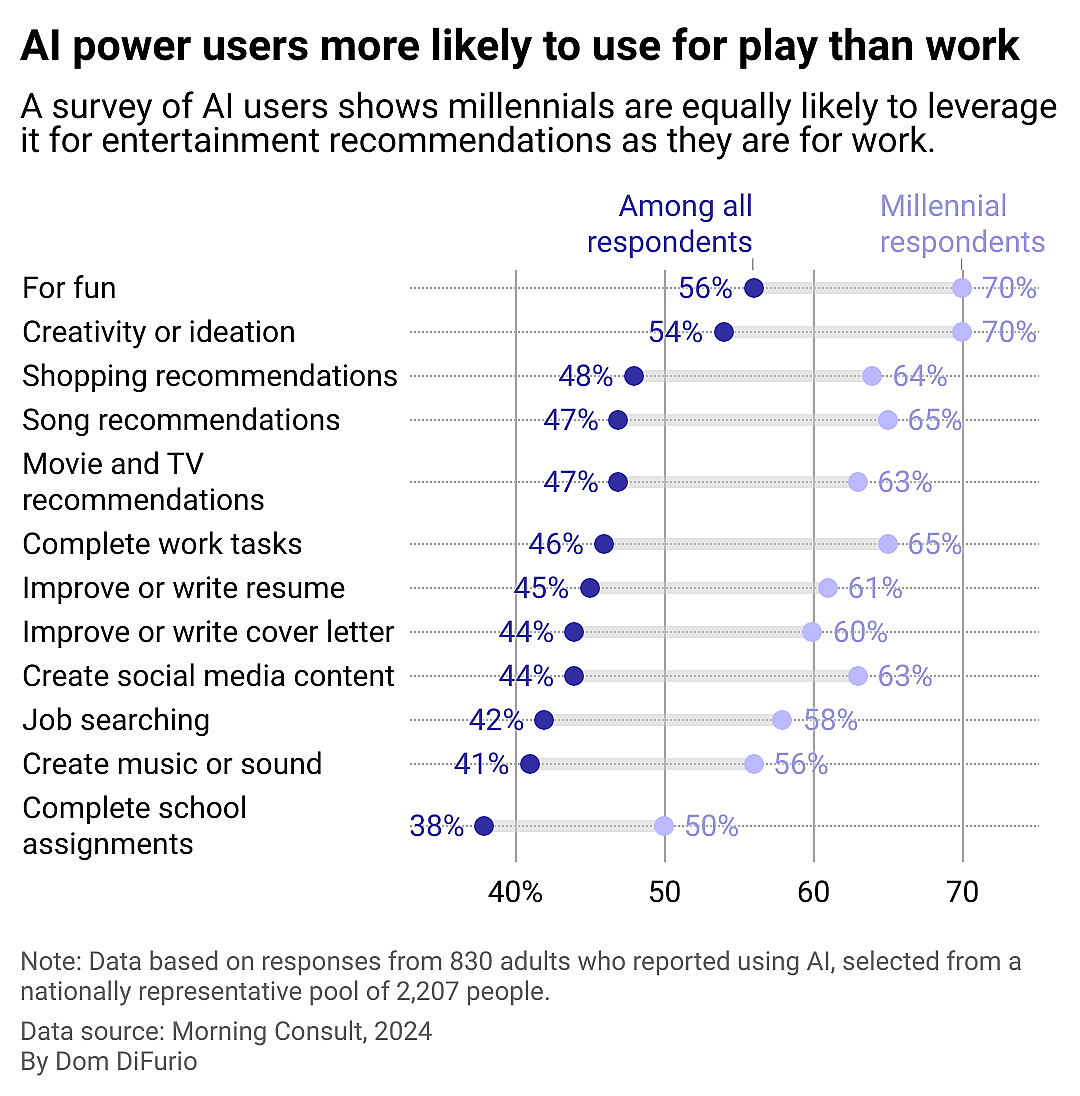
1 / 1Millennials make up the bulk of the workforce and are AI's early power users
True artificial intelligence, called artificial general intelligence or AGI, refers to software that displays a level of intelligence indistinguishable from that of a human. Experts agree that true AI is a ways off. However, today's AI-infused software is still powerful enough to significantly augment workers in many white-collar jobs—and even replace them in some limited cases like customer service functions.
Millennials' equal propensity to use AI for entertainment or work may speak to the entertainment consumption habits of those aged 28-43. But, it could also be representative of the anxiety the proliferation of new AI tools has caused in the larger workforce.
While not yet capable of AGI, the current capabilities of AI have thus far been strong enough to generate significant apprehensiveness about job displacement. White-collar work was long thought to be immune from early forms of automation, which mainly displaced manual labor jobs with the assistance of robotic technology in warehouses and on factory floors.
And even though polling indicates nearly half of AI's current users are leveraging the tools at work, other indicators show it hasn't come without compounded stress.
About two-thirds of workers say they are concerned about AI replacing their jobs, and an equal portion say they fear falling behind in their jobs if they don't use it at work, according to a 2023 survey developed by Ernst & Young to gauge worker anxiety around business' adoption of AI.
While the future of AI—and how big of a threat it poses for workers—remains to be seen, a new report from corporate advisory firm Gartner provides an optimistic view running counter to worker anxiety. The 2024 report forecasts that generative AI adoption within corporate workplaces could slow in the coming years as organizations are hit with the reality of the costs it requires to fully train AI models, as well as the looming intellectual property challenges making their way through courts.
Story editing by Nicole Caldwell. Copy editing by Kristen Wegrzyn.