Spokeo
1 / 2COVID 'Zoom towns' continue to attract remote workers
Remote work, most common among tech and office workers, has remained popular since the pandemic. For many cities, being a tech hub and a remote worker hub go hand in hand. High education levels are also a significant factor in all the metro areas at the top of the remote work charts. According to the Bureau of Labor Statistics, the top remote work industries include computer systems design, data processing, software development, and publishing.
Remote work led to a rise in cross-metro work, where employees can work in a different metro area from their manager. As The Washington Post reported, employees are 36% more likely to report to a manager who lives elsewhere and often in a city that hosts other managers, according to a 2024 ADP Research Institute analysis.
Now able to work from anywhere, remote workers often choose to move to the suburbs or less expensive cities entirely. Meanwhile, their managers opt to stay closer to company headquarters to further their in-person relationships with the higher-ups and other actors in the sector, like research institutes, clients, regulators, and competitors. Their proximity to key decision-makers is worth the price, even if their direct reports move away from them.
For a manager looking to climb high on the promotion ladder, not being present in the right circles will cost them, and videoconferencing doesn't further that kind of networking. As work-from-home arrangements become more popular, this phenomenon is sorting remote workers into pricier cities that disproportionately host managers—think San Francisco, Boston, and Washington D.C.—and more affordable areas that host rank-and-file employees, who don't need to live near influential decision-makers to do their jobs.
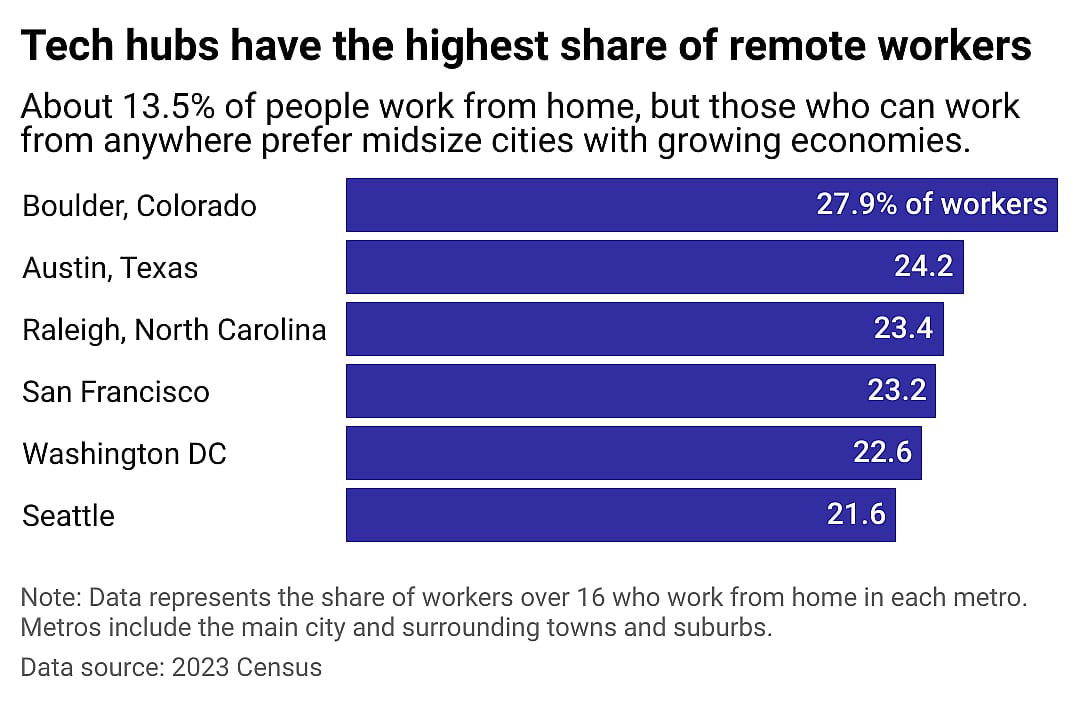
On the flip side, cities that offered less expensive housing and lower taxes absorbed remote workers from more expensive cities during the pandemic. Austin, Texas, saw a net migration of 28,000 remote workers in 2020 and 2021, with many seeking cheaper homes when they could work from anywhere, according to a New York Times analysis of American Community Survey data. Raleigh, North Carolina, is also seeing remote work migration, but new workers are flocking to the Research Triangle to work in technology and advanced manufacturing.
Boulder, Colorado, topped the list of metro areas with the highest share of remote workers, at nearly 28%, compared to the national average of 13.5%. Boulder and nearby Denver are becoming hotspots for tech startups, many of which started as remote-first to lower costs and recruit widely. The region is also becoming a budding ecosystem for quantum technology fueled by the University of Colorado.