accessiBe
1 / 3Which industries lend themselves more to remote work?
While the overall rate of remote work has increased, not all industries offer the same opportunities for employees.
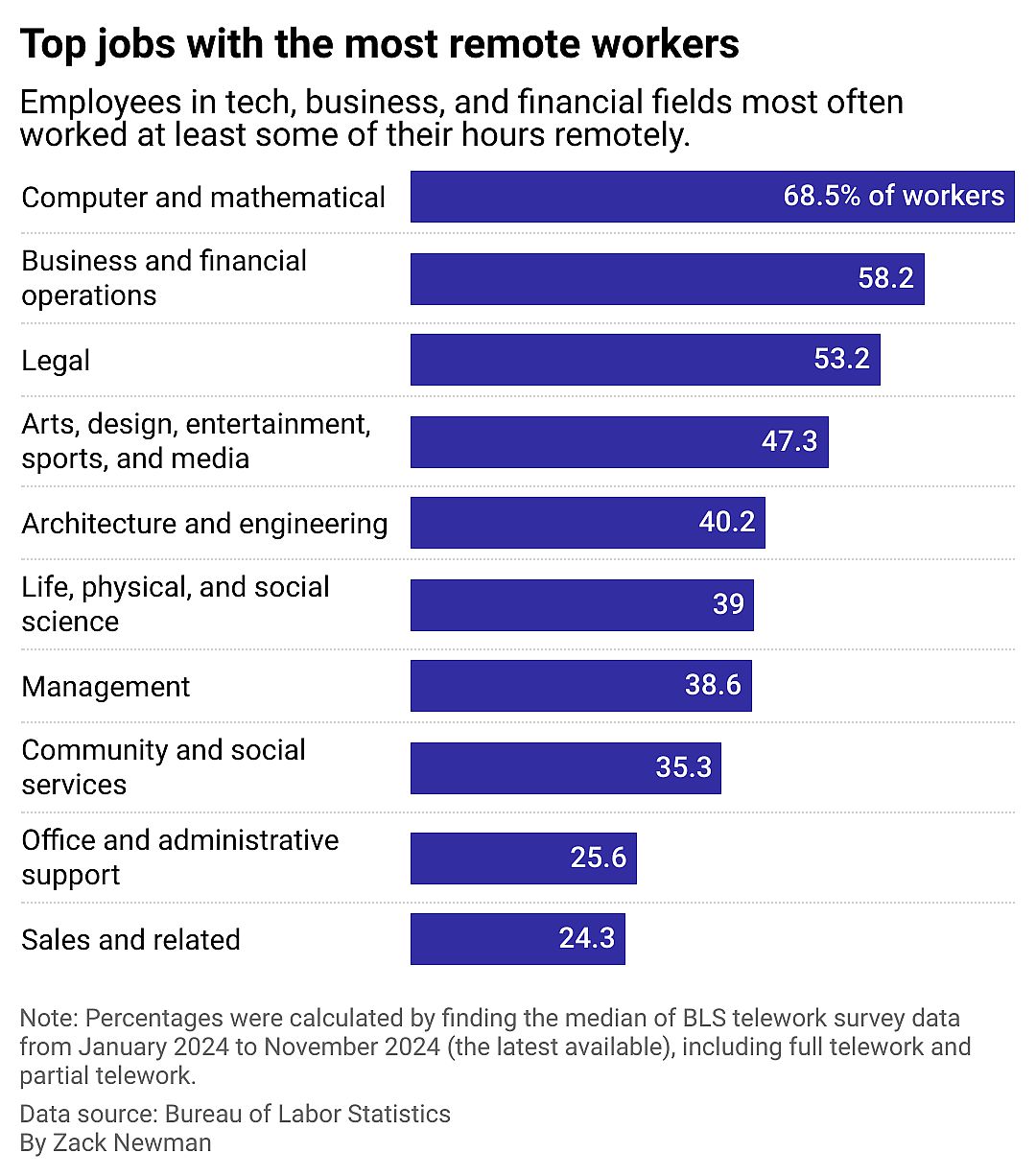
White-collar roles have the highest rates of people signing in from home. BLS data shows that more than half of employees in tech, business, and legal professions telecommute, with workers in computer- and math-related fields leading the way at a rate of 68.5%. Managers have also embraced remote work, with nearly 40% leading their teams from home at least some of the time.
By contrast, some jobs are less likely to be done remotely. During the pandemic, the Centers for Disease Control classified food service workers as "essential" and hailed them as heroes because they had to physically go to their places of work. Today, this category of workers has the lowest rate of remote work, at just 1.4%. Transportation and construction follow, with only 2% and 2.7% of workers, respectively, able to telework.
Other fields fall somewhere in the middle. Educators, for example, experienced significant changes during the pandemic. In the spring of 2020, 77% of public schools had transitioned to online learning, and 84% of college students reported at least some virtual instruction, according to the National Center for Education Statistics. While those numbers have since declined, 15% of educators and library workers still worked remotely in 2024, according to BLS.
Even health care—an industry known for hands-on work—has adapted. Today, 13.5% of health care professionals perform their duties remotely, often through telehealth or by handling administrative tasks from home. Working remotely can help address burnout, which was reported by nearly half of health care workers in 2022, according to the CDC.