Bounce
1 / 2How the 10 flights stack up
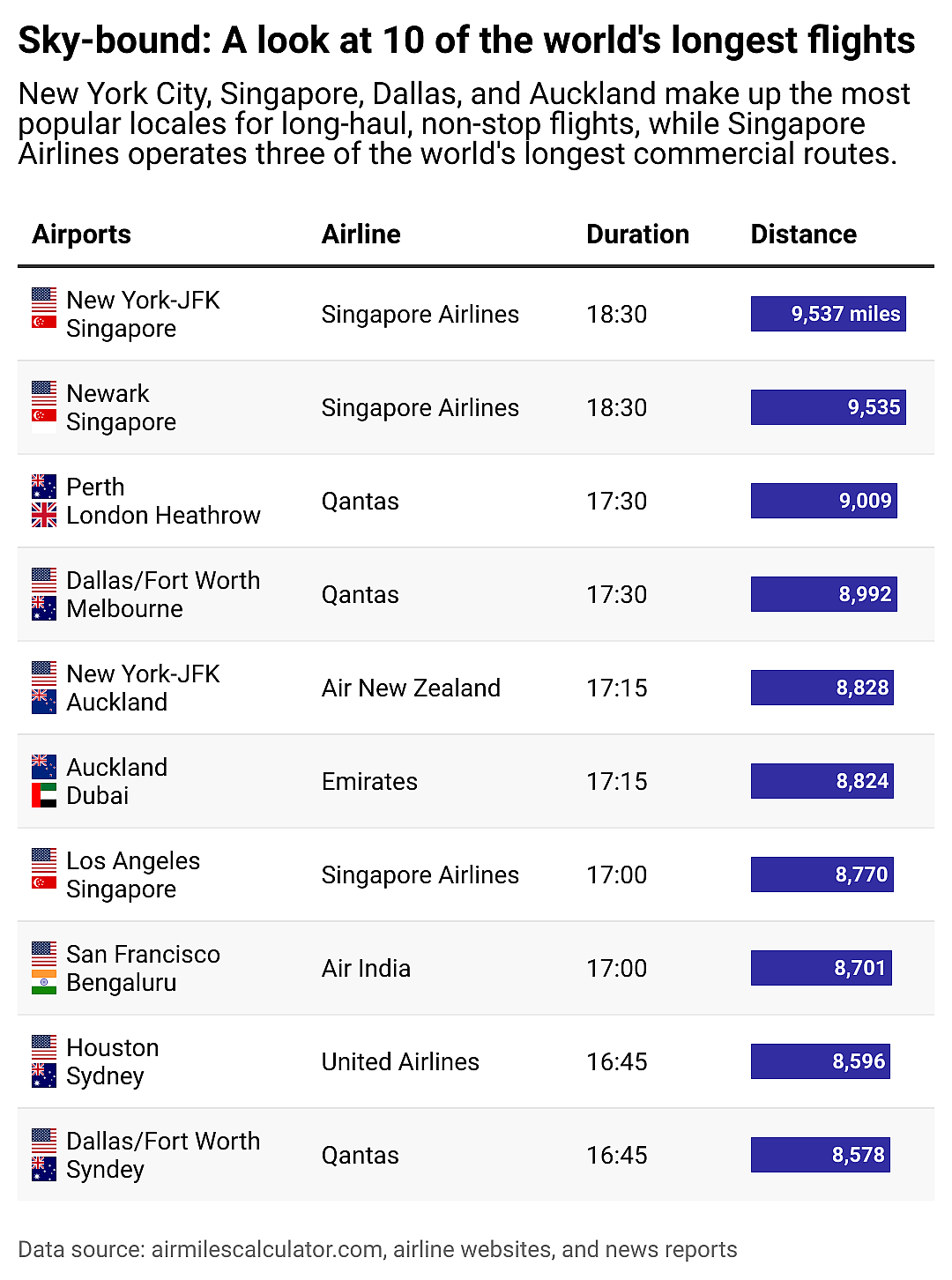
The two longest active commercial flights are routes between New York City's international airports—Newark and John F. Kennedy—and Singapore's Changi Airport. Flights to and from these airports are effectively similar in length, although the JFK-based route is technically longer by two miles.
Singapore Airlines first charted New York to Singapore in 2004 with regular service between Newark and Changi. That route—a business class-only flight on an Airbus A340-500 decked out with 100 passenger pods—was active until Singapore Airlines shut down service in 2013 due to rising fuel prices and a shrinking aircraft fleet. The airline brought back nonstop service between the two cities by reigniting Newark to Changi in 2018 and JFK to Changi in 2020.
The next longest route—the Qantas' London to Perth line—notably connected Europe with Australasia via a nonstop flight for the first time in history when it launched in 2018. Other trendsetting trips include Emirates' Auckland-Dubai service, the world's longest passenger flight for a spell when it took to the skies in 2016.
It's also noteworthy that all routes on this list involve Southeast Asia or Australasia and span a distance of 8,500 or more miles. Long flights to other regions include those between Atlanta and Johannesburg, South Africa (8,439 miles; run by Delta Airlines) and Los Angeles and Dubai, United Arab Emirates (8,339 miles; run by Emirates).
While all the flights surveyed fall short of 19 hours, Qantas has been angling to break the 19-hour mark with regular service for several years. In 2019, the Australian airline completed a 19-hour, 16-minute test flight between New York and Sydney. In May 2022, Qantas promised regular nonstop service between London and Sydney—a direct route that would last longer than 19 hours—by 2025.
Qantas has a long history of pushing the distance passenger planes can handle. In 2003, the airline flew an Airbus A330-200 nonstop from Toulouse, France, to Melbourne, Australia. That flight covered roughly 10,000 miles and took over 20 hours to complete. However, that test flight only had its four pilots and 12 people onboard, a far cry from the 200-plus passengers the Airbus jumbo jet usually carries.