Upwork
1 / 3How much time do leaders lose to non-core work?
Non-core responsibilities now make up a substantial part of many leaders' workweeks. These distractions take them away from the work they're best positioned to do and affect their ability to have meaningful impacts on business outcomes.
On average, SMB leaders in Washington reported spending 30% of their working time on tasks that fall outside their core area of expertise or job role, which translates to about 78 working days each year. About 22% are well beyond the average, spending more than half of their working time (130 or more workdays a year) on non-core tasks.
Nationally, this pattern holds across groups, including:
- Gender. Across the U.S., men in leadership roles estimated that non-core tasks claim about 31% of their time, while women in leadership roles put that figure at 29%, suggesting that both groups feel similarly stretched.
- Generation. Gen Z leaders reported that 33% of their time goes to non-core work, compared with 31% for millennials and 28% for Gen X. This suggests younger people in leadership roles are more likely to be working outside their responsibilities.
- Remote vs. on-site. Leaders in hybrid roles said they spend 32% of their time on non-core tasks, slightly more than remote (29%) and on-site leaders (29%).
- Seniority. Executives in the U.S. — including CEOs, CFOs, owners, partners, presidents, and vice presidents — estimated that 32% of their time is spent on non-core work. Directors reported 31% and managers 29%.
- Industry. Leaders in technology and marketing industries said 36% of their time is spent on non-core tasks, more than leaders in any other industry, while leaders in finance reported 34% — several percentage points higher than the overall average.
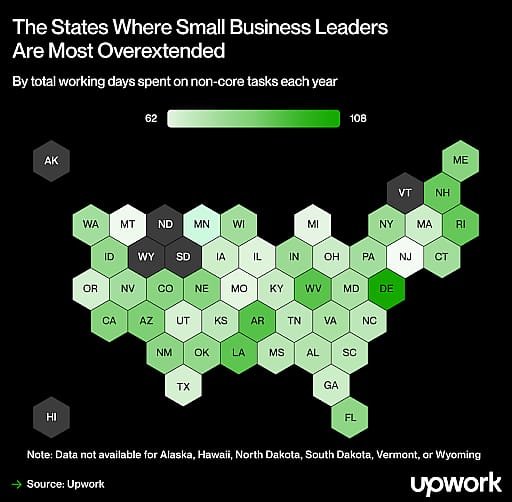
The number of workdays small business leaders spend each year on tasks outside their core role varies widely by state. The five states averaging the most overextended leaders are:
- Delaware: 108 days
- Arkansas: 94 days
- Louisiana: 93 days
- West Virginia: 93 days
- Rhode Island: 92 days
In contrast, leaders in the following states spend the fewest workdays — still totalling over two months on average — each year on tasks outside their core role:
- New Jersey: 62 days
- Montana: 63 days
- Michigan: 65 days
- Minnesota: 65 days
- Missouri: 66 days
When all of these angles are considered together, what becomes clear is that non-core work is more than a minor inconvenience. In most states and sectors, it consumes the equivalent of months of a leader's year.
In Washington, small business leaders who say they manage responsibilities outside their job description every week most commonly find themselves performing:
- Social media management: 22%
- Customer support: 20%
- HR/recruiting: 20%
Frequency, however, doesn't always match time spent. When asked which responsibilities consume the largest share of their workweek, Washington leaders pointed to:
- Customer support: 33%
- Administrative tasks: 28%
- Project management: 24%
When leaders are pulled away from their core responsibilities, they not only lose focus of their own tasks, but also aren't always the best qualified to do the added work they've taken on. By engaging independent specialists, leaders can maintain their focus where it's most impactful, while relying on experts to handle those tasks that can be delegated.