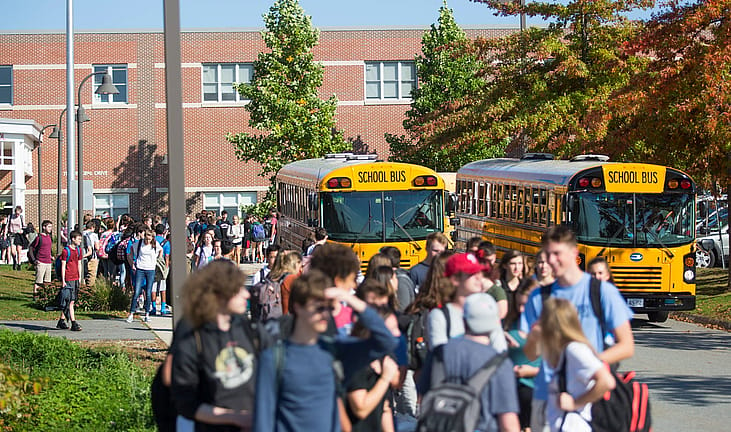
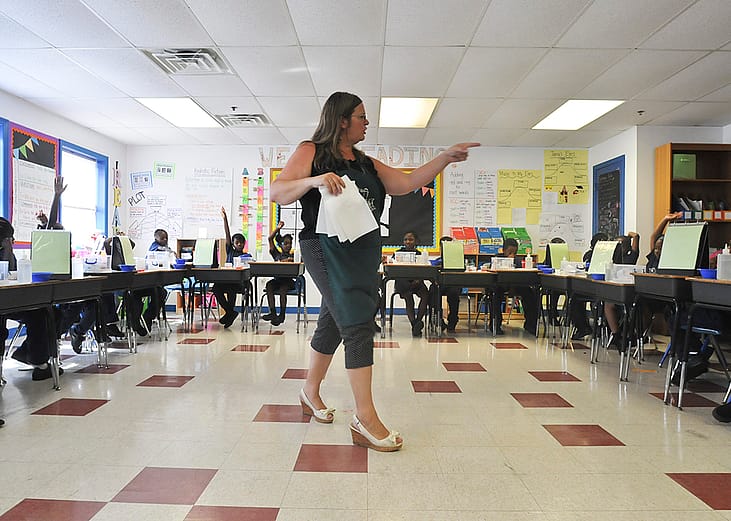
Each year, around 50 million young Americans attend public elementary and secondary schools, according to the National Center for Education Statistics, making the country's educational system one of the farthest-reaching and most impactful government services. That said, enrollment has recently seen a slight decline—roughly 49.5 million students enrolled in pre-K through 12th grade in the fall of 2023, a 0.2% decrease from the year before.
These numbers may drop even further in the coming years. Since taking office, President Donald Trump has been vocal about his plans to dismantle the Department of Education, which provides additional funding and oversight of all forms of education across the 50 states. In March 2025, Trump signed an executive order directing the closure of the department, though fully eliminating it requires Congressional approval.
In November 2025, the administration announced six interagency agreements to transfer key Education Department functions to the Departments of Labor, Interior, Health and Human Services, and State — a significant step toward restructuring federal education oversight. Though it remains to be seen whether Trump can actually eliminate the department altogether, the potential effects could be devastating for marginalized students—those who are low-income, LGBTQ+, or of color.
Because education is handled at the state level—from curricula and budgets to graduation requirements—a standard American education is somewhat hard to define. Formal academic education is one way children and young adults obtain the information needed to seek individual enrichment. Moreover, the social interaction inherent in public educational settings helps young people develop the traits and skills needed to thrive in diverse social environments.
To what extent education influences a person's ability to achieve a satisfactory level of well-being has been a constant discussion among psychologists, sociologists, educators, and philosophers ever since the time of Socrates; however, there is greater consensus about how education affects living conditions. Education has a causal relationship with income, housing, public policy, lifestyle, and health care. According to April 2025 data from the Bureau of Labor Statistics, the median weekly earnings for someone with a bachelor's degree or higher reached $1,754 in the first quarter of 2025, compared to the median weekly earnings of $743 for those without a high school diploma. Meanwhile, according to the National Association of Colleges and Employers' Summer 2025 Salary Survey, new college graduates from the Class of 2024 earned an average starting salary of $65,677, a 2.2% increase over the Class of 2023's average of $64,291.
To help understand exactly how these numbers play out across the U.S., Stacker used data from the Census Bureau's American Community Survey 5-Year Estimates, released in 2022, to determine areas with the highest educational attainment. This index evaluates each state's population across seven educational tiers, ranging from those uneducated past eighth grade to those with graduate or professional degrees. States are ranked by the percentage of the population with a graduate degree. Ties are broken by the percentage with a bachelor's degree or higher.
How does your state stack up? Read on to discover which states are the most educated in the U.S.
You may also like: How much do travel nurses make?
Terri Butler Photography // Shutterstock
1 / 52#52. Puerto Rico
Highest level of education completed:
- Less than 9th grade: 14.1%
- 9th to 12th grade, no diploma: 7.6%
- High school graduate (includes equivalency): 28.0%
- Some college, no degree: 11.9%
- Associate's degree: 11.0%
- Bachelor's degree: 19.6%
- Graduate or professional degree: 7.8%
#51. West Virginia
Highest level of education completed:
- Less than 9th grade: 3.8%
- 9th to 12th grade, no diploma: 8.1%
- High school graduate (includes equivalency): 40.1%
- Some college, no degree: 18.5%
- Associate's degree: 7.7%
- Bachelor's degree: 13.0%
- Graduate or professional degree: 8.8%
Eduardo Medrano // Shutterstock
3 / 52#50. Arkansas
Highest level of education completed:
- Less than 9th grade: 4.6%
- 9th to 12th grade, no diploma: 7.7%
- High school graduate (includes equivalency): 34.1%
- Some college, no degree: 21.7%
- Associate's degree: 7.7%
- Bachelor's degree: 15.5%
- Graduate or professional degree: 8.8%
Jacob Boomsma // Shutterstock
4 / 52#49. North Dakota
Highest level of education completed:
- Less than 9th grade: 2.6%
- 9th to 12th grade, no diploma: 4.1%
- High school graduate (includes equivalency): 26.1%
- Some college, no degree: 22.0%
- Associate's degree: 14.1%
- Bachelor's degree: 22.2%
- Graduate or professional degree: 8.9%
#48. Mississippi
Highest level of education completed:
- Less than 9th grade: 4.7%
- 9th to 12th grade, no diploma: 9.7%
- High school graduate (includes equivalency): 29.8%
- Some college, no degree: 22.1%
- Associate's degree: 10.5%
- Bachelor's degree: 14.2%
- Graduate or professional degree: 9.0%
You may also like: Worst jobs in America
Jacob Boomsma // Shutterstock
6 / 52#47. Nevada
Highest level of education completed:
- Less than 9th grade: 5.3%
- 9th to 12th grade, no diploma: 7.6%
- High school graduate (includes equivalency): 27.8%
- Some college, no degree: 24.6%
- Associate's degree: 8.6%
- Bachelor's degree: 17.0%
- Graduate or professional degree: 9.1%
#46. Louisiana
Highest level of education completed:
- Less than 9th grade: 4.6%
- 9th to 12th grade, no diploma: 9.2%
- High school graduate (includes equivalency): 33.1%
- Some college, no degree: 20.9%
- Associate's degree: 6.7%
- Bachelor's degree: 16.3%
- Graduate or professional degree: 9.2%
Sean Pavone // Shutterstock
8 / 52#45. Oklahoma
Highest level of education completed:
- Less than 9th grade: 3.8%
- 9th to 12th grade, no diploma: 7.4%
- High school graduate (includes equivalency): 30.8%
- Some college, no degree: 22.9%
- Associate's degree: 8.2%
- Bachelor's degree: 17.5%
- Graduate or professional degree: 9.3%
Steven Frame // Shutterstock
9 / 52#44. South Dakota
Highest level of education completed:
- Less than 9th grade: 2.7%
- 9th to 12th grade, no diploma: 4.8%
- High school graduate (includes equivalency): 30.1%
- Some college, no degree: 20.7%
- Associate's degree: 11.8%
- Bachelor's degree: 20.6%
- Graduate or professional degree: 9.4%
Charles Knowles // Shutterstock
10 / 52#43. Idaho
Highest level of education completed:
- Less than 9th grade: 3.2%
- 9th to 12th grade, no diploma: 5.6%
- High school graduate (includes equivalency): 26.5%
- Some college, no degree: 25.6%
- Associate's degree: 9.9%
- Bachelor's degree: 19.5%
- Graduate or professional degree: 9.6%
You may also like: Fastest-growing jobs in education
Grindstone Media Group // Shutterstock
11 / 52#42. Iowa
Highest level of education completed:
- Less than 9th grade: 2.8%
- 9th to 12th grade, no diploma: 4.4%
- High school graduate (includes equivalency): 30.6%
- Some college, no degree: 20.5%
- Associate's degree: 12.0%
- Bachelor's degree: 20.0%
- Graduate or professional degree: 9.7%
KYPhua // Shutterstock
12 / 52#41. Indiana
Highest level of education completed:
- Less than 9th grade: 3.5%
- 9th to 12th grade, no diploma: 6.7%
- High school graduate (includes equivalency): 33.0%
- Some college, no degree: 19.9%
- Associate's degree: 9.0%
- Bachelor's degree: 17.7%
- Graduate or professional degree: 10.1%
Sean Pavone // Shutterstock
13 / 52#40. Alabama
Highest level of education completed:
- Less than 9th grade: 3.8%
- 9th to 12th grade, no diploma: 8.8%
- High school graduate (includes equivalency): 30.5%
- Some college, no degree: 21.3%
- Associate's degree: 8.9%
- Bachelor's degree: 16.5%
- Graduate or professional degree: 10.2%
f11photo // Shutterstock
14 / 52#39. Kentucky
Highest level of education completed:
- Less than 9th grade: 4.8%
- 9th to 12th grade, no diploma: 7.6%
- High school graduate (includes equivalency): 32.8%
- Some college, no degree: 20.6%
- Associate's degree: 8.6%
- Bachelor's degree: 15.1%
- Graduate or professional degree: 10.6%
#38. Wyoming
Highest level of education completed:
- Less than 9th grade: 1.8%
- 9th to 12th grade, no diploma: 4.5%
- High school graduate (includes equivalency): 28.4%
- Some college, no degree: 25.2%
- Associate's degree: 11.6%
- Bachelor's degree: 17.9%
- Graduate or professional degree: 10.6%
You may also like: The 50 highest-earning 2-year degrees
CrackerClips Stock Media // Shutterstock
16 / 52#37. Tennessee
Highest level of education completed:
- Less than 9th grade: 4.0%
- 9th to 12th grade, no diploma: 7.2%
- High school graduate (includes equivalency): 31.6%
- Some college, no degree: 20.6%
- Associate's degree: 7.6%
- Bachelor's degree: 18.2%
- Graduate or professional degree: 10.8%
Tony Savino // Shutterstock
17 / 52#36. Wisconsin
Highest level of education completed:
- Less than 9th grade: 2.4%
- 9th to 12th grade, no diploma: 4.7%
- High school graduate (includes equivalency): 30.0%
- Some college, no degree: 20.2%
- Associate's degree: 11.2%
- Bachelor's degree: 20.7%
- Graduate or professional degree: 10.8%
jdross75 // Shutterstock
18 / 52#35. South Carolina
Highest level of education completed:
- Less than 9th grade: 3.5%
- 9th to 12th grade, no diploma: 7.7%
- High school graduate (includes equivalency): 28.7%
- Some college, no degree: 20.2%
- Associate's degree: 10.0%
- Bachelor's degree: 18.6%
- Graduate or professional degree: 11.2%
kintermedia // Shutterstock
19 / 52#34. Texas
Highest level of education completed:
- Less than 9th grade: 7.6%
- 9th to 12th grade, no diploma: 7.5%
- High school graduate (includes equivalency): 24.5%
- Some college, no degree: 21.2%
- Associate's degree: 7.5%
- Bachelor's degree: 20.4%
- Graduate or professional degree: 11.2%
photo.ua // Shutterstock
20 / 52Jon Bilous // Shutterstock
21 / 52#32. Montana
Highest level of education completed:
- Less than 9th grade: 1.6%
- 9th to 12th grade, no diploma: 4.1%
- High school graduate (includes equivalency): 27.8%
- Some college, no degree: 23.4%
- Associate's degree: 9.5%
- Bachelor's degree: 22.3%
- Graduate or professional degree: 11.3%
Jacob Boomsma // Shutterstock
22 / 52#31. Nebraska
Highest level of education completed:
- Less than 9th grade: 3.8%
- 9th to 12th grade, no diploma: 4.5%
- High school graduate (includes equivalency): 25.6%
- Some college, no degree: 22.5%
- Associate's degree: 10.7%
- Bachelor's degree: 21.5%
- Graduate or professional degree: 11.4%
mffoto // Shutterstock
23 / 52#30. Alaska
Highest level of education completed:
- Less than 9th grade: 2.3%
- 9th to 12th grade, no diploma: 4.5%
- High school graduate (includes equivalency): 28.5%
- Some college, no degree: 25.6%
- Associate's degree: 8.6%
- Bachelor's degree: 19.1%
- Graduate or professional degree: 11.5%
pisaphotography // Shutterstock
24 / 52#29. Florida
Highest level of education completed:
- Less than 9th grade: 4.4%
- 9th to 12th grade, no diploma: 6.6%
- High school graduate (includes equivalency): 27.9%
- Some college, no degree: 19.5%
- Associate's degree: 10.1%
- Bachelor's degree: 19.8%
- Graduate or professional degree: 11.7%
Joe Hendrickson // Shutterstock
25 / 52#28. Missouri
Highest level of education completed:
- Less than 9th grade: 2.8%
- 9th to 12th grade, no diploma: 6.3%
- High school graduate (includes equivalency): 30.5%
- Some college, no degree: 21.6%
- Associate's degree: 8.2%
- Bachelor's degree: 18.9%
- Graduate or professional degree: 11.8%
You may also like: Which states have the most (and best-paid) federal employees?
antsdrone // Shutterstock
26 / 52#27. Arizona
Highest level of education completed:
- Less than 9th grade: 4.9%
- 9th to 12th grade, no diploma: 6.8%
- High school graduate (includes equivalency): 23.5%
- Some college, no degree: 24.6%
- Associate's degree: 9.0%
- Bachelor's degree: 19.3%
- Graduate or professional degree: 11.9%
Jacob Boomsma // Shutterstock
27 / 52#26. Michigan
Highest level of education completed:
- Less than 9th grade: 2.6%
- 9th to 12th grade, no diploma: 5.8%
- High school graduate (includes equivalency): 28.5%
- Some college, no degree: 22.8%
- Associate's degree: 9.7%
- Bachelor's degree: 18.6%
- Graduate or professional degree: 12.0%
f11photo // Shutterstock
28 / 52#25. Utah
Highest level of education completed:
- Less than 9th grade: 2.5%
- 9th to 12th grade, no diploma: 4.4%
- High school graduate (includes equivalency): 22.7%
- Some college, no degree: 25.1%
- Associate's degree: 9.9%
- Bachelor's degree: 23.5%
- Graduate or professional degree: 12.0%
Derek Olson Photography // Shutterstock
29 / 52#24. North Carolina
Highest level of education completed:
- Less than 9th grade: 4.1%
- 9th to 12th grade, no diploma: 6.8%
- High school graduate (includes equivalency): 25.2%
- Some college, no degree: 20.8%
- Associate's degree: 10.0%
- Bachelor's degree: 20.9%
- Graduate or professional degree: 12.1%
Leigh Trail // Shutterstock
30 / 52#23. Hawaii
Highest level of education completed:
- Less than 9th grade: 3.4%
- 9th to 12th grade, no diploma: 3.9%
- High school graduate (includes equivalency): 26.8%
- Some college, no degree: 20.5%
- Associate's degree: 11.0%
- Bachelor's degree: 22.2%
- Graduate or professional degree: 12.2%
You may also like: Stop confusing busyness with achievement
Joseph Sohm // Shutterstock
31 / 52#22. Maine
Highest level of education completed:
- Less than 9th grade: 2.1%
- 9th to 12th grade, no diploma: 4.2%
- High school graduate (includes equivalency): 30.9%
- Some college, no degree: 18.9%
- Associate's degree: 10.3%
- Bachelor's degree: 21.0%
- Graduate or professional degree: 12.6%
turtix // Shutterstock
32 / 52#21. New Mexico
Highest level of education completed:
- Less than 9th grade: 5.4%
- 9th to 12th grade, no diploma: 7.8%
- High school graduate (includes equivalency): 26.0%
- Some college, no degree: 23.3%
- Associate's degree: 8.9%
- Bachelor's degree: 15.8%
- Graduate or professional degree: 12.7%
Sean Pavone // Shutterstock
33 / 52#20. Georgia
Highest level of education completed:
- Less than 9th grade: 4.4%
- 9th to 12th grade, no diploma: 7.4%
- High school graduate (includes equivalency): 27.2%
- Some college, no degree: 19.9%
- Associate's degree: 8.2%
- Bachelor's degree: 20.2%
- Graduate or professional degree: 12.8%
Sean Pavone // Shutterstock
34 / 52#19. Kansas
Highest level of education completed:
- Less than 9th grade: 3.5%
- 9th to 12th grade, no diploma: 4.9%
- High school graduate (includes equivalency): 25.7%
- Some college, no degree: 22.7%
- Associate's degree: 8.9%
- Bachelor's degree: 21.6%
- Graduate or professional degree: 12.8%
#18. Minnesota
Highest level of education completed:
- Less than 9th grade: 2.7%
- 9th to 12th grade, no diploma: 3.7%
- High school graduate (includes equivalency): 23.9%
- Some college, no degree: 20.5%
- Associate's degree: 11.6%
- Bachelor's degree: 24.6%
- Graduate or professional degree: 13.0%
You may also like: Fastest-growing jobs that pay over $150k
Zack Frank // Shutterstock
36 / 52#17. Pennsylvania
Highest level of education completed:
- Less than 9th grade: 3.0%
- 9th to 12th grade, no diploma: 5.6%
- High school graduate (includes equivalency): 33.8%
- Some college, no degree: 15.7%
- Associate's degree: 8.7%
- Bachelor's degree: 19.9%
- Graduate or professional degree: 13.2%
Josemaria Toscano // Shutterstock
37 / 52#16. Oregon
Highest level of education completed:
- Less than 9th grade: 3.3%
- 9th to 12th grade, no diploma: 5.2%
- High school graduate (includes equivalency): 22.5%
- Some college, no degree: 24.9%
- Associate's degree: 9.1%
- Bachelor's degree: 21.7%
- Graduate or professional degree: 13.3%
#15. California
Highest level of education completed:
- Less than 9th grade: 8.7%
- 9th to 12th grade, no diploma: 7.1%
- High school graduate (includes equivalency): 20.4%
- Some college, no degree: 20.5%
- Associate's degree: 8.0%
- Bachelor's degree: 21.9%
- Graduate or professional degree: 13.4%
Real Window Creative // Shutterstock
39 / 52#14. Delaware
Highest level of education completed:
- Less than 9th grade: 3.2%
- 9th to 12th grade, no diploma: 5.7%
- High school graduate (includes equivalency): 30.4%
- Some college, no degree: 18.8%
- Associate's degree: 8.2%
- Bachelor's degree: 19.4%
- Graduate or professional degree: 14.2%
kan_khampanya// Shutterstock
40 / 52Sean Pavone // Shutterstock
41 / 52#12. Rhode Island
Highest level of education completed:
- Less than 9th grade: 4.7%
- 9th to 12th grade, no diploma: 6.2%
- High school graduate (includes equivalency): 27.9%
- Some college, no degree: 17.7%
- Associate's degree: 8.2%
- Bachelor's degree: 20.9%
- Graduate or professional degree: 14.4%
marchello74 // Shutterstock
42 / 52#11. Illinois
Highest level of education completed:
- Less than 9th grade: 4.6%
- 9th to 12th grade, no diploma: 5.6%
- High school graduate (includes equivalency): 25.4%
- Some college, no degree: 20.1%
- Associate's degree: 8.2%
- Bachelor's degree: 21.8%
- Graduate or professional degree: 14.4%
Wangkun Jia // Shutterstock
43 / 52#10. New Hampshire
Highest level of education completed:
- Less than 9th grade: 2.1%
- 9th to 12th grade, no diploma: 4.3%
- High school graduate (includes equivalency): 27.3%
- Some college, no degree: 17.8%
- Associate's degree: 10.3%
- Bachelor's degree: 23.4%
- Graduate or professional degree: 14.9%
Maciej Bledowski // Shutterstock
44 / 52#9. Colorado
Highest level of education completed:
- Less than 9th grade: 3.2%
- 9th to 12th grade, no diploma: 4.4%
- High school graduate (includes equivalency): 20.6%
- Some college, no degree: 20.5%
- Associate's degree: 8.5%
- Bachelor's degree: 26.7%
- Graduate or professional degree: 16.1%
Kamira // Shutterstock
45 / 52#8. New Jersey
Highest level of education completed:
- Less than 9th grade: 4.6%
- 9th to 12th grade, no diploma: 4.9%
- High school graduate (includes equivalency): 26.4%
- Some college, no degree: 15.9%
- Associate's degree: 6.7%
- Bachelor's degree: 25.1%
- Graduate or professional degree: 16.4%
You may also like: The 25 fastest-growing jobs that pay over $100K
haveseen // Shutterstock
46 / 52#7. Vermont
Highest level of education completed:
- Less than 9th grade: 1.8%
- 9th to 12th grade, no diploma: 4.3%
- High school graduate (includes equivalency): 28.0%
- Some college, no degree: 16.5%
- Associate's degree: 8.6%
- Bachelor's degree: 24.2%
- Graduate or professional degree: 16.7%
#6. New York
Highest level of education completed:
- Less than 9th grade: 6.0%
- 9th to 12th grade, no diploma: 6.6%
- High school graduate (includes equivalency): 25.2%
- Some college, no degree: 15.2%
- Associate's degree: 8.9%
- Bachelor's degree: 21.3%
- Graduate or professional degree: 16.8%
#5. Virginia
Highest level of education completed:
- Less than 9th grade: 3.7%
- 9th to 12th grade, no diploma: 5.5%
- High school graduate (includes equivalency): 23.8%
- Some college, no degree: 18.7%
- Associate's degree: 7.9%
- Bachelor's degree: 22.8%
- Graduate or professional degree: 17.6%
Laura Stone // Shutterstock
49 / 52#4. Connecticut
Highest level of education completed:
- Less than 9th grade: 4.0%
- 9th to 12th grade, no diploma: 4.9%
- High school graduate (includes equivalency): 26.1%
- Some college, no degree: 16.6%
- Associate's degree: 7.8%
- Bachelor's degree: 22.3%
- Graduate or professional degree: 18.2%
Real Window Creative // Shutterstock
50 / 52#3. Maryland
Highest level of education completed:
- Less than 9th grade: 3.8%
- 9th to 12th grade, no diploma: 5.4%
- High school graduate (includes equivalency): 23.9%
- Some college, no degree: 18.4%
- Associate's degree: 6.9%
- Bachelor's degree: 22.0%
- Graduate or professional degree: 19.5%
You may also like: Tech and the city: 2025's best places in the US for women in tech
lunamarina // Shutterstock
51 / 52#2. Massachusetts
Highest level of education completed:
- Less than 9th grade: 4.2%
- 9th to 12th grade, no diploma: 4.6%
- High school graduate (includes equivalency): 23.2%
- Some college, no degree: 15.1%
- Associate's degree: 7.7%
- Bachelor's degree: 24.8%
- Graduate or professional degree: 20.4%
Orhan Cam // Shutterstock
52 / 52#1. Washington D.C.
Highest level of education completed:
- Less than 9th grade: 3.2%
- 9th to 12th grade, no diploma: 4.5%
- High school graduate (includes equivalency): 15.5%
- Some college, no degree: 12.4%
- Associate's degree: 3.0%
- Bachelor's degree: 25.5%
- Graduate or professional degree: 35.9%