Stacker
1 / 2It doesn't always take a 'Titanic' budget to win the Best Picture Oscar
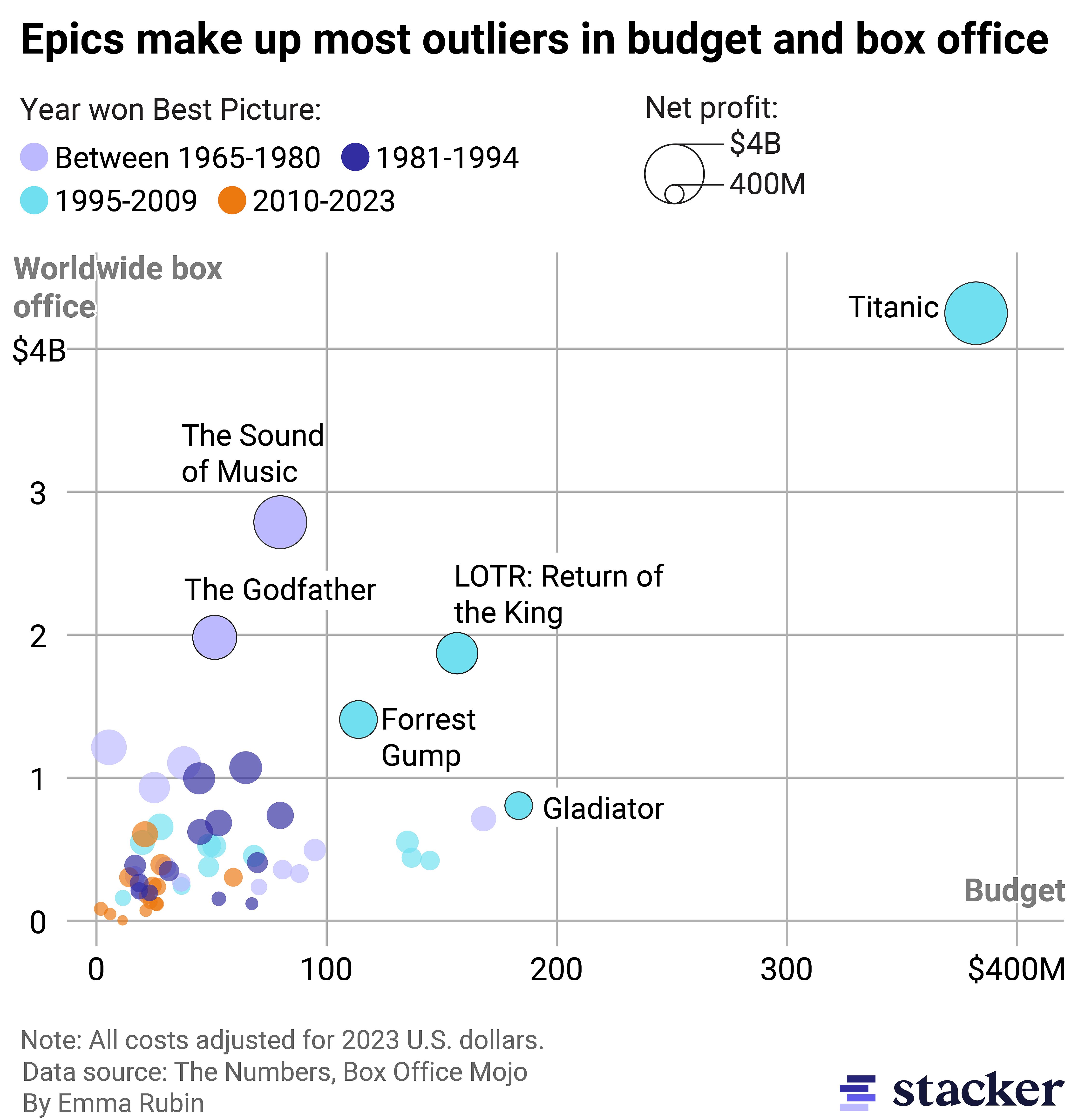
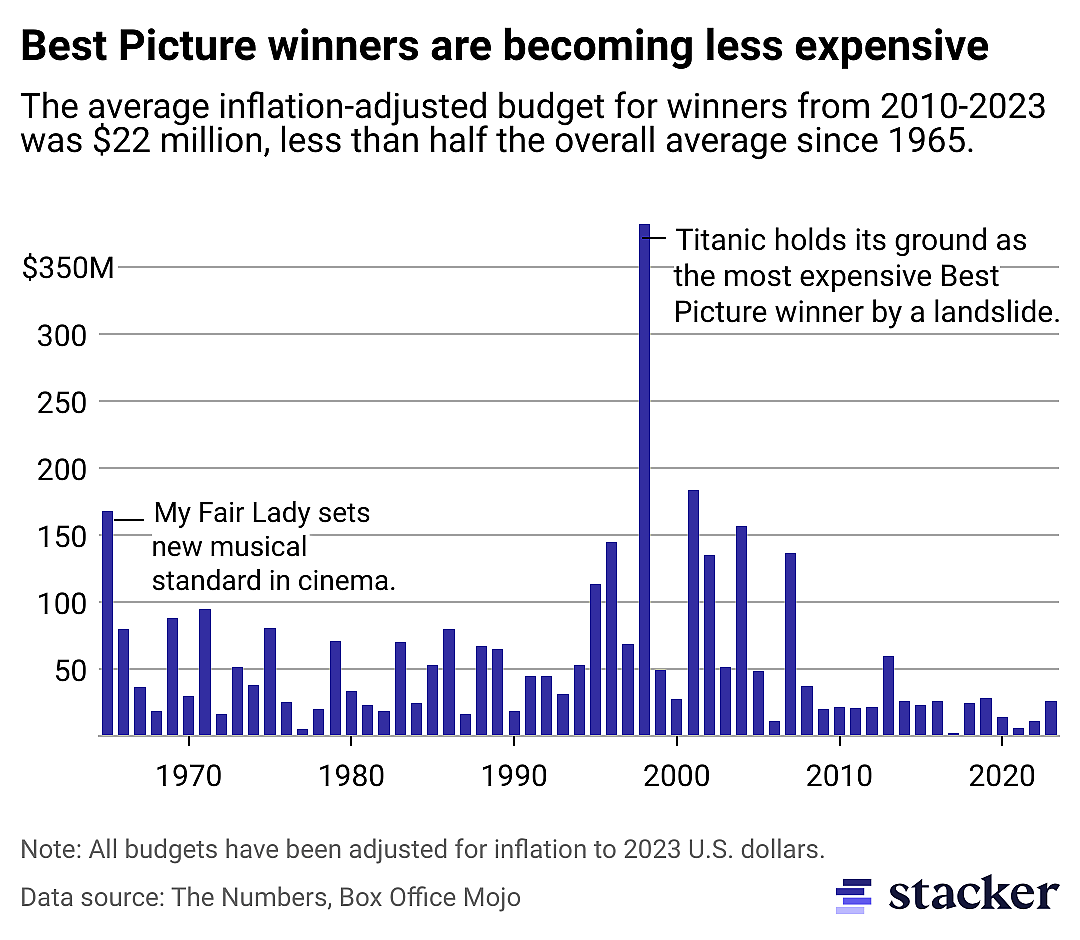
When "My Fair Lady" was filmed, Warner Bros. spent a hefty $17 million on its budget, or about $168.2 million in today's dollars. It was the most expensive movie the studio had ever produced at the time, but their gamble paid off. The movie went on to win Best Picture, Best Actor for Rex Harrison, Best Director for George Cukor, plus another five Oscars. When adjusted for inflation, no other movie would even come close to the budget for "My Fair Lady" until James Cameron's "Titanic" came along more than three decades later.
Prior to "Titanic," rarely did movies cross the $100-million budget mark, though some came close, such as "Patton," a biopic depicting the rebellious command of George S. Patton during World War II; "Oliver!," a musical about a runaway orphan; and "The Godfather Part II," a crime drama on the life of fictional mobster Vito Corleone in the 1920s.
But a film's quality isn't necessarily measured by how sumptuously a production has to spend to get the film made. "Moonlight," a coming-of-age drama about a young Black man growing up and accepting his identity, had the smallest Best Picture-winner budget ever at only $1.9 million.
How did a film with such a scant price tag snag Best Picture? Aside from a genuinely moving and well-made narrative that played well with Academy voters and feeling particularly "of the moment," "Moonlight" had the marketing heft of A24 behind it, the boutique independent distributor that clinched its second Best Picture win with "Everything Everywhere All at Once" last year. A24 has become known for its savvy merchandising and very online style of getting its films into public consciousness.
Behind "Moonlight" budget-wise is the Sylvester Stallone classic "Rocky," which only filmed with $5.4 million. An inspiring sports story about a small-time boxer getting the chance of a lifetime, the film's low budget partly stemmed from the risky move of casting a then-unknown Stallone in the lead role of the passion project script that he wrote.
Throughout the past decade, Best Picture winners have actually trended downwards when it comes to budgets, with an average of $22.2 million between 2010 and 2023. That's less than half the overall average since the data became available with "My Fair Lady" back in 1965.